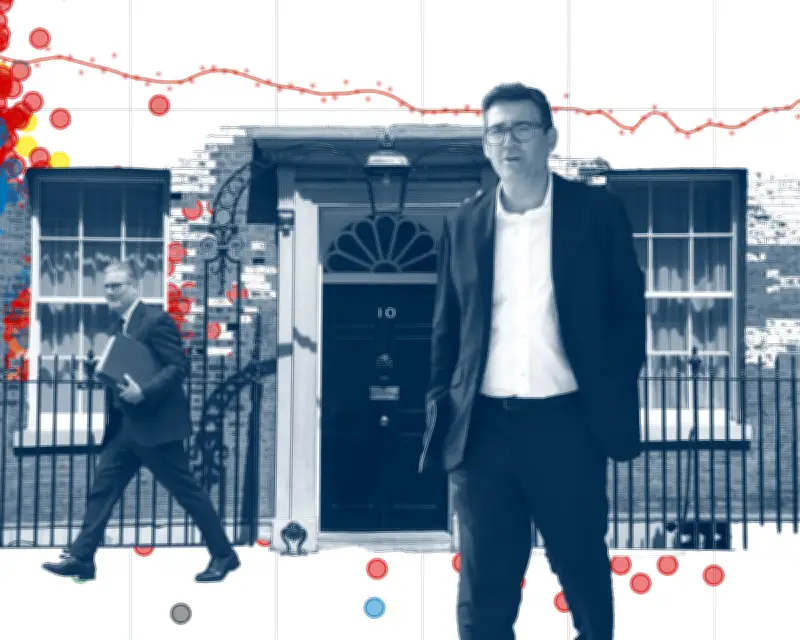
Andy Burnham enters Downing Street after Keir Starmer's tenure ended abruptly, with a net approval rating of -66 by September 2025, the lowest for any prime minister since 1977, according to Ipsos. Guardian data analysis reveals the fissures Starmer created with Labour's traditional supporters, and the traps Burnham must avoid.
Union Donations Hit Record Low Under Starmer
Trade union donations to Labour have steadily declined over the past 20 years, reaching their lowest point for any full year in 2025. Starmer clashed with unions early on: in 2022, he sacked frontbencher Sam Tarry for appearing on a rail strike picket line. In 2023, Unite general secretary Sharon Graham put Starmer “on notice”, warning support was not a “blank cheque”. Unite suspended deputy leader Angela Rayner over a bin strike row and cut membership fees by over half a million pounds in March 2025. Despite Starmer's employment rights bill hailed as a “generational shift”, unions remained cool. The GMB and Prospect criticised net zero policies, and a recent poll showed support for Labour and Reform UK tied at 28% among union members, a 20-point drop since the 2024 election.
Burnham has sought to mend ties, meeting union leaders at Unison headquarters and calling for “greater public control of essential services”. One union leader described him as “in listening mode”. However, a flashpoint emerged over his choice for chancellor: Unite and the GMB oppose energy secretary Ed Miliband, while Unison backs him. Burnham, grateful for unified support from eight affiliated unions, must keep them onside.

Muslim Voters Alienated Over Gaza
Starmer's response to the Israel-Gaza conflict cost him Muslim support. In October 2023, he said Israel had “the right” to withhold power and water from Gaza, prompting some councillors to leave. A senior Labour source dismissed them as “fleas”. By January 2024, Starmer's own polling showed concern; he backed a ceasefire in February and recognised Palestine in September 2024. A Savanta poll in June 2024 found 63% of British Muslims likely to vote Labour, but a recent JL Partners poll for Policy Exchange found 60% would consider voting for Gaza-supporting independents, and half would consider the Green Party, whose leader Zack Polanski calls Israel's actions a “genocide in Gaza”.
Burnham apologised for Labour's initial Gaza response, but critics eye his choice of James Purnell, former chair of Labour Friends of Israel, as chief of staff. Some suggest reversing the proscription of Palestine Action could win back some of England and Wales's 3.9 million Muslims.
Parliamentary Labour Party: Starmer's Hard Line Backfired
Starmer withdrew the whip from more MPs than any Labour leader since 1988, suspending seven leftwing MPs for voting to abolish the two-child benefit cap—a policy he later called his “proudest moment”. Despite concessions, 47 MPs rebelled on the welfare bill. Starmer removed the whip from four more over discipline breaches, including winter fuel allowance cuts and welfare changes.
Burnham promised a different culture, telling MPs he will never use discipline to “stifle debate”. He said the whips' office should be “our HR department”. But without whipping, his 403 MPs (majority 156) could prove unruly. Starmer loyalists are angry that Louise Haigh admitted plotting to remove Starmer early. London and south-east MPs may fear Burnham's “Manchesterism” or his plan to move No 10 staff north. Council tax reform could hit voters, environmentalists fear net zero rollbacks, and “red wall” MPs want a hard line on immigration.
Leftwing Voters: From Pledges to Purge
Starmer ran as a continuity Corbyn candidate with 10 leftwing pledges, but dropped them by end of 2020. Corbyn was suspended, sparking a leftwing “purge”. The ban on Palestine Action, upheld by the court of appeal, led to thousands of arrests, including retirees holding signs like “I oppose genocide, I support Palestine Action”. Starmer's “island of strangers” speech on immigration drew comparisons to Enoch Powell; he later regretted it but backed Home Secretary Shabana Mahmood's radical changes, including reinterpreting the European Convention on Human Rights.

Burnham has said Labour must “do better” on Israel-Palestine, but faces pressure to ban all arms to Israel (including F-35 spare parts) and reverse the Palestine Action ban. He backs Mahmood's indefinite leave to remain changes, but dozens of MPs want a “pause and rethink”. Leftwingers hope for more space, welcoming Burnham's support for public control of utilities, and hope for a leftwing chancellor like Ed Miliband, though Mahmood is now tipped for the role.
Burnham's strength, say those who know him, is that he likes people. But as he strives to reunite Labour, he will find he cannot please everyone all the time.