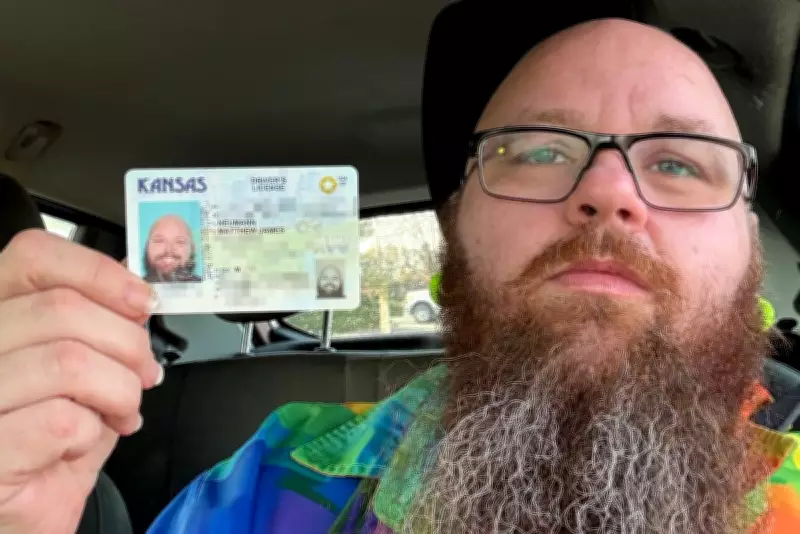
Trans Kansans Face Confusion and Panic as New ID Law Invalidates Documents
With minimal warning and no grace period, Kansas Republicans have invalidated an estimated 1,800 transgender people's identity documents, sparking widespread confusion, panic, and grief across the state. The new legislation, known as Senate Bill 244, was passed by the Republican supermajority over a veto by Democratic Governor Laura Kelly, taking effect on February 26, 2026.
Chaotic Rollout Leaves Trans Residents Stranded
The implementation of the law has been marked by chaos and poor communication. Many transgender Kansans received notification letters only a day before the deadline, while others, like Iridescent Roney, never received any official notice at all. Roney, a 29-year-old college career adviser in Lawrence, discovered the Thursday deadline last Wednesday night after returning home from work.
"The folks at Vital Statistics were terribly kind, and I appreciate them for that," Roney told reporters. "However, they didn't know what to do. There was no plan of action for what was going to happen."

The lack of proper notification has made it impossible for many trans people to renew their licenses by the deadline in Kansas, the 15th largest U.S. state with minimal public transportation options. Some individuals have been left stranded, unable to drive to work or even travel to the DMV to obtain new documents.
Schroedinger's Gender: Conflicting Documents Create Legal Limbo
Roney's experience highlights the absurd situations created by the new law. After spending an entire day navigating bureaucratic hurdles, she now holds conflicting identification documents. Her Missouri driver's license designates her as female, while her Kansas birth certificate brands her as male.
"According to the state of Missouri I'm female. According to the state of Kansas, I'm Schroedinger's gender," Roney explained, referencing the famous quantum mechanics thought experiment about a cat simultaneously alive and dead.
This discrepancy could create serious problems if she's ever required to use both documents together. The situation has left Roney feeling unsafe in Kansas, though she cannot leave because she serves as a carer for her chosen parents.
Financial and Practical Burdens Mount
Replacing invalidated documents comes with financial costs that many trans Kansans can ill afford. Roney spent approximately $50 in fees plus gas money to replace her documents. For those replacing driving licenses in Kansas, the fee is $8, which the Kansas Division of Vehicles says covers the cost of reissuance since the legislature appropriated no additional funds.
The practical consequences extend far beyond financial concerns. Trans people now face potential difficulties with employment verification, voting under Kansas's strict voter ID laws, accessing healthcare, and performing basic daily tasks like picking up medication.
Activists Vow Resistance and Legal Challenges
Matthew Neumann, a 44-year-old trans man who runs the LGBTQ Foundation of Kansas, refuses to comply with what he calls an illegal law. "This law is not legal, and until a judge tells me that it is legal, I'm not going to follow it," Neumann declared. "I fought for my rights, and I'm going to continue to fight."
Neumann's foundation is organizing support for affected individuals, including covering expenses up to $100 for document replacement and organizing rides from cisgender people with valid licenses. He has been told that sheriff's deputies will ticket any trans person driving on a license deemed invalid, and his foundation vows to pay for any resulting fines.
Legal Battles and Uncertain Enforcement
Two trans men have already sued the state with help from the ACLU, asking a judge to temporarily block what they call a "discriminatory and dehumanizing" law as contrary to the Kansas Constitution. However, on Tuesday, March 10, 2026, a judge declined to issue an injunction, saying they had not yet offered enough evidence of factual harm.

Enforcement of the law has been inconsistent, adding to the confusion. Neumann knows one trans man who renewed his license after S.B. 244 came into force and was surprised when staff issued him a male license in apparent violation of the law. Another trans woman reported that her license still appeared valid in the state's online portal two weeks after she received a letter demanding she surrender it.
Broader Implications and Personal Impacts
The law represents part of a growing GOP campaign against trans rights both in Kansas and nationally. Republicans have sought to restrict transgender healthcare access, exclude trans people from public bathrooms, remove them from military service, and reportedly limit their gun ownership rights.
For individuals like Jayme Johnson, a 40-year-old academic and musician who began transitioning in 2022, the law confirms her worst fears about government targeting. "It's like, which piece of information is gonna be the landmine that explodes on you?" she asked. The situation has left her feeling "really alone and isolated" and questioning her future in Kansas.
Claven Snow, a 47-year-old trans father of two in Douglas County, sees the law as "a harbinger of more sinister things on the horizon." He worries about what rights might be targeted next, including court papers verifying his paternity of his two school-age children.
Political Justifications and Ongoing Controversy
Supporters of S.B. 244 describe it as restoring "biological reality and common sense" to Kansas documents. Senate President Ty Masterson stated, "SB 244 restores sanity in Kansas. We swiftly overrode Laura Kelly's radical veto that would have forced our mothers, sisters, wives, and daughters to share their bathrooms with biological men in government buildings."
Defending the law in court, Attorney General Chris Kobach argued that driver's licenses are government documents and that the government has the right to determine what information they contain. He maintained that sex is unchangeable and thus should not change on official documents.
As legal challenges continue and affected individuals navigate the practical consequences of the new law, transgender Kansans face an uncertain future marked by bureaucratic confusion, financial strain, and profound personal disruption.