
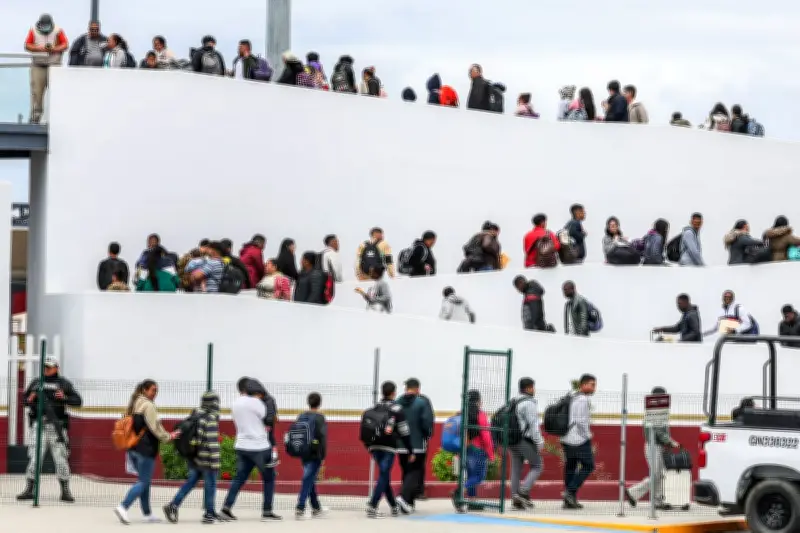
The US Supreme Court has given the Trump administration the authority to turn back asylum seekers at the US-Mexico border, in a landmark decision that fundamentally alters the US asylum system. The ruling, decided 6-3, allows the administration to block migrants from entering US soil, where they would otherwise be guaranteed the right to claim asylum under federal law. This practice, which the Trump administration had sought to implement for years, had been halted under the Biden administration but was reinstated after Donald Trump's re-election.
Court Ruling and Dissent
The majority opinion, authored by Justice Samuel Alito, was concurred by Chief Justice John Roberts and Justices Clarence Thomas, Neil Gorsuch, Brett Kavanaugh, and Amy Coney Barrett. Dissenting were Justices Elena Kagan, Ketanji Brown Jackson, and Sonia Sotomayor. Sotomayor penned a 35-page dissent—nearly twice the length of Alito's opinion—criticizing the majority's interpretation of the law.
Alito wrote: "In ordinary speech, no one would say that a person 'arrives in' a place ... before the person enters that place." Sotomayor countered in her dissent, warning of dire consequences: "The government may now circumvent a vast range of laws protecting asylum-seekers by simply blocking their entry at the border. They may do so even if the asylum seeker is at the threshold of a port of entry designated to receive all noncitizens who seek entrance into the country. Even if the port of entry has ample capacity to inspect that person, including an available asylum officer trained to process asylum applications. Even if the asylum seeker is certain to be persecuted, or killed, if she is turned away."
Background of the Case
The case was originally filed in 2017 by Al Otro Lado, a legal and humanitarian service provider based in California and Mexico, along with a group of asylum seekers subjected to the turnback policy. The Trump administration had vastly expanded the practice of turning back migrants at the border, leaving them stranded at dangerous encampments or temporary housing. President Joe Biden rescinded the policy in 2021, but after Trump's re-election, his administration asked the Supreme Court to review lower court rulings that had banned the practice.
US immigration law entitles migrants arriving in the US to seek asylum. The Supreme Court case hinged on the definition of "arrive in" the US. The Trump administration argued that to "arrive" means to fully set foot on US soil; if a migrant is turned back before crossing the border, they are not entitled to asylum. Lower courts had repeatedly invalidated this practice, with advocates and attorneys arguing it is illegal and contrary to the country's long history of providing refuge to those fleeing persecution.
Broader Implications and Administration Actions
The Trump administration has long viewed asylum as an obstacle to its goal of shutting down the southern border. Last year, administration officials promoted a global campaign to roll back asylum protections, seeking to dismantle the post-World War II framework supporting refugees and asylum seekers. During a United Nations gathering in September, Deputy Secretary of State Christopher Landau characterized the asylum system as "a huge loophole in our migration laws."
The US Department of Homeland Security (DHS) under Trump has sought not only to turn away people arriving at the border but also to urge immigration courts to summarily dismiss asylum claims. Increasingly, the DHS has been sending migrants fleeing persecution to third countries where they have never been.
Historical Context
A shift toward limiting access to asylum at the southern border began during the Obama administration, when officials sought to "meter" the flow of migrants into the US. Asylum claims at the border increased alongside dwindling opportunities for other types of immigration and lengthy backlogs for visas and green cards. In 2016, tens of thousands of people from Haiti began arriving at the southern border seeking safety; many had first sought to settle in Brazil after the catastrophic 2010 earthquake but made their way north after Brazil experienced a stark economic downturn.
Immigration agents, in some cases, began standing at international bridges, seeking to prevent migrants from reaching ports of entry. Many who were turned away ended up stranded at camps without adequate food or access to medical care. The Trump administration formalized the practice by stationing officers at the international border line to block asylum seekers from setting foot on US soil.
Comparison to Historical Tragedy
During oral arguments, Justice Sotomayor compared the practice of turning away asylum seekers to the tragedy of the St. Louis, a passenger ship with Jewish refugees that was turned away from the US just before World War II. About half the passengers who were returned to western European countries were trapped and killed when Germany invaded.




