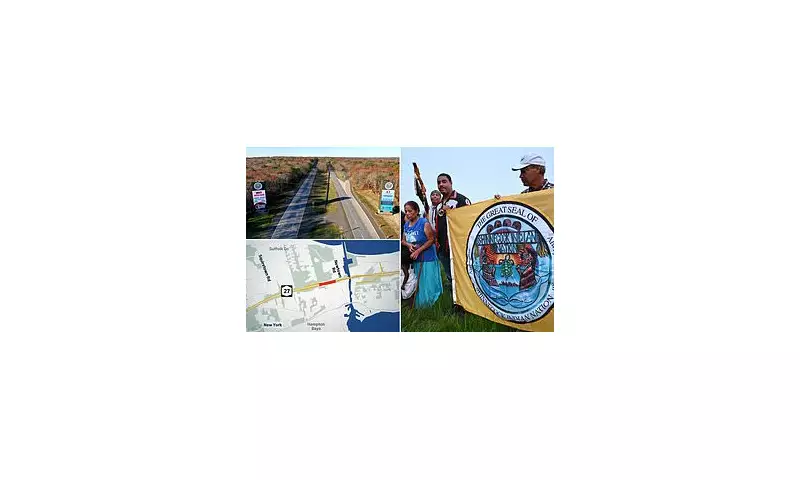
A Native American tribe on Long Island has launched a federal lawsuit against the State of New York, demanding financial compensation and legal recognition. The Shinnecock Indian Nation alleges that a portion of a major highway was constructed illegally on their sovereign territory without the required federal approval.
Decades-Old Land Dispute Escalates to Federal Court
The legal complaint, filed in the US District Court in Brooklyn on 22 December, names New York Governor Kathy Hochul, Attorney General Letitia James, and state transportation officials. The core of the dispute centres on a stretch of the tribe's Westwoods land in Hampton Bays, which they claim has been continually violated.
The tribe asserts that an easement granted in 1959 for the construction of Route 27, the Sunrise Highway, never received the necessary federal authorisation to be built on their protected land. An easement grants permission to use an entity's property for a specific purpose, but the Shinnecock maintain this one is invalid where tribal land is concerned.

A Vital Road and a Fight for Sovereignty
The Sunrise Highway is a crucial transportation link, connecting the affluent Hamptons and the eastern end of Long Island to the wider region. Hampton Bays lies roughly 85 miles from New York City. Importantly, the Shinnecock are not seeking to close this vital route. Instead, their lawsuit asks the court for several rulings.
These would force New York State to negotiate a 'valid right-of-way' with proper federal permissions and provide compensation for the decades of land use. The legal filing states unequivocally: 'This land is and has always been restricted fee land held by the Nation.'
Billboard Revenue and Legal Threats
This federal action is the latest chapter in a years-long conflict over the land. In 2019, the state's Department of Transportation and the Town of Southampton sued tribal leaders for operating large digital billboards and a travel plaza near the highway. These billboards, according to reports, generate around $900,000 in annual revenue for the Nation.
Previously, a state court ruled in favour of New York's authority under the 1959 easement and ordered the billboards switched off. Lance Gumbs, the Shinnecock Vice Chairman who also goes by the name Fierce Eyes, stated that this action severely impacts the tribe's government operations and community welfare.
'Turning off the signs would severely impact the health and well-being of our Tribal Community,' Gumbs wrote online. He further accused state officials of ignoring federal Indian law and threatening tribal leadership, 'ignoring the sovereign immunity that elected officials have.' The tribe is now seeking a temporary restraining order in federal court to prevent the state from deactivating the signs.
Gumbs declared the tribe 'was forced to sue the State of New York in Federal Court to protect the Sovereignty and Jurisdiction over our Shinnecock Nation Land we have owned since time immemorial!' The easement case is scheduled to return to federal court on 30 December. The Daily Mail has contacted Governor Hochul's office for comment.