The devastating fire at the Wang Fuk Court apartment complex in Hong Kong's New Territories, which claimed 151 lives, has cast a harsh light on the city's evolving political landscape. While the official response has showcased lingering differences from mainland China's approach to tragedy, analysts warn the gulf is narrowing rapidly under Beijing's tightening grip.
Independent Inquiry and a Scripted Press Conference
In the aftermath of the disaster, Hong Kong's Chief Executive, John Lee, announced the creation of an independent committee to investigate the blaze. This move taps into a local tradition of judge-led inquiries following major incidents, a practice virtually unimaginable across the border where the Chinese Communist Party (CCP) controls the judiciary.
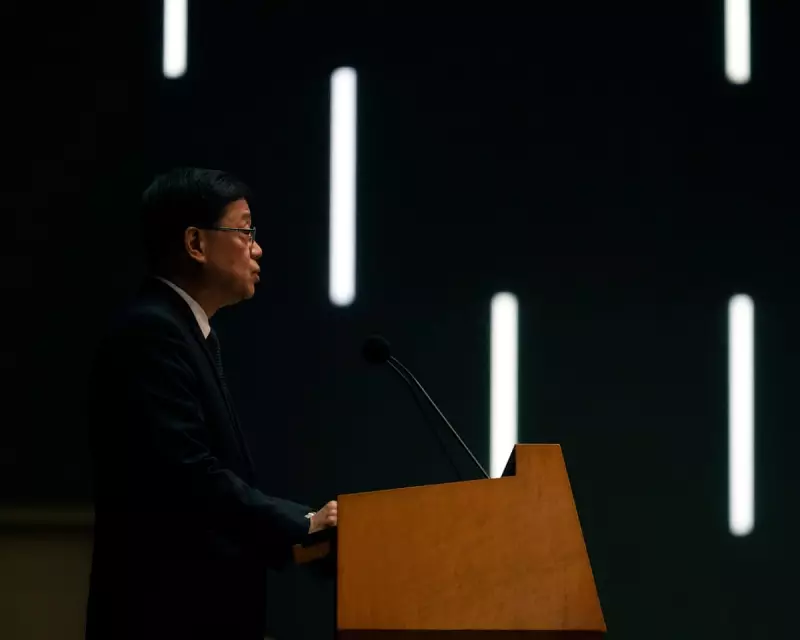
However, the scene at Lee's press conference on Tuesday presented a stark contrast to standard practice in Beijing. An AFP journalist directly questioned Lee's leadership, asking why he deserved to keep his job after such a catastrophic loss of life in a supposedly prosperous society. Such an unscripted, challenging question would never be posed publicly to China's leader, Xi Jinping, highlighting a remaining, if shrinking, space for media scrutiny in Hong Kong.

A 'Patriots-Only' Political Landscape
The tragedy's shadow looms over the upcoming Legislative Council (LegCo) elections on Sunday. These polls, Hong Kong's equivalent of a general election, will be conducted for the second time under the "patriots only" principle established after the 2019-2020 pro-democracy protests. Only government-approved candidates are permitted to stand, eliminating meaningful opposition.
This marks a dramatic shift from the feisty, multi-party campaigns of the past. Turnout in the 2021 "patriots-only" election hit a record low of 30.2%, compared to 58.3% in 2016. With most forms of protest now criminalised under national security laws, abstaining from voting has become one of the few safe ways for residents to register dissent. Mainland Chinese citizens have no equivalent electoral avenue to boycott.
Crackdown on Dissent and a Muzzled Judiciary
The erosion of Hong Kong's distinct systems is evident in its legal sphere. Following the implementation of two national security laws, many experts believe the city's judiciary has lost its independence. Thirteen people have been arrested in connection with the fire, including employees of a construction company, but no official has yet taken responsibility.
The arrest of student Miles Kwan over a petition demanding governmental accountability for the fire underscores the shrinking space for free expression. "Before the national security law, there wouldn't be any repercussions for people just for speaking out," noted Jeffrey Wasserstrom, a professor of history at UC Irvine.
While Hong Kong's information environment remains more open than mainland China's—it does not block Western social media or Google—the national security laws have significantly muzzled independent media. The contrast with mainland China's handling of tragedy was underscored by the swift online deletion of an article questioning if mainland cities faced similar "hidden dangers" from dense housing.
The disaster inevitably draws comparison to the 2022 Urumqi apartment fire in mainland China, which killed at least nine people and sparked the historic White Paper protests against zero-Covid measures. The CCP's efforts to erase that protest from public memory signal the likely direction for Hong Kong, even if complete success is less certain.