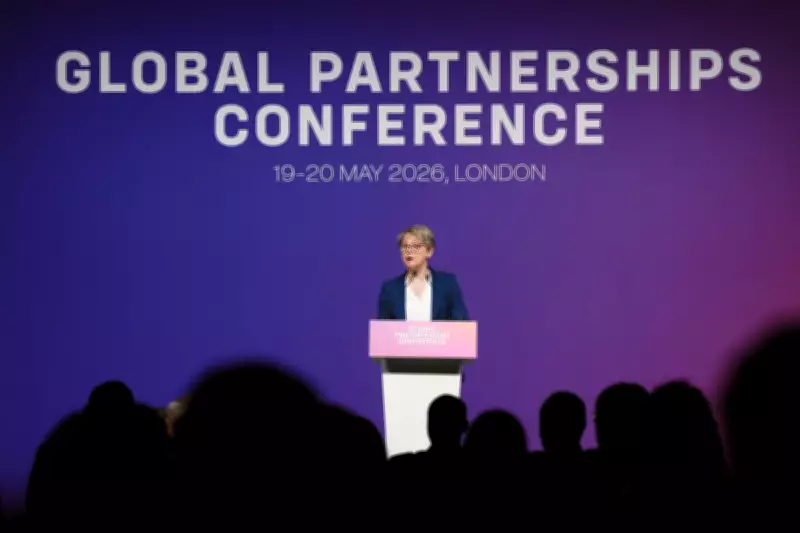
The United Kingdom has issued a stark warning regarding the potential for a worldwide food crisis, as Foreign Secretary Yvette Cooper highlighted the ongoing blockade of the Strait of Hormuz by Iran. Speaking at the Global Partnerships Conference in London, co-hosted by the UK and South Africa, Cooper emphasized the need for a "bold new approach" to international development amidst severe cuts to foreign aid budgets across several nations, including the UK and the United States.
Cooper's Warning on Global Instability
During her keynote address, Cooper described the current global landscape as "more volatile, more contested, more unstable than ever." She pointed to the three-month closure of the Strait of Hormuz by Iran as a critical threat that is strangling supply chains for energy and fertiliser, thereby exacerbating the risk of a food crisis. "The global economy is being held hostage, with the Global South paying the biggest price," she stated, noting that the timing of the blockade coincides with the planting season for many communities, thus threatening crop yields and food prices well into the following year.
Cooper referenced warnings from the World Food Programme that approximately 45 million people in the Global South are at risk of acute hunger this year. "The world risks sleepwalking into a global food crisis," she cautioned, urging immediate action.

Concurrent Crises and New Development Strategy
Beyond the immediate threat from Iran, Cooper highlighted other concurrent crises, including conflict, climate change, and communicable diseases such as the ongoing Ebola outbreak in the Democratic Republic of the Congo. She argued that these multifaceted challenges necessitate a shift in how wealthy nations approach development aid.
The UK's new strategy, as outlined by Cooper, focuses on prioritising humanitarian grant aid for fragile and conflict-affected countries while building investment partnerships with more stable developing nations. This approach aims to mobilise wider investments and different forms of capital. Key announcements at the conference included £1 billion in climate investments from British International Investments, a government-owned development investor, which is expected to unlock an additional £3.5 billion in private capital. The UK also launched new "Communities of Expertise"—demand-led, interdisciplinary hubs designed to share UK expertise in areas such as climate, energy, education, health, finance, and governance.
Mixed Reactions to UK's Position
However, the conference saw a mixed response to the UK's stance. Sarah Champion, chair of the International Development Committee, expressed concerns that the ambition of the conference outstrips the reality of a significantly reduced budget. "I remain concerned that the ambition pinned to the conference far outstrips the reality of what can be achieved with a much-reduced budget," she said. Champion emphasised the need for patient investment in preventing the root causes of poverty, such as conflict, inequality, and climate change, rather than merely reacting to crises.
Other nations, such as Norway, are adapting their development strategies without cutting overall budgets. A senior official from an African embassy in London voiced scepticism about increased investment from the Global North, citing persistent misperceptions of risk. "There remains a historic perception from investors that all the diverse African countries are actually the same, and all are risky, even when that is not the case," he said, pointing to the high cost of insuring shipments from Africa compared to those from Brazil to Europe.
NGO Criticisms and Calls for Action
UK non-governmental organisations also expressed concern. Jennifer Larbie from Christian Aid called for new funds and debt relief for low-income countries affected by the crisis. "This crisis should spur solidarity," she said. Richard Hawkes, Chief Executive of Oxfam GB, criticised the government's continued arms sales to Israel while cutting aid. "The UK Government cannot credibly speak about peace and stability while continuing arms sales to Israel and cutting the very aid that supports people caught up in crisis," he stated.

Dorothy Sang from CARE International UK highlighted the gendered nature of food insecurity, noting that women often eat last and least in crises. "Without the right voices in the room, the billions raised could struggle to deliver the transformative change we need," she said, calling for women's experiences and expertise to be central to solutions.