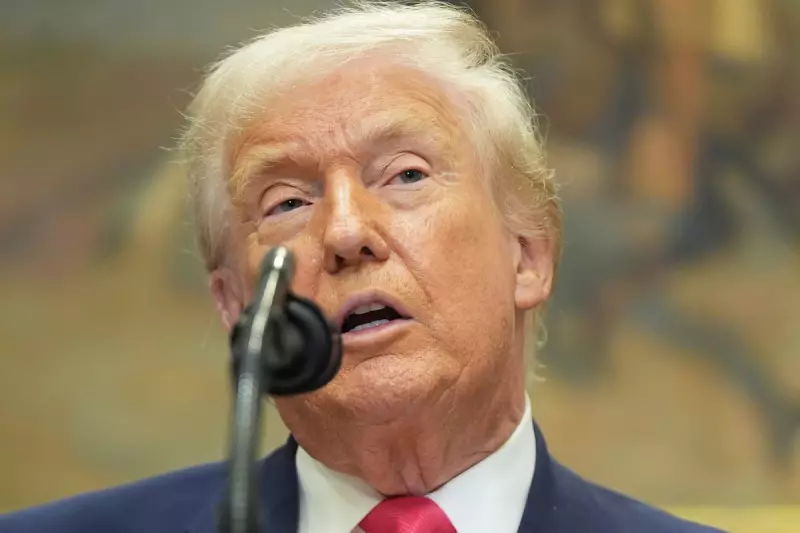
President Donald Trump has provoked outrage by labelling Somali immigrants living in the United States as "garbage" and stating they should leave the country. The remarks, made during a Cabinet meeting on Tuesday, came amid reports of a planned federal immigration enforcement operation in Minnesota, home to America's largest Somali community.
Fact-Checking the Rhetoric
President Trump's unsubstantiated claims that Somali immigrants "contribute nothing" stand in stark contrast to official demographic data. Nearly 58 per cent of Somalis in Minnesota were born in the U.S., and among the foreign-born population in the state, a significant 87 per cent are naturalised U.S. citizens.
"They contribute nothing. I don't want them in our country," Trump told reporters. "We can go one way or the other, and we're going to go the wrong way if we keep taking in garbage into our country." He doubled down on Wednesday, asserting, "Somalians should be out of here. They've destroyed our country." He also dismissed Minneapolis Mayor Jacob Frey, a critic of his rhetoric, as a "fool."
The Plight of Somalia: Decades of Flight
The context for this migration lies in Somalia's protracted crisis. Somalis have been fleeing the Horn of Africa nation for decades, following the collapse of dictator Siad Barre's regime. This led to civil war, warlord clashes, and the rise of the al-Qaida-linked al-Shabab extremist group.
Widespread insecurity has displaced millions internally and into neighbouring countries. Many spent years in refugee camps, like those in Kenya, awaiting resettlement to the U.S. or elsewhere. Inside Somalia, the primary threat remains al-Shabab, which controls rural areas and stages periodic, devastating attacks in the capital, Mogadishu.
The country's fragile federal government is engaged in a "total war" against the militants, but complex clan dynamics and external support via the Gulf of Aden sustain the group's resilience. This instability also fuelled Somali piracy, with a commercial vessel hijacked in the Indian Ocean earlier this month for the first time in eighteen months.
A Nation Struggling with Climate and Conflict
While Mogadishu sees some revival driven by returnee investment, Somalia's approximately 19 million people face dire circumstances. It has one of the world's weakest healthcare systems, a situation worsened by donor pullback, including the Trump administration's dismantling of USAID.
Somalia is also acutely vulnerable to climate change, suffering from cyclical droughts, floods, and cyclones. The International Crisis Group notes that climate change and conflict are "increasingly intertwined," with al-Shabab using control of water resources to tax vulnerable communities.
In response to Trump's comments, Somalia's Prime Minister declined to comment. The Trump administration has also paused all immigration applications from Somalia this week, further tightening its stance on a nation whose people have long sought safety and opportunity abroad.