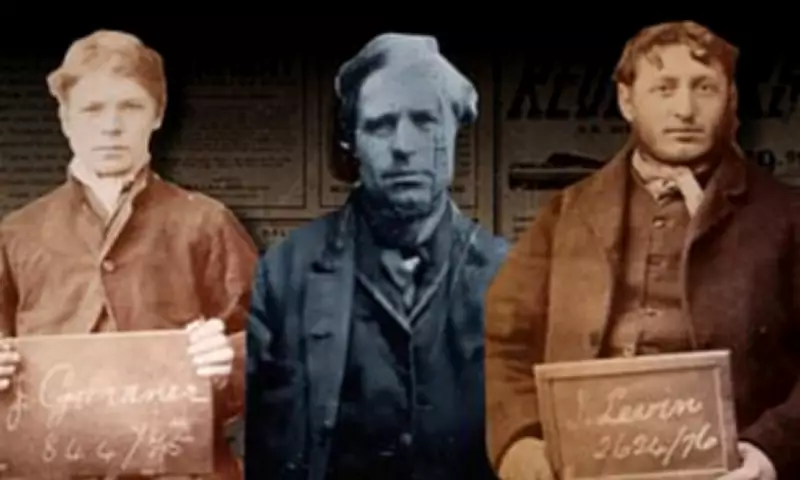
The Real Peaky Blinders: Victorian Mugshots Reveal Brutal Birmingham Criminals
The razor-sharp cheekbones and tailored suits of Cillian Murphy's Tommy Shelby have certainly elevated the Peaky Blinders of Birmingham's Small Heath to iconic status alongside Italian mobsters from Manhattan and Cuban gangsters from Florida. While global audiences have fallen for the piercing stare and Brummie brogue of Shelby's gang, along with their trademark flat caps, were the real Peaky Blinders people you'd want to share a pint with at The Garrison?
According to a newly examined collection of mugshots from the turn of the 20th century, preserved in the vault of the West Midlands Police Museum, the answer is a definitive no. Teenage thieves, domestic abusers, wife murderers, and fraudsters ran rampant in Birmingham during this era. While Steven Knight's series gave the city a slick, graphic-novel style makeover, the true picture of its cobbled streets was far less appealing.
The Origins of the Peaky Blinders
Local newspaper reports introduced the term 'Peaky Blinders' long before writer Steven Knight brought the infamous label to screens. In the 1870s, so-called 'slogging gangs' were rife—young men who banded together by neighbourhood and clashed with rival crews in street fights. These were not minor scuffles; on April 8, 1872, the Birmingham Mail reported up to 400 members of a slogging gang descended upon Cheapside, smashing businesses and assaulting shopkeepers before police intervened.

The term 'Peaky Blinder' first emerged in 1890, when a member of the public wrote to a Birmingham newspaper complaining of violent outrages by the 'Peaky Blinder gang from Small Heath'. Over the 1890s, it generalised to describe an underclass of criminals citywide. The judiciary often referred to young men as being of the 'peaky class', noting their shared fashions, hairstyles, and violent, dishonest nature. Contrary to popular myth, razorblades are not mentioned in contemporary sources until the 1920s, with researchers suggesting their use was likely more legendary than factual. The name is believed to stem from a billycock hat fashioned to a point and pulled low over the eyes, effectively 'blinding' the wearer.
Notorious Figures and Gang Violence
Henry Lightfoot was among the first labelled a 'Peaky Blinder' by the press, described as 'running amok' and causing police endless trouble in 1895, with a long career of theft and violence. George Fowler, another dubbed a Peaky Blinder, was convicted of the manslaughter of PC Charles Philip Gunter in 1901. A newspaper headline at the time read, '15 years penal servitude for Peaky Blinders'.
The first session of the new Birmingham Assize Court on July 31, 1891, saw street ruffians placed in the 'beautiful dock'. Henry Butterworth, James Sutton, and Walter Packwood were convicted of highway robbery with violence after punching, kicking, and robbing a pedestrian. Reports noted their shock at the severe sentences, with one journalist writing that only 'judicious shocks such as these can ruffianism be stamped out'.
Domestic Horror and Theft
Domestic violence was tragically common in Victorian Birmingham. One of the earliest murder mugshots in the archives is of William Smith, who killed his wife Elizabeth in August 1862 by cutting her throat after a rage. Another case involved John Woolley, who stabbed his partner Ellen in 1882 after she ended their relationship due to his drunken habits; he was sentenced to five years' penal servitude.
Theft was widespread, not limited to street urchins. James Gardener, 16, was jailed for a month after stealing a fowl and trying to sell it to an undercover officer. In a fraud case, Julius Levin was arrested in 1876 for obtaining watch chains with bad cheques totalling £600 (about £90,000 today), leading to six months' hard labour.
Notable Crimes and Legal Evolution
In 1890, a 'murderous attack on a music hall manager' saw William Beard, Agnes Cullis, and Alfred Rutter convicted of manslaughter after assaulting Arthur Hyde for refusing free entry. Beard, illiterate, marked his record with an X instead of a signature.

James Twitty, with multiple petty theft convictions, was involved in the 1898 murder of spinster Mary Ann Aliban during a burglary. He and accomplice Claude Mumby were initially sentenced to death, but Queen Victoria commuted it to life imprisonment after a petition. Twitty died in 1948 after 50 years in prison.
Alcohol-related crimes were rampant, with records showing individuals notching over 200 convictions. The Inebriates Act of 1898 targeted habitual drunkards, placing them on a register to prevent service in pubs. Richard Flemming was one such notorious figure, his mugshot showing tattered clothing.
Birmingham's legal system evolved during this period; it became an Assize town in 1884 after gaining city status, with cases previously sent to Warwick or Coventry. The Assize system was abolished in 1972, replaced by crown courts. The West Midlands Police Museum, founded in 1891 and reopened in 2022, preserves this dark history, housed in the former Steelhouse Lane police station.