
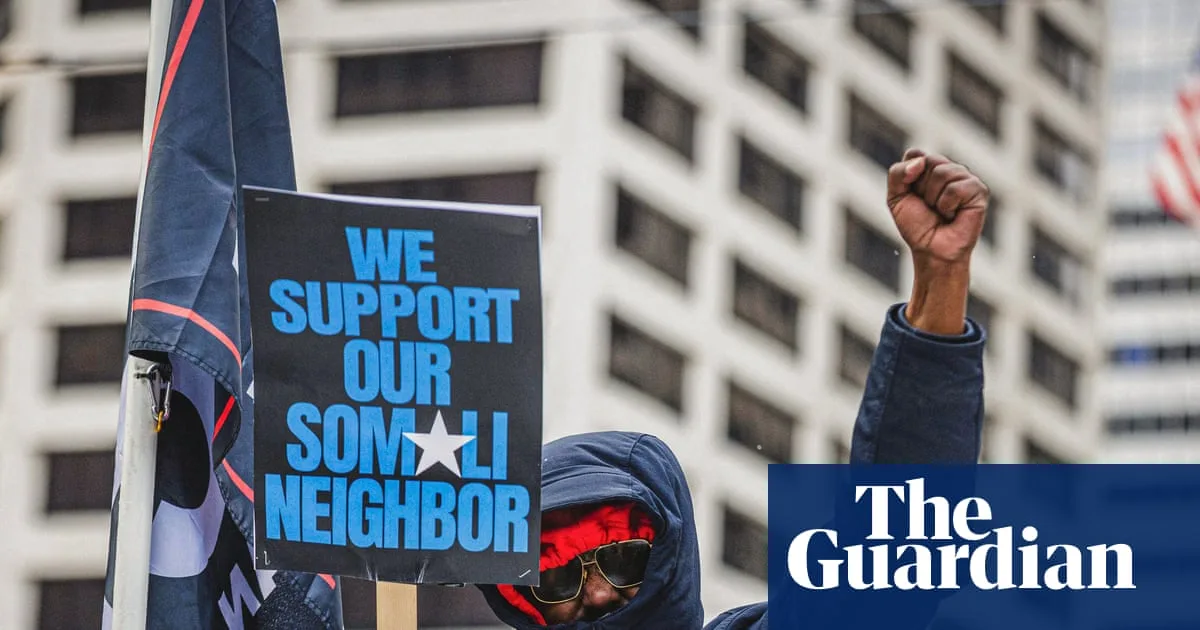
Confrontations between US Immigration and Customs Enforcement (ICE) and protesters have intensified on the streets of Minneapolis, causing deep anxiety among the Somali diaspora. Behind the headlines, however, there is a solid resolve, with community leaders describing a generationally traumatic moment for Somalis in the US and beyond.
Donald Trump has spent much of his second term fixated on Somali Americans, making derogatory remarks about both them and Somalia to justify anti-immigration policies, particularly in Minnesota, home to over 100,000 people of Somali descent. The President appears especially exercised by Congresswoman Ilhan Omar, who is of Somali origin, and has exchanged barbs with him. When Omar was attacked by a man who sprayed her with an unknown substance, Trump responded by calling her a fraud who “probably had herself sprayed”.
According to Professor Idil Abdi Osman of Leicester University, the targeting of the Somali community is convenient. “The shift towards the right in Europe and the US constitutes a ‘political thunderstorm’ that Somalis have become absorbed in,” she said. “They become an embodiment of the kind of communities that Trump can easily target and use as a scapegoat – that is convenient for the populist narrative.”
Somalis are Black, Muslim and immigrant, making them targets for racism, Islamophobia and anti-immigration sentiments simultaneously. The sharpest manifestation is in the US, but reverberations are felt across the tightly connected global diaspora. The Somali diaspora is exceptionally connected due to forced migration from the civil war; settlement schemes often split large families across countries, creating extensive transnational networks.
“We respond to all events through strong family networks and solidarities,” said Jawaahir Daahir, founder of UK-based Somali Development Services. She noted that political and media discourse rarely focuses on the intimate impact on individuals. “For many, the current climate has created a sense of heightened concerns about safety, belonging, discussions about whether we are seen as equal citizens.” A Minnesota-based academic reported that some parents fear sending their children to school in case they are picked up by ICE, even though most are US citizens.




