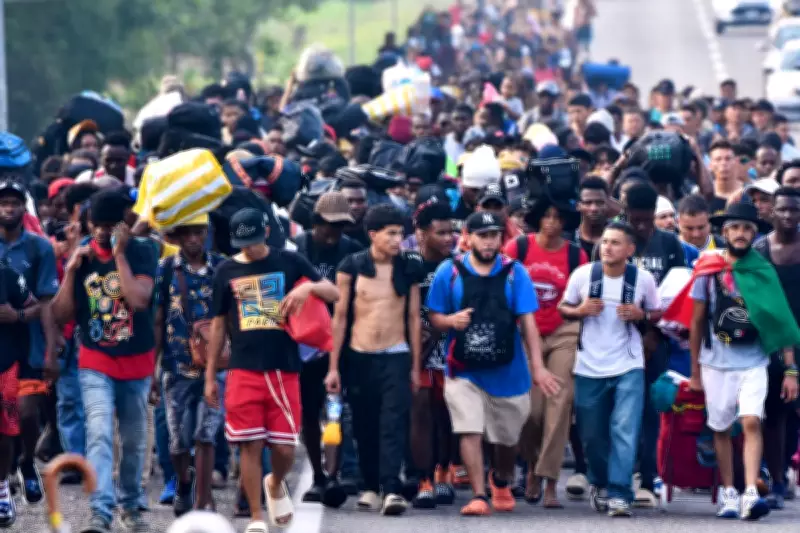
A group of approximately 500 migrants embarked on a march through southern Mexico on Wednesday, voicing their frustration over prolonged waits for immigration paperwork and urgently requesting official authorization to relocate to regions with better employment opportunities. The demonstration aimed to draw attention to the bureaucratic hurdles that leave many feeling trapped and without viable options for sustaining themselves.
Origins of the March
The migrants departed from Tapachula, a city near the Guatemala border, on Tuesday night. Their journey was not merely a physical trek but a symbolic act to underscore the dire circumstances faced by those stuck in limbo while their immigration statuses are processed. Tapachula has historically functioned as a key transit point for migrant populations, but in recent months, it has experienced a significant surge in arrivals, including many third-country nationals such as Cubans deported under the Trump administration. Official statistics on these influxes remain unpublished by the Mexican government, adding to the opacity of the situation.
Voices from the March
Among the protesters was Joandri Velázquez Zaragoza, a 40-year-old Cuban national who articulated the collective despair. "Without papers, there are no opportunities. We migrants feel like prisoners in Tapachula," he stated. Velázquez, an evangelical pastor and mason, supports a wife and two children back in Cuba, where a deepening crisis is characterized by frequent power outages and severe food shortages. He arrived in Tapachula in August 2024, initially attempting to secure a U.S. asylum appointment via the CBP One mobile app without success. After the program's termination under the Trump administration, he applied for asylum in Mexico, but both his application and appeal were rejected, leaving him in a precarious legal and economic position.

Shifting Patterns and Government Response
While foot marches are a common occurrence in this region, their objectives have evolved. Unlike previous movements that targeted the United States, recent protests typically involve groups of a few hundred migrants who disperse within days without venturing beyond southern Mexico. During this latest march, the National Guard, the National Migration Institute, and local police monitored the procession but did not intervene to halt it. Coinciding with the march's commencement, the Mexican government announced a new agreement aimed at enhancing labor inclusion for individuals in transit across southern states, including Campeche, Chiapas, Tabasco, and Quintana Roo.
Systemic Issues and Abuses
The Southern Border Monitoring Collective, a coalition of civil society groups, issued a stark warning this week about the exploitation faced by migrants. They reported that people in transit are being charged up to 40,000 Mexican pesos (approximately $2,300) for documentation that is legally supposed to be free. The collective also condemned the increasing militarization of Mexico's southern border and the Northern Triangle region, arguing that heightened security measures have escalated the risks and abuses endured by migrants, rather than providing protection.
Broader Context of Migrant Plight
The march occurs against a backdrop of ongoing humanitarian challenges. In a related incident on Monday, Mexican authorities discovered 229 migrants trapped inside a truck in Veracruz. The vehicle had been towed to a police impound lot following a stolen-vehicle report, but officers only realized people were inside when the migrants began shouting for help, highlighting the perilous conditions many face during their journeys.
This protest underscores the urgent need for more efficient and humane immigration processing systems, as migrants continue to navigate complex legal landscapes while seeking safety and economic stability.