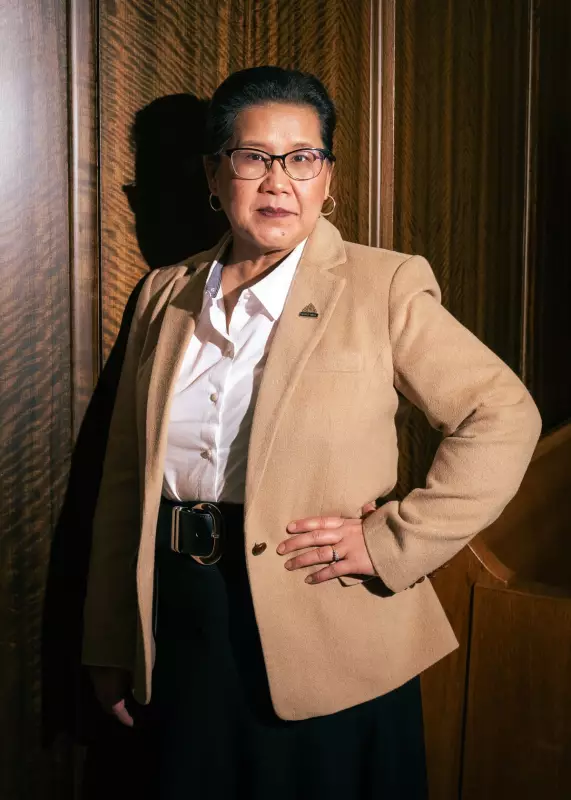
Mayor Kaohly Her sits in her office at Saint Paul City Hall, Minnesota, on 22 January 2026, confronting what she describes as a sustained federal assault on her city's immigrant population. The newly installed mayor, whose remarkable journey from Hmong refugee to political leader has captured national attention, finds herself at the centre of escalating tensions between local authorities and federal immigration enforcement agencies.
A City Under Siege
"Saint Paul has been under siege by ICE starting back in June already," Mayor Her reveals in an exclusive interview. "We're home to one of the largest Hmong communities in the country, but when the ICE raids started they flew under the radar. They've only come to light recently since the shooting of Renee Good, and it's escalated since."
The reference to Renee Good, a Minneapolis mother of three killed by an Immigration and Customs Enforcement officer just as Her began her term, marks a turning point in the crisis. Since that incident, Mayor Her has faced federal investigation for allegedly obstructing immigration enforcement while simultaneously implementing emergency measures to protect vulnerable communities.
Constitutional Observers and Emergency Protocols
The mayor's office has mobilised rapidly, working with dozens of advocacy groups to establish constitutional observer courses designed to train citizens in documenting ICE operations without interference. Simultaneously, they've developed protocols with local law enforcement for handling emergency calls about ICE sightings throughout the city.
"We've put together some lifelines that we think are critical," Her explains. "If somebody has an abandoned vehicle because they were detained by ICE, we have a program so they can get access to their vehicles without paying large fees." The administration has also challenged ICE's ability to stage operations in local parks, asserting municipal authority over public spaces.
Personal and Political Journey
Mayor Her's background provides unique perspective on the current crisis. Born in a bamboo hut in the mountains of Laos during the Vietnam War era, she arrived in the United States at age three as part of a refugee resettlement program. Her family's history includes service to the US government in Laos, with her grandfather fighting alongside American forces in the CIA-backed Laotian civil war.
After fifteen years in investment and finance, Her transitioned to public service through community organising, directing a Hmong women's organisation, and serving on Saint Paul's human rights commission and board of education. Her political career accelerated with election to the Minnesota House of Representatives from 2019 to 2025 as a member of the Democratic-Farmer-Labor party, before challenging and defeating incumbent mayor Melvin Carter last November.
Community Impact and Racial Profiling Concerns
The impact on Saint Paul's immigrant communities has been profound and visible. "In Saint Paul's Hmong community, I've noticed that the markets are empty and it's easy to find parking," Her observes. "They would normally be bursting at the seams, and the few people that were there were getting their food quickly and leaving. Everyone is afraid. I have family members who haven't opened their drapes in days because they're afraid someone can see in and see that they are Asian."
Her points to disturbing patterns in enforcement actions. "ICE agents have been asking where Asian people live," she claims, highlighting what she sees as underlying racial motivations behind the operations. "We have undocumented immigrants here who are from European countries, but none of those people are being targeted."
Federal Response and Political Context
The Department of Homeland Security has vigorously denied allegations of racial profiling. Assistant Secretary for Public Affairs Tricia McLaughlin stated that claims of targeting based on ethnicity "are disgusting, reckless and categorically false," asserting that enforcement focuses solely on immigration status rather than race or skin colour.
Mayor Her connects the intensified enforcement directly to national politics, particularly the Trump administration's approach. "His disdain toward the state, and the fact that he has never been able to win here, made it very clear that there was a retribution to be paid and he is making good on that," she argues. "People want to talk about this as an immigration issue, but it is not. Minnesota has always welcomed its refugees."
Legal Challenges and Separation Ordinance
Saint Paul maintains a separation ordinance prohibiting coordination with ICE, and the city has joined litigation seeking to end what local officials describe as an ICE surge. The US Justice Department has dismissed these legal efforts as "legally frivolous," creating a standoff between municipal and federal authorities.
The case of ChongLy Scott Thao, a 57-year-old US citizen photographed being taken from his home by ICE officers wearing only shorts in freezing temperatures, has become emblematic of community concerns. Although Thao was later returned home, and DHS claimed his arrest was part of an operation targeting sex offenders at his address, the incident has fuelled allegations of excessive and indiscriminate enforcement.
Building Bridges Amid Division
Despite the polarising nature of the immigration debate, Mayor Her emphasises unity and measured response. "What the administration is doing is unifying us, bringing us together and making us strong," she suggests. "People want this to be a partisan issue, but it is not."
She maintains relationships with conservative counterparts in Minnesota, reflecting what she describes as the state's distinctive political culture. "At the federal level, they do not realize that we are different in Minnesota. Even if we disagree, there is a fundamental belief in humanity."
As Vice President JD Vance visited the Twin Cities urging local cooperation with federal immigration officers without contacting Mayor Her's office, the mayor extended an open invitation for dialogue. Meanwhile, she continues to frame the struggle as transcending partisan politics. "I hope that people can see what was happening here is bigger than parties – it's really about people's fundamental human rights. I hope that people see this is about preserving our democracy and not about party lines."
With her city facing sustained federal pressure and her administration under investigation, Mayor Kaohly Her represents both the personal dimensions of America's immigration debate and the institutional conflicts between local autonomy and federal enforcement authority. Her journey from refugee to mayor, now confronting what she describes as an unprecedented challenge to her community's safety and dignity, continues to unfold in the politically charged atmosphere of the Twin Cities.