
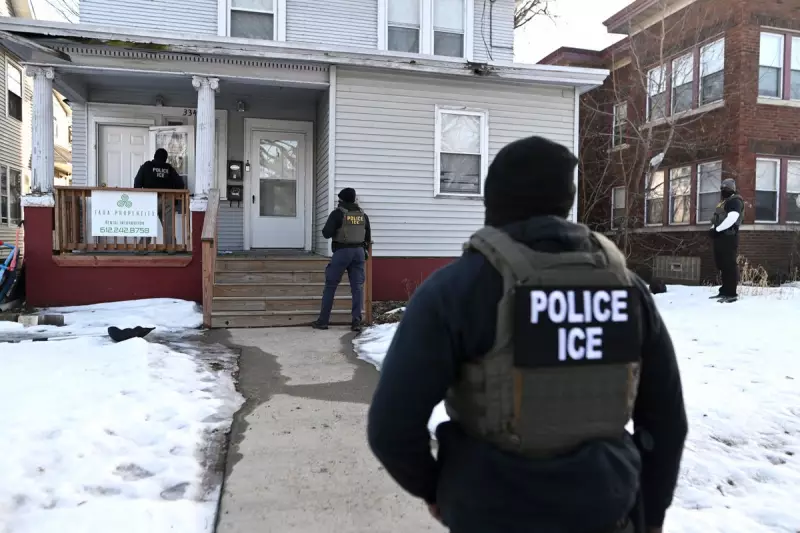
Federal immigration officers have been granted extensive new authority to forcibly enter private residences without judicial warrants, according to an internal Immigration and Customs Enforcement memo obtained by The Associated Press. This significant policy shift marks a dramatic departure from long-established constitutional guidance regarding government searches and seizures.
Constitutional Concerns Raised
The directive permits ICE agents to use force to gain entry to homes based solely on administrative warrants when arresting individuals with final removal orders. Legal advocates argue this directly conflicts with Fourth Amendment protections against unreasonable searches and overturns years of advice given to immigrant communities about their rights.
For years, immigrant advocacy groups, legal aid organisations, and local governments have consistently advised individuals not to open their doors to immigration agents unless presented with a judge-signed warrant. This guidance is grounded in Supreme Court rulings that generally prohibit law enforcement from entering homes without judicial approval.
Policy Implementation and Training
The memo, signed by acting ICE director Todd Lyons and dated May 12, 2025, states that although the Department of Homeland Security has not historically relied on administrative warrants alone for such arrests, the DHS Office of the General Counsel has determined that constitutional and immigration laws do not prohibit this approach.
According to whistleblower disclosures, the memo has not been widely shared within the agency but has been used to train new ICE officers being deployed to implement the administration's immigration enforcement agenda. New hires are reportedly being instructed to follow the memo's guidance instead of written training materials that contradict it.
Recent Enforcement Actions
The Associated Press witnessed ICE officers ramming through the front door of a Liberian man's home in Minneapolis on January 11 with only an administrative warrant, wearing tactical gear with rifles drawn. Documents revealed no judge had authorised the raid on private property.
Homeland Security spokeswoman Tricia McLaughlin stated in an email that everyone served with administrative warrants has received "full due process and a final order of removal," adding that officers have found probable cause for arrests. She cited Supreme Court and Congressional recognition of administrative warrants in immigration enforcement without providing specific details.
Procedural Requirements and Limitations
The memo outlines specific procedures officers must follow, including knocking on doors, identifying themselves, explaining their purpose, and limiting operations to hours between 6 a.m. and 10 p.m. Individuals inside must be given a "reasonable chance to act lawfully" before force can be used.
"Should the alien refuse admittance, ICE officers and agents should use only a necessary and reasonable amount of force to enter the alien's residence, following proper notification of the officer or agent's authority and intent to enter," the document states.
Legal Challenges Expected
The policy change is almost certain to face legal challenges and criticism from advocacy groups and immigrant-friendly state and local governments. Whistleblower Aid, representing two anonymous government officials, described the directive as "secretive - and seemingly unconstitutional" in their complaint.
David Kligerman, senior vice president at Whistleblower Aid, noted that although the memo was issued in May, it took time for clients to find a "safe and legal path to disclose it to lawmakers and the American people."
Historical Context and Training Discrepancies
Traditionally, most immigration arrests have been conducted under administrative warrants that authorise arresting specific individuals but do not permit forced entry into private spaces without consent. Only judicial warrants carry that authority.
During a visit to the Federal Law Enforcement Training Center in Georgia last August, ICE officials repeatedly stated that new officers were being trained to follow Fourth Amendment protections. However, whistleblowers claim newly hired officers are being told they can rely solely on administrative warrants for home entries, conflicting with written Homeland Security training materials.
ICE officers have typically waited for individuals to appear in public spaces like sidewalks or workplaces to make arrests without risking Fourth Amendment violations. The new policy represents what Whistleblower Aid calls a "complete break from the law" that undermines constitutional protections.