
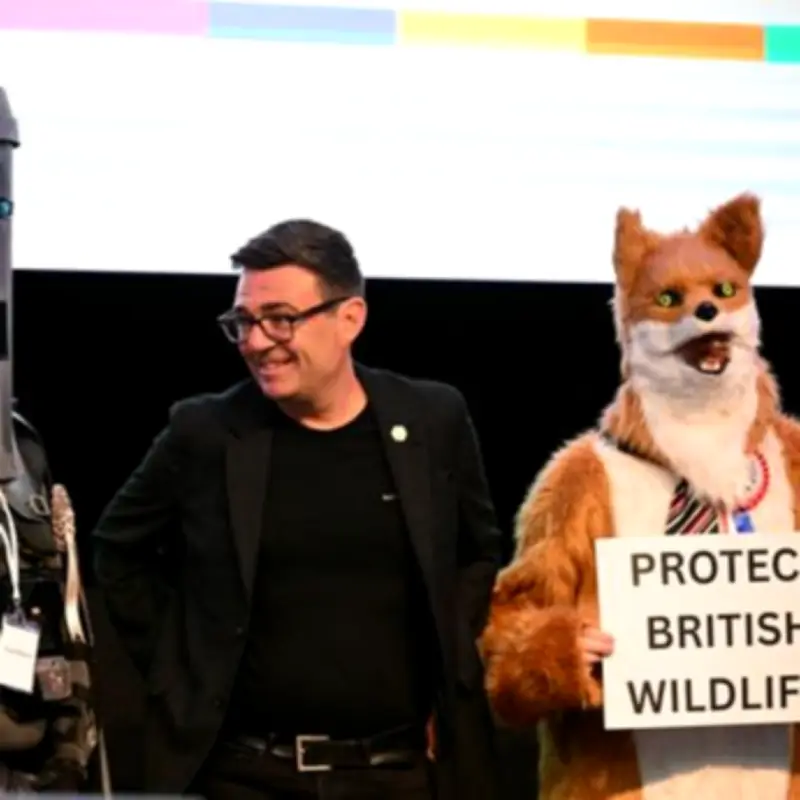
A man dressed in a fox costume mingled with the crowd, while Count Binface scrutinized the venue's toilets, and the Monster Raving Loony Party members wore outlandish headgear that became progressively more elaborate. Journalists staked out a prime spot in the media room, relying on copious amounts of subpar coffee to fuel their reporting, accompanied by local treats such as a bowl of Uncle Joe's Mint Balls, which are manufactured in a Wigan factory.
While Sky News had secured a private room for their presenters to prepare for the evening, our sister paper the Manchester Evening News made do with the ladies' toilets for their pre-broadcast routine. For one night, The Edge in Wigan took centre stage in British politics.
The voters of Makerfield carried the weight of choosing a candidate with the potential to become the UK's next Prime Minister. The pressure was on. In the end, the outcome was far from suspenseful, with Andy Burnham securing a landslide victory with 54.8% of the vote, leaving Reform's Rob Kenyon in second place with 34.5%.
Colorful Characters and Peculiar Encounters
But by-elections often highlight the characters, peculiar encounters, and unanticipated moments that make the event memorable. The national media descended on the Makerfield constituency from the moment the by-election was called, prompted by the resignation of Labour MP Josh Simons. Journalists and camera crews from prominent media outlets, including Aljazeera, the New York Times, and a German media organisation, swarmed the area, scrambling to secure interviews with candidates and voters while rushing to cover events hosted by the contesting parties.
Among the more enthusiastic participants was Count Binface, the intergalactic space warrior, who garnered almost as much interest from broadcasters as some of the mainstream candidates. Following an interview with Sky News, where a presenter initially failed to recognise him, Binface praised the MEN, saying, "The MEN, that's some proper journalism!" He also commended the Edge, specifically the Post Code café, which remained open all night to the gratitude of many journalists, and described its toilets as "above average" – likely the first endorsement of the venue's facilities by someone wearing a silver bin-head.
While he claimed to steer clear of "ad hominem attacks", he didn't hold back in labelling Reform's Rob Kenyon as a "sexist plumber", a nod to past social media posts that haunted Kenyon's campaign. "I don't like sexists who have appalling views about abortion," Binface declared, earning some applause, before shifting his attention to Labour. "The current Prime Minister is so weak that your Labour candidate here is running on the message of 'Vote Labour, the leader is sh**e!'" he quipped, triggering widespread laughter. "Personally I find that a surreal mandate, but then look who's talking."
Elusive Candidate and Party Dynamics
When questioned about Restore Britain's Rebecca Shepherd, Binface retorted: "Who?" This was a sentiment many journalists could relate to, given Shepherd's elusive behaviour towards the majority of the media - and public - throughout the campaign. Throughout the campaign, the MEN had repeatedly attempted to secure an interview with Shepherd, only to be met with silence. When Restore leader Rupert Lowe was asked why his candidate had not participated in any interviews, he responded: "Well, she's been busy campaigning. Doing interviews doesn't necessarily win you votes, but being out on the street does."
However, a chance encounter occurred when Shepherd was spotted sitting with her team in the cafe. When asked for a brief comment, Shepherd declined several times, before stating: "I've had a complete media blackout from the media so I'm returning the favour." Much of the commentary on Restore's chances came directly from the party leader. Lowe contended that his party, which only officially registered in March, had run a robust campaign and deserved more recognition. Regardless of any pre-polling day expectations, the final count of 3,111 votes, equating to 6.8 percent of the vote, left Burnham's victory margin looking comfortable.
Election Night Scenes
Elsewhere, the usual election night scenes unfolded: candidates engaging in conversation between interviews, activists exchanging experiences after weeks of door-knocking, and election officials striving to maintain order amidst the buzz and excitement. Just before 2am, whispers began circulating through the corridors of the Edge: Andy Burnham was on his way. No, he would arrive in an hour. No, he would be there in 15 minutes. Photographers utilised various objects to gain a better vantage point, ranging from the humble step ladder to more daring choices such as bins and safety cones.
After a tense twenty minutes of anticipation, the man of the hour made his entrance – clad entirely in black with a Bee Network badge, warmly greeting the crowd of campaigners, cabinet members, and an array of increasingly large hats sported by Monster Raving Loony Party members. As the applause from the Labour supporters subsided, a voice rang out: "Next step Downing Street, Mr Burnham?"
As piles of ballot papers were meticulously sorted and counted, the mood amongst Labour figures grew increasingly hopeful. Notably, party leader Nigel Farage was conspicuous by his absence, and shortly after 1am, rumours began circulating in the counting hall that he had been spotted leaving for London. Just after 3am, the declaration confirmed what many at The Edge had suspected for much of the evening. Burnham had secured a decisive victory, Reform had finished a distant second (with Kenyon making a swift exit shortly after Burnham's speech), and the by-election that had drawn significant attention from Westminster, Fleet Street, and beyond had come to a close.
In a speech that promised 'political change' and 'more power for the North' - with much ambiguous hinting but no mention of Burnham's widely predicted next steps to challenge Prime Minister Sir Keir Starmer for his title. For the journalists packing up their laptops after filing their stories, campaigners nursing their disappointments, and election staff nearing the end of a long and tiring shift, perhaps the main man himself best summed up how everyone felt in the early hours of Friday morning. As he left the venue, an exhausted Burnham, accompanied by his wife and daughter, brushed off the swarm of reporters and camera crews pressing him about 'leadership challenges' and his 'next steps' with a straightforward reply: "I'm going for a pint!"




