
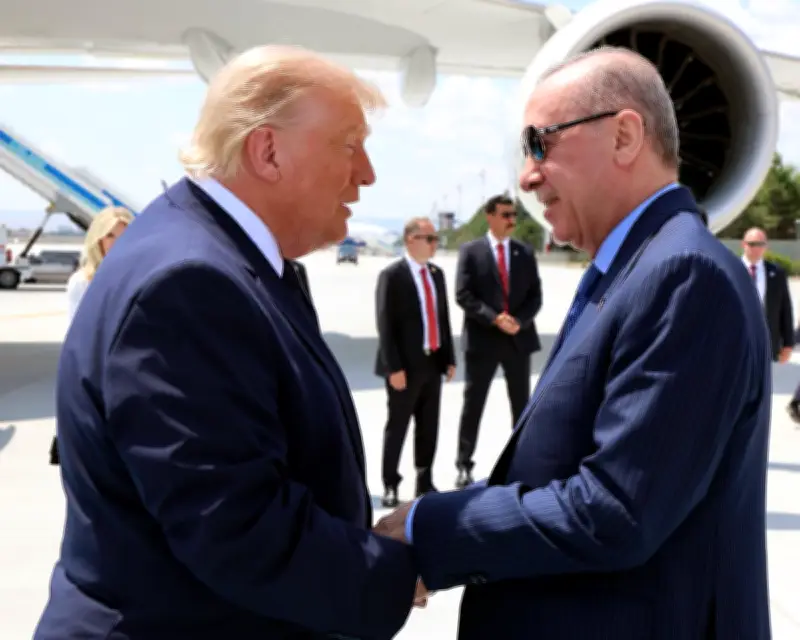
Donald Trump has revived his bid for the US to acquire Greenland, threatening to pull all American armed forces out of Europe after the continent repeatedly pushed back. Arriving at the Nato summit in Ankara on Tuesday, the US president also suggested his commitment to defending Europe had been tempered by political decisions by leaders on immigration and energy.
Trump Renews Greenland Dispute
Reviving an earlier row, Trump suggested that the disagreement about the ownership of Greenland – which is part of Denmark, a fellow Nato member – had “hurt” his relationship with the military alliance. “Denmark doesn’t spend money to really help Greenland, but it’s an important part for the US, and it’s surrounded by China ships and Russian ships … [It] should be controlled by the US, not by Denmark. And when they wouldn’t go along with it, and with all the money we spend to help them with Russia,” he said.
In response, Rachel Reeves, the UK chancellor, told reporters: “The future of Greenland is up to the people of Greenland and of Denmark, and not up to the US president. I’ve been very clear about that ever since it was first suggested.”
Threat to Withdraw US Forces from Europe
Trump also threatened to remove all American soldiers from Europe, saying: “We don’t have to spend any money; we could remove all of our soldiers out of Europe because, as you probably noticed, Europe’s a very different place than it was 20 years ago … they better be careful with immigration and energy. If they’re not careful with those two things, you’re not going to have a Europe any more.”
Criticism of UK and Nato Allies on Defence Spending
Trump renewed his criticism that Nato allies do not spend enough on defence and are too reliant on the US – an argument European members are attempting to meet head-on by announcing multi-billion-pound defence collaborations. “Why are we spending hundreds of billions of dollars and they’re not there for us? We’ve always been there for them,” he said, although Nato’s mutual defence clause has only ever been triggered after the September 11 attacks on New York, where allies joined US troops in Afghanistan.
The UK has already pushed back on criticism from the US that some allies are “lagging behind” on funding, with Trump expected to rebuke countries, including the UK, for not making enough progress on hitting the target of spending 3.5% of GDP by 2035.
UK Leads European Defence Project
The UK will lead a £37bn European project to develop a long-range missile that could strike thousands of miles behind Russia’s frontline with Ukraine as part of efforts to end Nato’s reliance on the US. Amid ongoing uncertainty over Trump’s commitment to the alliance, the UK will work with countries including France, Germany and the Baltic states to produce its own deep-precision strike capability. The new weapon, which would be the most advanced Nato has at its disposal, could strike targets between 200 miles and 1,200 miles away with pinpoint accuracy, meaning from Ukraine it could hit military targets well behind Russian lines, and could even reach Moscow.
UK Chancellor Suggests New Defence Financing
As Labour struggles to fund a steep increase in defence spending to meet Nato targets, Reeves suggested for the first time that the “multilateral defence mechanism” of off-balance sheet financing could be merged with Canada’s Defence, Security and Resilience Bank initiative. Supporters argue the Canadian-led scheme, which was supported by John Healey when he was defence secretary but opposed by the Treasury, would give the UK access to a bank with £86bn of lending capability for defence projects, for a UK subscription of £900m.




