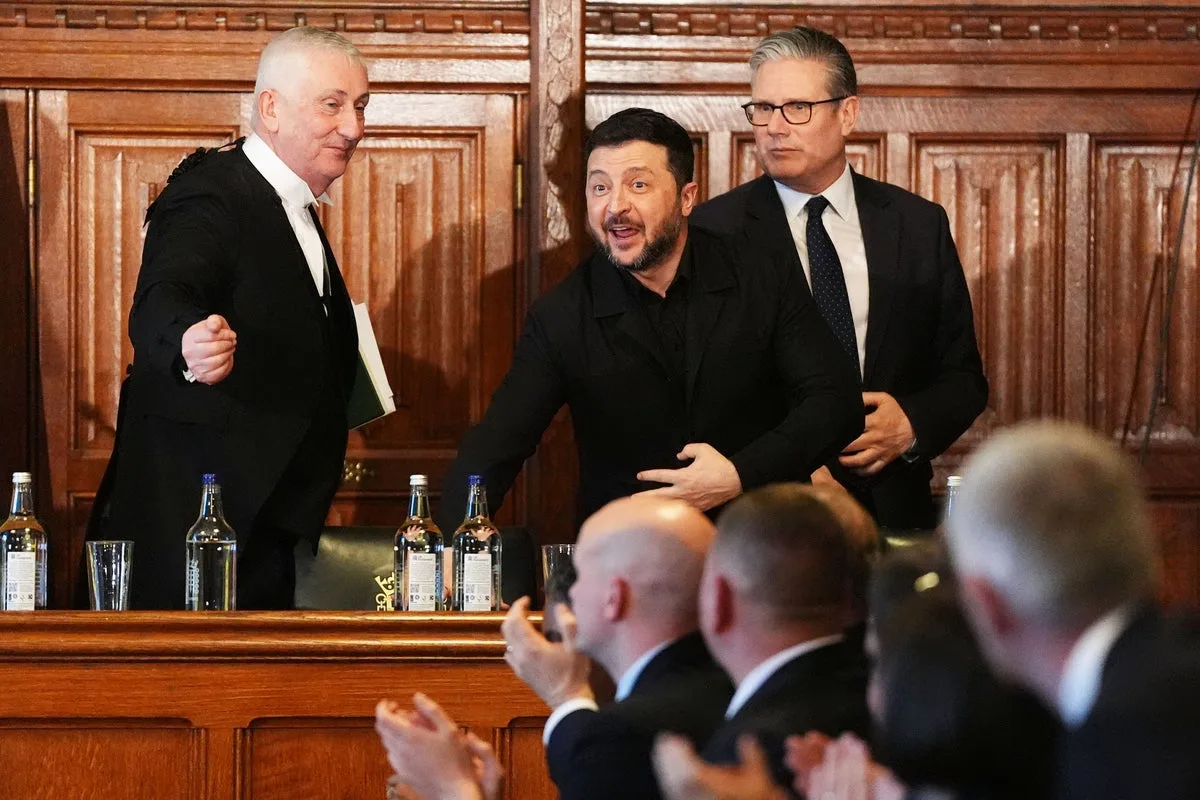
Zelensky Transforms Ukraine's Image from Victim to Strategic Partner
Volodymyr Zelensky has fundamentally shifted global perceptions of Ukraine from a nation under siege to a country possessing sophisticated military technology and strategic value. During his recent visit to London, the Ukrainian president presented himself not as a leader begging for assistance, but as a partner offering tangible solutions to modern warfare challenges.
Real-Time Battlefield Demonstrations in Westminster
Zelensky arrived at Westminster armed with an iPad displaying live Ukrainian battlefield feeds, demonstrating how his forces successfully intercept 87-90 percent of drone and missile attacks using predominantly domestically developed weaponry. This technological showcase represented a dramatic departure from previous appeals for help against Russia's full-scale invasion.
The Ukrainian president presented this classified real-time monitoring system to King Charles III, allowing visualization of every drone elimination, infantry movement, incoming missile strike, and long-range air assault within Russian territory. Following this royal audience, Zelensky received a standing ovation in Parliament, where he emphasized Ukraine's evolving role in global security.
Ukrainian Experts Deployed Across Gulf Nations
Currently, 201 Ukrainian military specialists are actively operating in Bahrain, the United Arab Emirates, Saudi Arabia, and Qatar, with an additional 34 en route to Kuwait. These experts are transferring wartime technology specifically designed to counter Iranian-origin missiles and drones that have threatened Gulf security.
"You need us just like we need you," Zelensky explicitly stated, positioning Ukraine as an essential partner rather than a dependent nation. His message highlighted how Kyiv's hard-earned battlefield experience could benefit Middle Eastern allies facing similar aerial threats.
Trump's Simultaneous Criticism of NATO and UK
While Zelensky built alliances in London, Donald Trump was expressing disappointment with British Prime Minister Sir Keir Starmer in Washington. The US president criticized Starmer's refusal to join US-Israeli military action against Iran and disparaged UK immigration and energy policies.
Trump further accused the BBC of utilizing artificial intelligence in documentary production, despite the broadcaster's clarification that only conventional editing techniques were employed. "I love Europe," Trump remarked during a meeting with Irish Taoiseach Micheal Martin, before adding, "Bad things have happened here. Very bad things. And you better do something about immigration, and you better do something about energy."
NATO Tensions and Russian Connections
The American president repeated his criticism of NATO members abstaining from direct military engagement against Iran, overlooking contributions from nations like the United Kingdom in defending Gulf states against Iranian attacks. "I think NATO is making a very foolish mistake," Trump declared, characterizing allies as unwilling to assist despite agreeing with US positions.
Trump's perceived unreliability as an ally has been underscored by threats against NATO members Canada and Greenland, alongside pressure on alliance states to purchase American weaponry for Ukraine. Simultaneously, he has halted all US military aid to Kyiv while reportedly facilitating Russian access through his envoy Steve Witkoff, who maintains extensive contact with Vladimir Putin's economic representative Kirill Dmitriev.
Contrasting Visions for Global Security
Zelensky presented a starkly different perspective during his parliamentary address, contrasting normal British life with Ukrainian realities: "We are here in this great building of the British Parliament, calm and safe, not in a shelter. On your way here, you saw tree branches over the streets, not protective nets against FPV drones."
The Ukrainian leader challenged assumptions about geographical protection, noting that "ballistic missiles can strike at thousands of kilometres" and warning that "if evil wins, the evolution of war will cross any distance to us." He positioned Ukraine's experience as crucial for developing regional defense systems that could monitor Iranian and Houthi attacks in real time.
Building Defensive Partnerships
Ukraine seeks continued collaboration with Middle Eastern and European nations to enhance drone defense capabilities and fund anti-missile batteries utilizing Patriot and THAAD systems. Despite Trump's dismissal of Ukrainian expertise, Zelensky insists his country has substantial contributions to make toward global security architecture.
"We must deliver real security, safety on the streets, safety at home, the protection of our culture and real respect for the rights and security of our people and national security proven by war," Zelensky asserted, framing current leadership's responsibility in stark terms.
The contrasting approaches of the two leaders could not be more pronounced: one offering practical warfare solutions and alliance building, while the other expresses discontent with traditional partners and questions fundamental security arrangements. This divergence highlights significant fractures in Western solidarity as Ukraine continues its defense against Russian aggression.




