Vietnam's Military Outlines Contingency for US 'War of Aggression'
An internal Vietnamese military document, completed in August 2024 and titled "The 2nd U.S. Invasion Plan," reveals that the nation's defence establishment is actively preparing for a potential American war of aggression. This comes just a year after Vietnam elevated its diplomatic relations with Washington to a Comprehensive Strategic Partnership, the highest level possible.
Deep-Seated Fears of External Subversion
The document, analysed in a report released by human rights organisation The 88 Project, exposes a profound duality in Hanoi's approach. While publicly pursuing trade and diplomacy, the military views the United States as a "belligerent" power. The analysis confirms a deep-seated fear within the Communist leadership of external forces fomenting an uprising—a so-called "colour revolution"—akin to those seen in Ukraine or the Philippines.
Ben Swanton, co-director of The 88 Project and the report's author, emphasised the pervasiveness of this view. "There's a consensus here across the government and across different ministries," he stated. "This isn't just some kind of a fringe element or paranoid element within the party or within the government."

Strategic Calculations and Historical Memory
The military planners acknowledge that "currently there is little risk of a war against Vietnam." However, they argue that due to the US's perceived belligerent nature, vigilance is required to prevent Washington and its allies from "creating a pretext" for invasion. The document suggests US strategy across three administrations—Obama, Trump, and Biden—has increasingly sought to form a front against China in Asia, potentially entrapping Vietnam.
This perspective is rooted in a long memory of the war that ended in 1975. Zachary Abuza, a professor at the National War College, noted that while Western diplomats often focus on Chinese aggression, Vietnamese leaders' paramount fear remains a US-backed colour revolution that could threaten the regime's survival.
Balancing Act Between China and the US
The document offers a stark contrast to the 2023 Comprehensive Strategic Partnership signed by President Biden. Vietnamese planners assert that while the US views Vietnam as "a partner and an important link," it ultimately aims to impose its values to gradually change the socialist government.
Nguyen Khac Giang of Singapore's ISEAS–Yusof Ishak Institute highlighted the internal tensions this causes. "The military has never been too comfortable moving ahead with the Comprehensive Strategic Partnership with the United States," he said. These tensions surfaced publicly in June 2024 when a Vietnamese army TV report accused US-linked Fulbright University of fomenting a colour revolution.
Trump's Second Term: New Partnerships and Fresh Anxieties
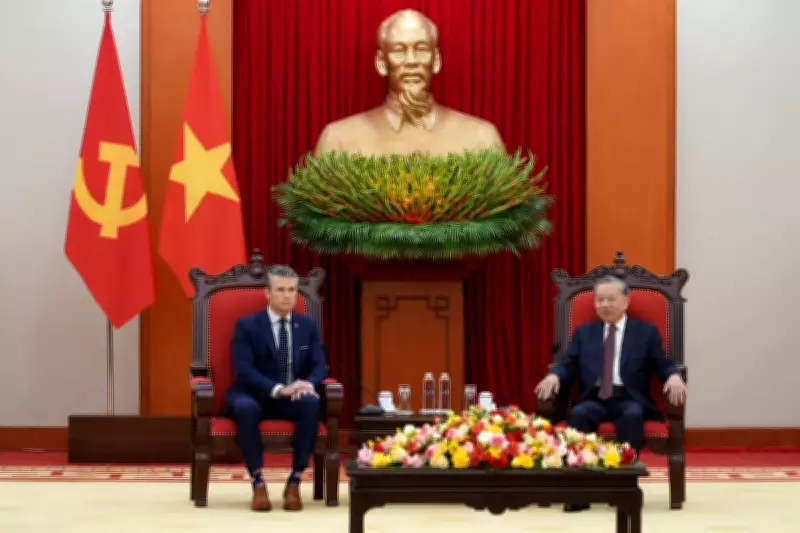
Under Vietnamese leader To Lam, who rose to power around the time the document was written, ties with the US have strengthened, particularly under the Trump administration. Lam swiftly accepted an invitation to join Trump's Board of Peace, and a major Trump-branded resort project broke ground in Vietnam.
However, Trump's military actions elsewhere, such as the operation against Venezuela's Nicolás Maduro, have provided fresh justification for Vietnamese conservatives' unease. Any US action involving Cuba, a close Vietnamese ally, could send shockwaves through Hanoi's political elite.
Abuza summarised the confusing signals for Vietnam: "The Vietnamese are going to be confused by the Trump administration, which has downplayed human rights and democracy promotion, but at the same time been willing to violate the sovereignty of states and remove leaders they don't like."
The US State Department declined to comment directly on the invasion plan but reaffirmed its commitment to the partnership, stating it "promotes prosperity and security for the United States and Vietnam." Vietnam's Foreign Ministry did not respond to requests for comment on the report.