JD Vance Defends Support for Viktor Orbán in Hungary Election
US Vice-President JD Vance has firmly rejected accusations that the United States is meddling in Hungarian politics, labelling such claims as "darkly ironic." This comes as recent polls indicate that the opposition Tisza party could secure a supermajority in the upcoming elections, posing a significant challenge to incumbent leader Viktor Orbán.
Unprecedented Visit and Political Backing
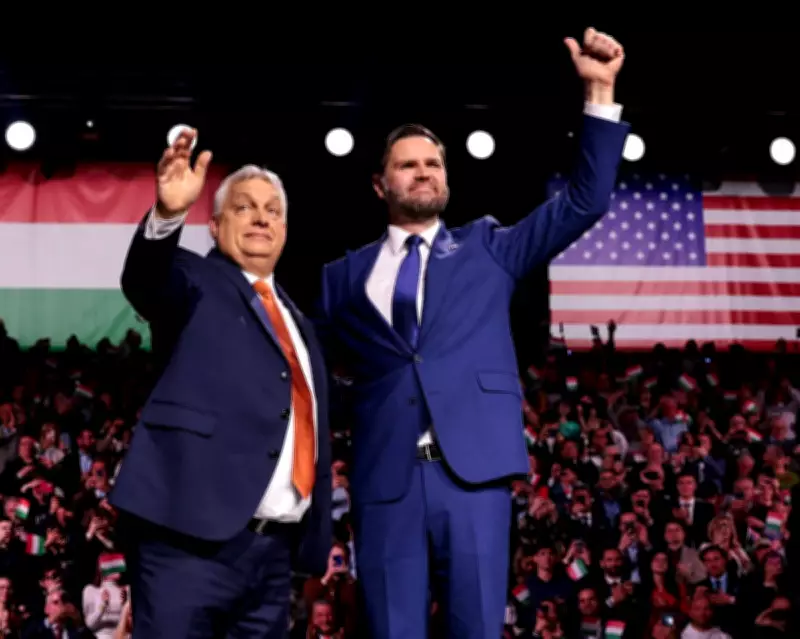
During a whirlwind visit to Budapest, Vance acknowledged the unusual timing of his trip, stating, "It's unprecedented for an American vice-president to come the week before an election." He explained his decision to support Orbán by citing what he described as the "garbage happening against" the Hungarian leader in the campaign. Vance emphasised, "We had to show that there are actually lots of friends across the world who recognise that Viktor and his government are doing a good job and they're important partners for peace."
However, Vance insisted that his efforts to bolster Orbán's lagging campaign do not constitute foreign interference. "I find it darkly ironic that people are accusing me of engaging in some kind of foreign influence," he remarked. Orbán's "illiberal democracy" has long been viewed as an inspiration for the Maga movement in the US, adding a layer of political significance to Vance's involvement.

International Reactions and EU Tensions
The German government swiftly countered Vance's assertions, with a spokesperson rejecting the idea that the European Union is interfering in Hungary's election. The spokesperson pointedly noted that Vance's presence in Hungary "already shows, or speaks for itself, who is interfering in what." While the EU was reluctant to engage publicly, a spokesperson indicated that diplomatic channels would be used to convey concerns to Washington.
Opposition leader Péter Magyar, who is leading in the polls, issued a sharp statement upon Vance's arrival: "No foreign country may interfere in Hungarian elections. This is our country. Hungarian history is not written in Washington, Moscow or Brussels – it is written in Hungary's streets and squares." Magyar, a former insider of Orbán's Fidesz party, has gained traction by accusing the government of rampant corruption, tapping into voter frustration over issues like deteriorating public services, soaring housing prices, and economic stagnation.
Election Stakes and Poll Projections
The election has become deeply polarising, with Orbán framing it as a choice between war and peace, while Magyar focuses on domestic concerns. A projection from the polling agency Median suggests that Tisza could win a two-thirds majority in Hungary's 199-seat parliament. Although accusations of vote-buying and gerrymandering make predictions challenging, a Tisza supermajority would enable constitutional amendments and unlock EU funds.
Vance's involvement appears aligned with Orbán's strategy, as he blamed the EU for Hungary's problems, despite research showing Hungary has received substantial EU funding. Vance also criticised Ukrainian leader Volodymyr Zelenskyy, describing his comments as "completely scandalous" and accusing Kyiv of using energy supplies to influence Hungary. This refers to Zelenskyy's remarks after Orbán vetoed further EU sanctions on Russia and additional loans for Ukraine.
Russian Influence and Territorial Concessions
Vance made no mention of recent scandals revealing Russia's influence over Orbán's government, including allegations of Russian intelligence efforts to sway the election. Leaked audio has captured Hungarian officials, such as Foreign Minister Péter Szijjártó, allegedly sharing confidential EU details with Russia. In one instance, Szijjártó reportedly offered to send documents about Ukraine's EU accession to Russian counterpart Sergei Lavrov.
During his visit, Vance implied that resolving the Russian invasion of Ukraine might require territorial concessions from Kyiv, stating, "We're talking about haggling at this point over a few square kilometres of territory in one direction or another." This stance contrasts with broader EU and US policies supporting Ukraine's sovereignty.

Broader Implications and Criticism
US Senator Jeanne Shaheen highlighted Hungary's increased reliance on Russia since the invasion of Ukraine, with Russia now accounting for 93% of Hungary's crude oil imports. Shaheen noted, "Orbán has repeatedly hampered Europe's ability to defend against Russian aggression while providing billions in energy payments to boost Putin's war chest." This reliance underscores the complex geopolitical dynamics at play as Vance rallies behind Orbán in a contentious election cycle.