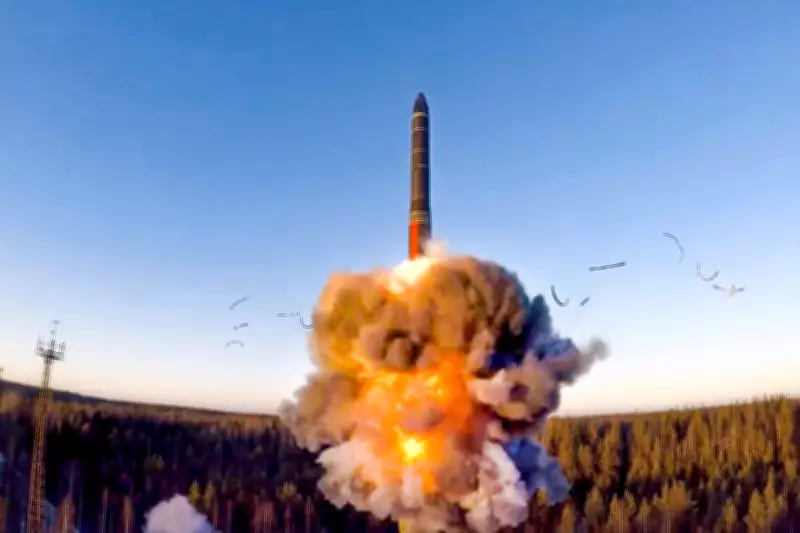
The final remaining nuclear arms control pact between the United States and Russia has officially expired, marking a pivotal moment in global security. The termination of the New START Treaty on Thursday, 5th February 2026, effectively removes all caps on the world's two largest atomic arsenals for the first time in more than half a century.
Implications of the Treaty's Expiration
This development has sparked significant international concern, with many experts warning it could set the stage for an unconstrained nuclear arms race. The expiration comes after years of diplomatic tensions and failed negotiations between Washington and Moscow.
Background of the New START Treaty
The New START Treaty was originally signed in 2010 by then-US President Barack Obama and Russian President Dmitry Medvedev. The agreement restricted each nation to no more than 1,550 deployed nuclear warheads on a maximum of 700 missiles and bombers. It was designed to be verifiable through comprehensive on-site inspections, although these inspections ceased in 2020 due to the COVID-19 pandemic and never resumed.

The treaty was initially set to expire in 2021 but received a five-year extension, bringing us to the current expiration date. This extension was intended to provide time for negotiating a successor agreement, but those discussions have ultimately proven unsuccessful.
Recent Developments and Diplomatic Stances
Russian President Vladimir Putin had previously expressed willingness to adhere to the treaty's limits for an additional year if the United States would reciprocate. However, US President Donald Trump has remained noncommittal about extending the agreement, creating a diplomatic stalemate.
In a significant diplomatic move, Putin discussed the treaty's impending expiration with Chinese leader Xi Jinping on Wednesday, according to Kremlin adviser Yuri Ushakov. Ushakov noted that Washington has not responded to Russia's proposed extension, stating that Russia "will act in a balanced and responsible manner based on thorough analysis of the security situation."
Russia's Official Position
The Russian Foreign Ministry issued a statement on Wednesday night clarifying their position: "Under the current circumstances, we assume that the parties to the New START Treaty are no longer bound by any obligations or symmetrical declarations within the context of the Treaty, including its core provisions, and are fundamentally free to choose their next steps."
This formal declaration underscores the complete dissolution of the treaty's binding framework and leaves both nations free to pursue independent nuclear policies without the constraints that have governed their arsenals for decades.
Historical Context and Previous Suspensions
The New START Treaty represented the culmination of a long succession of US-Russian nuclear arms reduction agreements, all of which have now been terminated. In February 2023, Putin suspended Moscow's participation in the treaty, citing concerns about allowing US inspections of Russian nuclear sites while Washington and its NATO allies were openly pursuing Russia's defeat in Ukraine.
Despite this suspension, the Kremlin emphasized at the time that Russia was not withdrawing from the pact entirely and pledged to continue respecting its nuclear weapons caps. This position has now changed with the treaty's formal expiration.
Putin's Warnings and Future Concerns
In September, Putin warned that allowing the New START Treaty to expire would be destabilizing and could potentially fuel nuclear proliferation. He offered to abide by the treaty's limits for one year to provide both sides with additional time to negotiate a successor agreement, but this proposal did not lead to renewed negotiations.
The expiration of this landmark treaty represents a significant shift in global nuclear dynamics and raises serious questions about the future of arms control between the world's two largest nuclear powers. Without the framework provided by New START, the international community faces increased uncertainty regarding nuclear transparency, verification, and strategic stability.