US Diplomatic Missions Worldwide Placed on High Alert Amid Escalating Iran Tensions
The United States has issued a sweeping directive placing every one of its embassies and diplomatic posts on high alert across the globe. Secretary of State Marco Rubio ordered an immediate worldwide security review on Tuesday, driven by escalating fears of Iranian retaliation tied directly to the ongoing war in the Middle East.
Unprecedented Global Security Directive
In a rare and comprehensive cable sent to all diplomatic missions and reviewed by The Washington Post, the State Department instructed that 'ALL posts worldwide' must urgently reassess their security posture. This directive marks a significant escalation, underscoring the grave concern that the regional conflict could spill over far beyond its traditional boundaries.
The cable explicitly warned of 'the ongoing and developing situation in the Middle East and the potential for spill-over effects,' signaling a stark shift in the US assessment. Officials now perceive the threat as genuinely global, rather than confined to known hotspots in the region.
Emergency Protocols Activated Worldwide
Signed by Secretary Rubio and issued under the authority of Undersecretary for Management Jason Evans, the order mandates every US diplomatic mission to convene its Emergency Action Committee without delay. These specialized teams are tasked with identifying emerging threats, coordinating rapid response plans, and preparing for worst-case scenarios to protect personnel and facilities.
Furthermore, the directive reinforces the department's 'no double standards' policy. This requires diplomatic posts to share any credible threat information with American citizens abroad, ensuring that warnings provided to embassy staff are communicated transparently to the public.
A Pattern of Attacks and Global Reverberations
While heightened alerts have been common in the Middle East in recent weeks, Tuesday's order represents the first instance in the current crisis where all US diplomatic posts worldwide have been instructed to simultaneously review their defenses. This global escalation follows a sustained pattern of attacks.
Since the commencement of the US-Israeli bombing campaign on February 28, Iran and its proxy militia groups have targeted American diplomatic sites across the Middle East. These attacks have forced temporary closures and evacuations in several countries. One internal State Department assessment reviewed by the Post indicates that Iranian-backed groups have carried out 292 attacks on US facilities since that date, describing the threat to American personnel as 'persistent.'
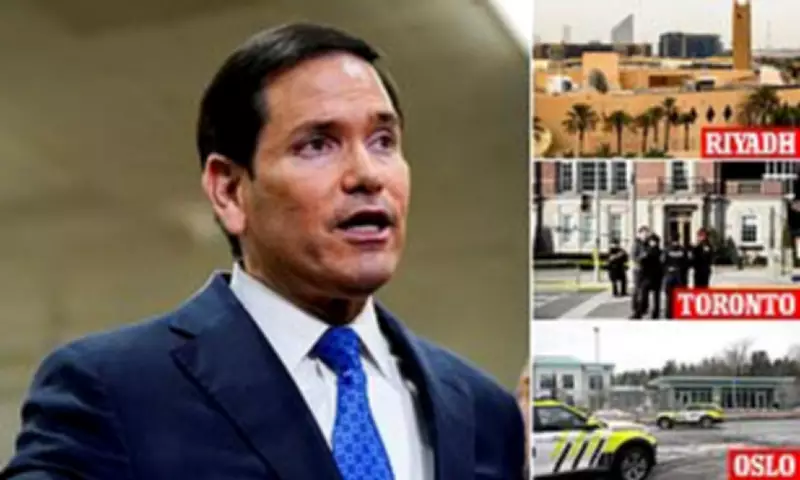
The damage has been severe in some locations. At the US Embassy in Riyadh, Saudi Arabia, a drone strike earlier this month left sections of the compound partially 'unrecoverable,' with collapsed roofing and areas contaminated by smoke, according to internal damage assessments.
Threats Extend Beyond the Middle East
Alarmingly, the threats are no longer confined to the Middle East region, demonstrating the conflict's far-reaching repercussions. Recent security incidents have included reported gunfire outside the US Consulate in Toronto and an explosion near the US Embassy in Oslo. These events serve as stark reminders that geopolitical tensions are reverberating globally.
In some instances, the situation has grown even more direct and alarming. Reports indicate that groups of armed men have approached private residences seeking information about US citizens. In a separate, highly concerning incident over the weekend, an apartment building housing US diplomatic personnel in Israel was struck by what was described as an 'intercepted, unexploded Iranian ballistic warhead.' Although no injuries were reported, officials stressed the episode highlighted the critical, life-or-death importance of seeking immediate shelter when alarms are activated.
Motivation Behind the Global Alert
Despite the all-encompassing nature of this global security alert, it remains unclear whether specific, new intelligence directly triggered the move. Alternatively, the decision may reflect mounting concern over a steadily deteriorating and unpredictable international security landscape. The directive from Secretary Rubio represents a proactive, precautionary measure in the face of an increasingly volatile and interconnected global threat environment linked to the Middle East conflict.