Ukrainian Alarm Over Greenland Crisis as Distraction from War
In the Benedikt cafe in the historic port city of Odesa, a striking wooden map dominates one wall, with Greenland positioned prominently at its apex. The waiter, while not closely following recent developments regarding Donald Trump's ambitions for the Danish territory, immediately recognises disturbing parallels with Vladimir Putin's imperial land grab in his own country. "They're crazy. The pair of them," he remarks, capturing a sentiment shared by many Ukrainians observing the unfolding Greenland crisis from a nation still under relentless Russian attack.
Three Fundamental Problems Identified
Oleksandr Merezhko, chair of the Ukrainian parliament's foreign policy committee and an international law expert, outlines three core concerns regarding the Greenland situation. "Firstly, it represents a dangerous distraction from our current reality," he explains. "Any diversion among our European partners inevitably weakens the coalition supporting Ukraine, undermines NATO cohesion, and erodes transatlantic solidarity."
The second issue revolves around how Trump's demands challenge the post-World War II international rules-based order. "As an international lawyer, I maintain that territorial integrity remains sacrosanct," Merezhko emphasises. "We firmly support Denmark's territorial sovereignty. My fear is that the Greenland issue plays directly into Putin's vision of dividing the world into spheres of influence."

Direct Threat to Ukraine's Defence
Leo Litra of the New Europe Center articulated serious concerns in Ukrainska Pravda this week, writing that "US actions regarding Greenland effectively legitimise aggressive territorial claims by stronger states against their neighbours." He continued: "This precisely mirrors the logic underpinning Russia's aggression against Ukraine. Policies of this nature have faced unequivocal condemnation until now."
Litra warned that developments surrounding Greenland "pose a direct threat to Ukraine's defence in its war against Russia" and force "a fundamental reassessment of Europe's entire security architecture, as well as its relationship with its principal ally, the United States."
Kremlin's Calculated Response
The crisis has not gone unnoticed in Moscow, where Kremlin officials have offered carefully calibrated responses. Spokesperson Dmitry Peskov remarked on Monday that "regardless of whether it's good or bad and whether it complies with international law or not, there are international experts who believe that if Trump takes control of Greenland he will go down in history." He added, "Without discussing whether it's good or bad, it's hard not to agree with these experts."
On Tuesday, Russian Foreign Minister Sergei Lavrov echoed arguments Moscow has used to justify its illegal invasion of Ukraine, stating regarding Greenland that "in principle, Greenland isn't a natural part of Denmark." Russian-controlled bot networks have reportedly amplified Kremlin disinformation about Ukraine through the Greenland prism, including circulating a fabricated video falsely claiming President Volodymyr Zelenskyy supported sending Ukrainian troops to defend the Arctic territory.
European Exhaustion and Waning Attention
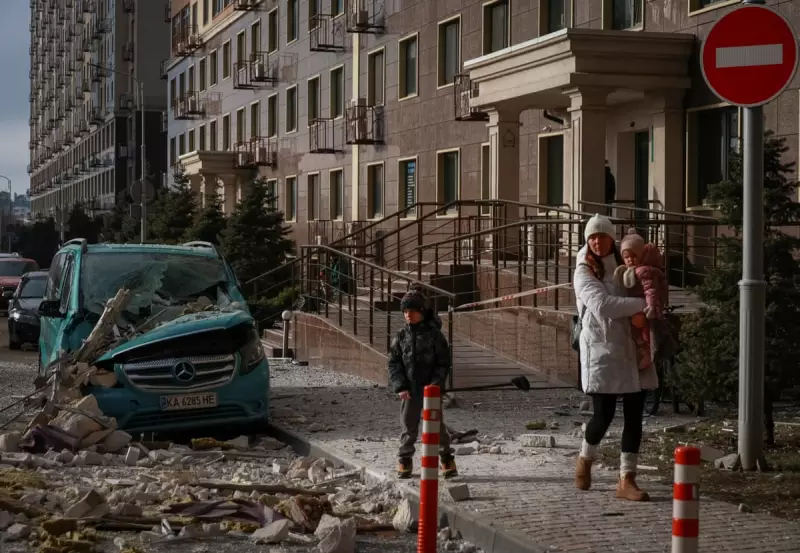
For ordinary Ukrainians enduring Russian airstrikes, freezing temperatures, and power cuts, the Greenland crisis highlights another pressing concern: a perceived European exhaustion with the conflict and a dangerous decline in sustained attention. Speaking at the World Economic Forum in Davos, President Zelenskyy characterised the Greenland situation as emblematic of "a dithering and divided Europe buffeted by more powerful forces."
"Just last year, here in Davos, I ended my speech with the words 'Europe needs to know how to defend itself,'" Zelenskyy recalled. "A year has passed, and nothing has changed. Europe remains in Greenland mode: maybe someone somewhere will do something."

War Fatigue in the Information Age
Oleksii Striapko, an IT specialist in Kharkiv, expressed a nuanced perspective on European engagement. "As a Ukrainian who has been living in a state of war for four years now, I feel not so much Europe's indifference as its war fatigue," he observed. "When new crises arise, such as those in the Middle East, tensions in the Arctic, or Trump's statements about NATO and Greenland, the media and politicians naturally switch their focus."
Striapko continued: "The information space cannot withstand constant concentration on one conflict for years. Trump's statements undermine the sense of stability. Europe is increasingly thinking not only about Ukraine, but also about its own security without the guaranteed support of the US. The world has entered a phase of parallel conflicts."
Potential Silver Linings Amidst Uncertainty
Some Ukrainian observers adopt a more sanguine outlook. Bohdan Honcharenko, an entrepreneur based in Kyiv, suggested that "the challenges with Greenland are not something to be afraid of, because military intervention is impossible without the approval of the US Congress." He characterised Trump's statements as "just attacks on Europe" rather than imminent threats.
Both Honcharenko and Merezhko identified a potential "silver lining" in the crisis: it might persuade European nations to take greater responsibility for continental security, particularly regarding Ukraine and the persistent Russian threat. "We're strong in technology, drone security, modern combat tactics and other military aspects," Honcharenko noted. "Therefore, the consolidation of Europe around Ukraine will strengthen, and accordingly, our support will grow. So panic is unnecessary."
As the Greenland crisis continues to unfold alongside Ukraine's ongoing defensive war, these perspectives from Odesa, Kharkiv, and Kyiv reveal a nation acutely aware of geopolitical parallels, deeply concerned about waning international attention, yet cautiously hopeful about potential European security realignments that could ultimately strengthen their position against Russian aggression.