Trump's Inconsistent Gulf Demands Test Allied Resolve
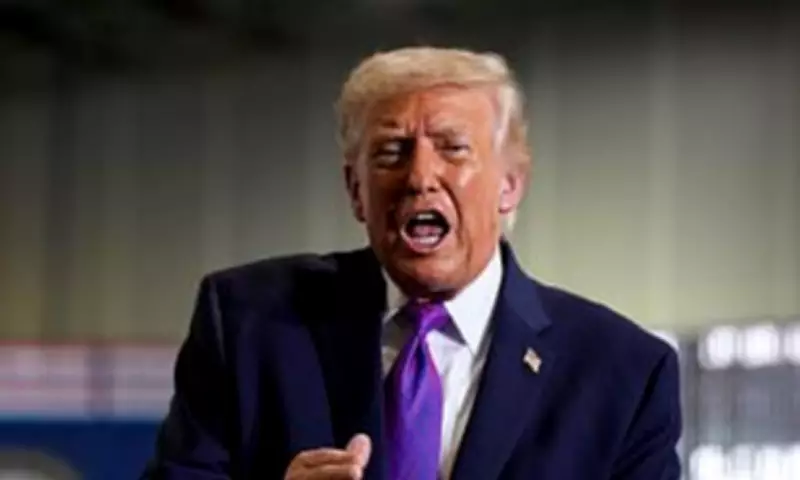
Donald Trump, never a president known for consistency in foreign policy, has emerged as the ultimate flip-flopper on international security matters. Despite recently asserting that the United States has 'already destroyed 100 per cent of Iran's military capability,' he abruptly called this weekend for America's allies to bolster the U.S. Navy in the Gulf to keep the strategically vital Strait of Hormuz open to supertankers.
Britain's Tepid Response and Global Caution
Within hours of Trump's appeal, Energy Secretary Ed Miliband responded with notable hesitation. He tepidly informed the BBC's Laura Kuenssberg that Britain would 'consider' sending both naval ships and mine-hunting drones to help maintain access through the critical maritime bottleneck. The reaction from other key allies—including Japan, South Korea, and France—has been even more circumspect. These nations have acknowledged Trump's plea for assistance but have merely pledged to 'monitor' the situation, stopping short of committing any vessels.
The British Government is undoubtedly concerned, hence the potential deployment of drones to the region, as oil prices surge and the UK's negligible gas reserves continue to dwindle. This cautious approach contrasts sharply with Trump's dismissive attitude just a week earlier, when he sneered at Britain for preparing to deploy HMS Dragon to the Mediterranean as a safeguard for British troops in Cyprus against potential attacks from Iran and Hezbollah. 'It's a little bit late to be sending ships, right?' he scoffed at the time.
Trump's Long-Standing Ambitions and Military Realities
Apparently, timing is relative. Trump now appears to recognise that the U.S. Navy alone may be insufficient to ensure 'the Hormuz Strait OPEN, SAFE and FREE!' as he proclaimed on his Truth Social platform. Seizing control of Kharg Island—home to a major Iranian oil terminal considered the country's economic lifeline north of the Strait—has long been a dream for Trump. In 1988, in one of his earliest public political statements, he warned, 'I'd be harsh on Iran.' Since the 1979-81 hostage crisis, which humiliated the U.S., Trump has consistently expressed fury toward Iran's leadership.
'One bullet shot at one of our men or ships and I'd do a number on Kharg Island. I'd go in and take it,' he bragged in 1988. 'Iran can't even beat Iraq, yet they push the United States around. It'd be good for the world to take them on.' However, Kharg Island is precisely why previous U.S. administrations have avoided direct confrontation with Iran. The island sits in deep waters, allowing 200,000-ton oil tankers to dock and load oil pumped through extensive pipelines from the mainland.
The Drone Threat and Strategic Vulnerabilities
Nearly four decades ago, President Ronald Reagan commanded a far larger navy. Today, the situation for U.S. forces is even more precarious, largely due to Tehran's formidable arsenal of suicide drones. While the U.S. and Israel have significantly degraded Iran's air defences, nuclear facilities, and ballistic missile production, its drones can be assembled cheaply and almost anywhere. Larger explosive-laden models might be constructed in a domestic garage, while smaller ones capable of carrying grenade clusters could be assembled in a kitchen.
Iran potentially operates numerous clandestine bomb factories, with components sourced internally or imported from China via Pakistan. Drone operators and artillery units hide in the Zagros mountains overlooking the Strait, turning shipping lanes below into potential shooting galleries. This presents a formidable obstacle to any U.S.-led effort, with or without allies, to secure safe passage into the Gulf.
Economic and Military Complications
Another unresolved issue is Iran's capacity to halt its own oil supply if U.S. forces were to occupy Kharg Island. Although a significant American bombardment might disable the island's defences while sparing its storage infrastructure, Iran is under no obligation to maintain oil flow through pipelines from the mainland. Currently, oil exports from Kharg transit the Strait into the Indian Ocean, destined for markets like India and China. If the U.S. seized Kharg, Iran would likely shut off the taps despite short-term economic pain, exacerbating global oil shocks—an outcome Trump desperately seeks to avoid.
If Britain were to offer assistance beyond drones, it could theoretically deploy six ships and two submarines, but this would dangerously deplete its Atlantic defences. The Royal Navy's limited numbers leave it particularly vulnerable to kamikaze drones and torpedo speedboats in the Gulf's hazardous waters.
Allied Skepticism and Diplomatic Alternatives
Donald Trump's international call to arms demands much from allies, many of whom have faced his swingeing tariffs and scornful remarks about their military capabilities and sacrifices. Moreover, his equivocal stance toward Russia and Ukraine fails to inspire confidence among European powers that he would risk U.S. ships to support allies if conflicts escalate. It might be more pragmatic for nations to negotiate directly with Iran—as France, Italy, China, and India appear to have done—to secure safe passage for their vessels through the Strait.
Trump may discover that 'doing a number on Kharg Island' is one challenge, but defeating Iran in the complex theatre of the Gulf is an entirely different proposition. Mark Almond, director of the Crisis Research Institute in Oxford, underscores the precarious nature of these geopolitical manoeuvres.