Trump's 'Disappointment' in UK Over Iran War Backfires Spectacularly
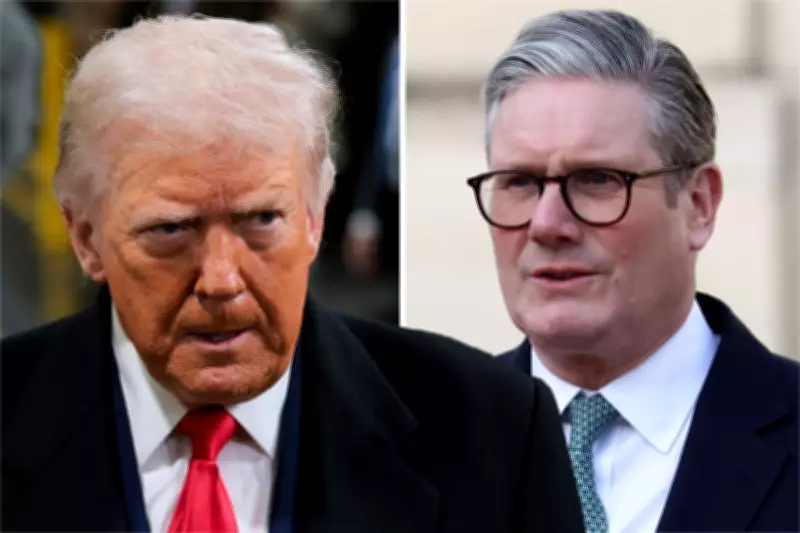
Donald Trump has declared he is "very disappointed" by Prime Minister Keir Starmer's hesitation in granting the United States access to British military bases for operations against Iran. In a striking retort, Simon Walters highlights that this sentiment is profoundly mutual, with millions across Britain expressing deep disappointment in the president himself.
A Near Impossible Position for Starmer
Regardless of political allegiance, observers recognise that Starmer was placed in a near impossible situation when Trump demanded UK support for his initial assault on Iran. The prime minister's subsequent shift in stance, aimed at safeguarding British citizens vulnerable to Iranian retaliation in the Gulf, is widely viewed as a necessary and pragmatic move.
Trump's criticism is further undermined by his recent imposition of crippling tariffs on UK imports, a decision driven by pique over a US Supreme Court ruling. This act of hypocrisy compounds the president's frequent factual inaccuracies, as noted by commentators.

Historical Amnesia and Flawed Comparisons
In an interview with The Daily Telegraph, Trump asserted that Starmer's actions were unprecedented in the history of UK-US relations. This claim overlooks critical historical precedents:
- The United States refrained from supporting Britain in World War II until the Japanese attack on Pearl Harbor in 1941.
- Labour Prime Minister Harold Wilson rejected American requests to deploy British troops during the Vietnam War in the 1960s, a decision supported by voters and vindicated by history.
Thus, it is not Starmer who has disappointed the public regarding Iran; rather, the disappointment lies squarely with Trump for a litany of failures and contradictions.
A Catalogue of Disappointments
The president's actions have sparked widespread concern and criticism for numerous reasons:
- Failing to learn from the Iraq War, where bungled US intervention led to regional disaster.
- Not consulting Britain, a loyal ally, prior to attacking Iran.
- Omitting congressional approval for the attack, contravening the US Constitution.
- Not foreseeing civilian casualties among Iranians, Americans, Britons, and others.
- Displaying glaring contradictions with his past criticism of Barack Obama over Iran.
- Executing a major U-turn by establishing a 'Board of Peace' only to launch a war weeks later.
- Mocking his Nobel peace prize aspirations through aggressive actions.
- Showing double standards by targeting Ayatollah Khamenei while cosying up to Vladimir Putin.
- Lacking a practical endgame for the war or consideration for Iranian freedom hopes.
- Risking Iranian instability akin to the post-2003 Iraq chaos, with ongoing global repercussions.
- Encouraging nuclear proliferation by rogue states like North Korea seeking deterrence.
- Showing contempt for NATO and the UN, undermining international alliances.
- Reinforcing global perceptions of the US as a bully flouting rules for self-interest.
- Fueling claims that war distracts from economic failures, electoral challenges, and scandals like Epstein.
In summary, Trump's expression of disappointment has ignited a powerful counter-narrative, highlighting his own missteps and the resilient complexity of UK-US relations.