Trump's Board of Peace Inaugural Meeting Opens Amid European Boycott
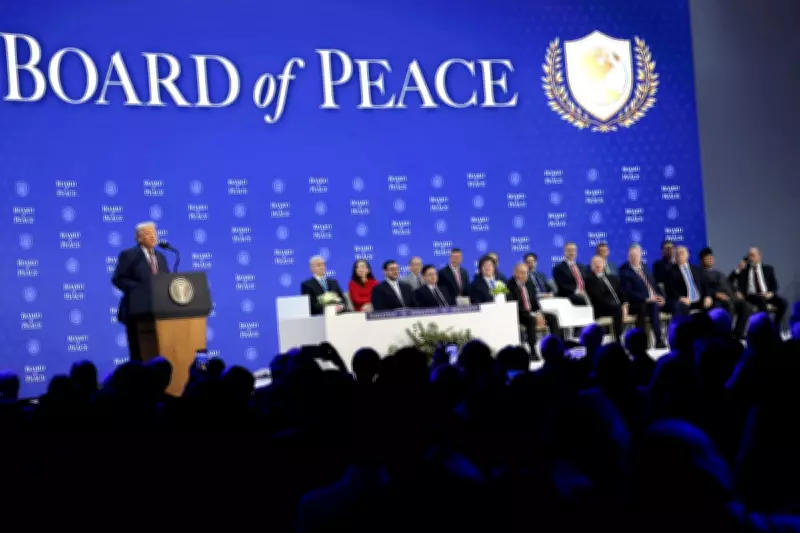
Dozens of world leaders and national delegations are set to convene in Washington DC for the first meeting of Donald Trump's Board of Peace, an initiative launched at the World Economic Forum in Davos, Switzerland, on 22 January. However, the summit faces significant challenges as key European allies, including the United Kingdom, Germany, and France, have declined to participate, citing concerns over the organization's opaque funding and political objectives.
Fundraising Focus and Gaza Reconstruction Pledges
The White House has indicated that the event at the renamed Donald J Trump Institute of Peace will primarily function as a fundraising effort. Trump announced on social media that member states have pledged over $5 billion towards rebuilding Gaza, which has been devastated by the war with Israel and remains in a severe humanitarian crisis. Additionally, the US president claimed that countries have committed thousands of personnel to an International Stabilization Force and Local Police to maintain security in the region.
Originally formed with Gaza reconstruction as its primary goal, the board's mandate has since been expanded by Trump to address other global conflicts. Despite this, expectations for the meeting are low, both in Washington and the Middle East, where a 100-day peace and recovery plan announced by Jared Kushner in Davos has stalled, and aid into Gaza continues to trickle in at minimal levels.

Expert Criticism and Diplomatic Concerns
Aaron David Miller, a senior fellow at the Carnegie Endowment for International Peace and former US diplomat, expressed skepticism about the board's ability to resolve core issues in the Israel-Gaza conflict. He highlighted key unanswered questions, such as who will govern Gaza, provide security, and address the immediate needs of Palestinians. Miller noted that the board appears to be a tool for projecting activity rather than achieving substantive diplomatic progress, stating, "Pledges are one thing, delivering is another."
The initiative has also faced criticism from international figures. Ursula von der Leyen, President of the European Commission, has declined her invitation, and Pope Leo XIV announced that the Vatican will not join, citing concerns that the board could undermine the United Nations' role in managing global crises. Cardinal Pietro Parolin, the Vatican's top diplomat, emphasized the importance of UN leadership in such situations.
Attendees and Political Motivations
The meeting will be attended primarily by Middle Eastern delegations, including representatives from Israel, the United Arab Emirates, Saudi Arabia, Turkey, Jordan, and Qatar, along with countries like Argentina, Paraguay, Hungary, and Kazakhstan, which have little direct involvement in the Gaza conflict. Many are perceived as seeking favor with the Trump administration by participating, especially as the board offers a permanent seat for a $1 billion donation, potentially propping up Trump's signature initiative.
Max Rodenbeck, Israel/Palestine project director for the International Crisis Group, warned that the board faces huge global skepticism and must deliver tangible improvements quickly to maintain credibility. He noted, "If this meeting does not result in fast, tangible improvements on the ground – and particularly on the humanitarian front – its credibility will quickly crumble."
Challenges on the Ground and Implementation Hurdles
On the ground, progress has been minimal. Nearly a month after Kushner unveiled the peace plan, those tasked with its implementation remain unclear about their roles and resources. Fifteen members of the National Committee for the Administration of Gaza (NCAG) are stranded in Cairo, unable to act due to a lack of authority and tools. In a social media post, the NCAG expressed frustration, insisting it cannot be expected to carry responsibility without full administrative, civilian, and police powers.
Gershon Baskin, an Israeli peace activist involved in the negotiations, described the situation as "everything is going slower than expected, and everyone is very frustrated." He added that the NCAG lacks clarity on its budget, tasks, and authority, making a move to Gaza unconstructive at this stage.

Security and Humanitarian Obstacles
Efforts to establish an International Stabilization Force (ISF) have seen limited progress, with Indonesia offering 8,000 troops but no deployment yet. Diplomats in Jerusalem worry that the ISF plan will fail without conditions like Hamas disarmament and IDF withdrawal. Aid into Gaza remains severely restricted, with bans on dual-use items like metal tent poles hindering reconstruction. Sam Rose, acting Gaza director of UNRWA, noted that the conflict management has devolved into an unsustainable pattern, with ongoing violence and displacement.
Israeli Prime Minister Benjamin Netanyahu, who initially supported the board, has chosen to skip the meeting, sending Foreign Minister Gideon Saar instead. This move reflects the political challenges in an election year, as Netanyahu navigates far-right pressures and avoids associations with regional powers linked to Hamas.
Overall, Trump's Board of Peace opens amid deep skepticism, with its success hinging on overcoming diplomatic boycotts, unclear mandates, and urgent humanitarian needs in Gaza.