In his first public remarks since launching military strikes, President Donald Trump declared on Monday that an Iran equipped with nuclear weapons would represent an "intolerable threat" to the United States, using this assertion to defend his decision to initiate large-scale combat operations without Congressional approval.
Trump's Justification for Unilateral Action
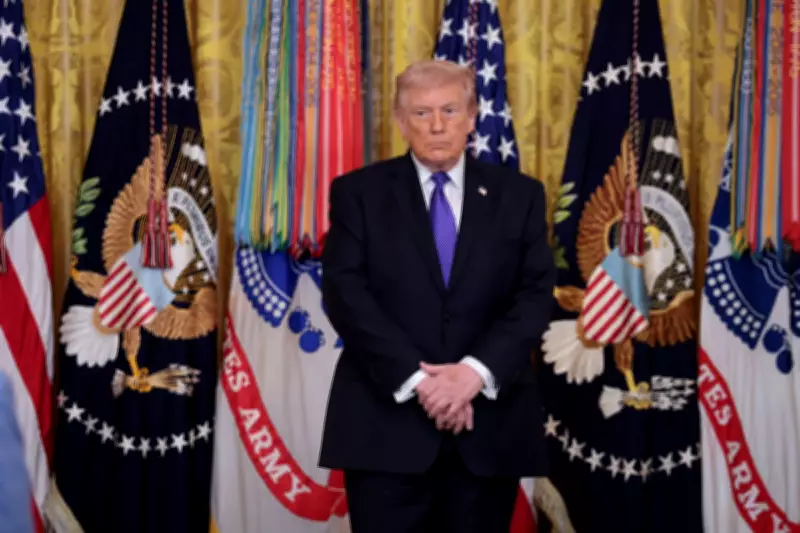
Speaking at a Medal of Honor ceremony at the White House, Trump argued that Iran's advancing ballistic missile program, capable of targeting Europe and U.S. bases, was designed to shield its nuclear weapon development. "The purpose of this fast-growing missile program was to make it extraordinarily difficult for anyone to stop them from making these highly forbidden nuclear weapons," he stated, emphasizing that such capabilities would have posed a "very clear, colossal threat to America."
Escalating Military Operations
The president confirmed that U.S. forces are engaged in "large scale combat operations" in Iran, following a social media announcement early Saturday. In a phone interview with CNN, Trump boasted that American troops are "knocking the c**p" out of Iran and claimed the conflict is "going very well," attributing success to "the greatest military in the world."

Potential for Ground Troops and Political Risks
Trump did not rule out deploying American ground forces to Iran, a move that could provoke Congressional opposition and backlash from his MAGA Republican base, which has supported foreign military actions as long as they avoid boots on foreign soil. "I don't have the yips with respect to boots on the ground — like every president says, 'There will be no boots on the ground.' I don't say it," he told the New York Post, suggesting flexibility in his strategy.
Public Opinion and Polling Data
Despite Trump's confidence, recent Reuters/Ipsos polling reveals limited public support for the strikes. Only 27% of Americans approve of the military action, compared to 43% who disapprove and 29% who are uncertain. Trump, however, insisted to the Post that he "did the right thing" and cited polling as showing backing for his decision, though specifics were not provided.
The president's comments mark a significant escalation in his public rhetoric on the Iran conflict, framing it as a preemptive measure against a nuclear threat. As operations continue, the debate over executive authority and military intervention intensifies, with implications for U.S. foreign policy and domestic politics.