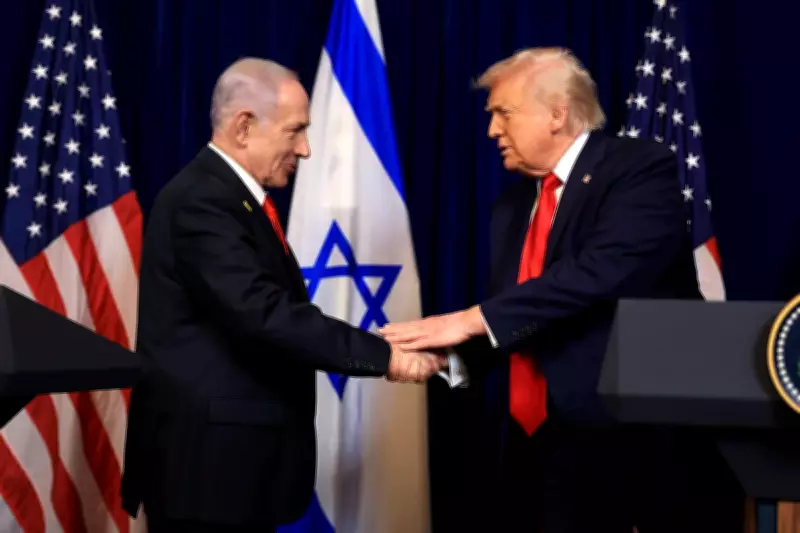
Trump Must Finally Confront Netanyahu as Fragile Ceasefire Buckles
As a fragile ceasefire in the Middle East shows signs of collapsing, Donald Trump is under mounting pressure to demonstrate he can say no to Benjamin Netanyahu. Israel's brutal strikes on Lebanon's capital, Beirut, demand a strong rebuke from the White House if there is to be any realistic chance of securing a peace deal in the volatile region.
Escalating Violence Threatens Peace Prospects
Even with emerging prospects for talks between Israel and Lebanon, this week's US-Iran ceasefire remains what Vice-President JD Vance describes as a fragile truce. Missiles continue to fly across the region, and the vital Strait of Hormuz – now the world's most critical shipping lane – remains effectively closed to most maritime traffic. Israel's aggression against Hezbollah forces in Lebanon, resulting in the loss of innocent lives and destruction of civilian infrastructure in the already weakened Lebanese state, is making the difficult task of securing Gulf peace virtually impossible.
The international community watches in dismay as Israel issues evacuation warnings in Beirut, raising fears of Gaza-level destruction. Reports indicate negotiations between Israel and Lebanon are scheduled to begin next week at the State Department in Washington, coinciding with delegations from the US and Iran arriving in Pakistan for their own diplomatic talks.

Netanyahu's Military Strategy Undermines Diplomacy
However, there will be little chance of finding consensus while Netanyahu's government continues its nihilistic military campaign in Beirut and beyond. Only America possesses the leverage to force Israel to join the ceasefire, but Donald Trump appears as unwilling as ever to exert meaningful pressure on his friend Bibi. Yet President Trump must take action to salvage the chance of peace with Iran, ensure security for crucial US allies in the Gulf states, and give his Republican Party any realistic prospect of retaining control of Congress in the November elections.
It is not difficult to understand why Netanyahu persists in his stubborn approach. He is deliberately prolonging this conflict for the same reasons he initially manoeuvred the Americans into involvement. From Israel's perspective, weakening Iran and its terrorist proxies represents a rational strategic objective. An Iran with nuclear weapons would pose an existential threat to Israel and endanger US interests throughout the region.
The Broader Regional Implications
Netanyahu correctly points to Iran's constant antisemitic rhetoric and the malign intentions of groups like Hamas, Hezbollah, and Yemen's Houthis toward Israel and its citizens. Many in Tehran and those connected to the Islamic Republic genuinely seek to eliminate Israel from the map. Hence, the Netanyahu government remains determined to prevent the ultimate jeopardy of nuclear weapons on long-range missiles – a scenario unacceptable to Israel regardless of defensive systems like Iron Dome.
Yet the continuing war in the Gulf further destabilises the entire region. By attacking Lebanon, Netanyahu believes he weakens Iran and Hezbollah simultaneously. Nevertheless, his preference for direct military action prevents broader peace efforts. Any potential deal would likely include agreements favourable to Israel, such as Iran renouncing stockpiles of enriched uranium. This was precisely what Oman brokered between the US and Iran before Netanyahu persuaded Trump that war and rapid regime change in Tehran represented a faster path to shared objectives.
Political Realities Demand Diplomatic Solutions
Whatever merits that argument once held have become irrelevant. Regime change has not occurred spontaneously, as some Trump advisers privately warned, and the Islamic Republic emerges stronger and potentially richer despite conventional force losses. There has never been a purely military solution to Middle East tensions, including the Palestine-Israel question. This reality necessitates a ceasefire, an end to Israel's campaign in Lebanon, and addressing illegal West Bank settlements.

Left to his own instincts, President Trump would likely deploy vast US resources toward vanquishing Iran, perhaps even implementing his favourite threat of bombing it back to the Stone Age. Fortunately, he lacks absolute monarchical power and cannot follow these appalling instincts untrammelled. Having gambled and lost in Iran, he must now extricate himself before further economic and electoral damage occurs, and before impeachment possibilities become uncomfortably real.
Trump has admitted as much publicly. While Netanyahu remains determined, and Trump sympathises with his objectives, political survival after the midterm elections must take precedence. For once, the American president will need to say no to Bibi. Lebanon has suffered enough devastation, and the fragile ceasefire demands decisive American leadership to prevent complete collapse.