NATO Chief Reveals Trump's 'Disappointment' Over Allies' Iran War Stance
NATO Secretary General Mark Rutte has disclosed that Donald Trump was "clearly disappointed" by the refusal of United States allies to participate in military action against Iran. This revelation followed a private meeting between the two leaders in Washington on Wednesday, which occurred at a particularly delicate diplomatic moment.
'Very Frank' Discussions Between 'Two Good Friends'
Speaking exclusively to CNN after their closed-door conversation, Rutte characterized the exchange as "very frank, very open" discussions between what he described as "two good friends." While the NATO chief declined to confirm whether Trump specifically reiterated his threat to withdraw from the alliance over the Iran conflict, he acknowledged that the American president clearly expressed his views about recent developments.
"He clearly told me what he thought of what happened over the last couple of weeks," Rutte stated during the interview, adding that the situation presented "a nuanced picture." The meeting took place less than twenty-four hours after the United States and Iran agreed to a fragile two-week ceasefire arrangement that includes opening the strategically vital Strait of Hormuz.

Trump's Escalating NATO Criticism
Prior to the Washington summit, Trump had intensified his criticism of the seventy-seven-year-old military alliance, labeling NATO a "paper tiger" and suggesting the United States might consider departure after member nations ignored his call for military assistance to help reopen the critical waterway. The closure of the Strait of Hormuz has triggered significant increases in global oil prices, creating economic pressures worldwide.
In a characteristically blunt post on his Truth Social platform following the meeting, Trump wrote: "NATO WASN'T THERE WHEN WE NEEDED THEM, AND THEY WON'T BE THERE IF WE NEED THEM AGAIN. REMEMBER GREENLAND, THAT BIG, POORLY RUN, PIECE OF ICE!!!" This reference to Greenland connects to Trump's earlier frustrations with NATO opposition to his desired acquisition of the territory from Denmark.
Legal and Political Constraints on NATO Withdrawal
The discussion occurs against a backdrop of legal constraints that complicate any potential US withdrawal from NATO. Congress passed legislation in 2023 that prevents any American president from unilaterally pulling out of the alliance without congressional approval. This law was championed by Marco Rubio, who currently serves as Trump's secretary of state but was a Florida senator at the time of the legislation's passage.
White House press secretary Karoline Leavitt acknowledged earlier on Wednesday that Trump had indeed discussed leaving NATO, noting that "it's something the president will be discussing in a couple of hours with Secretary General Rutte." Despite these discussions, the legal framework presents significant obstacles to any immediate withdrawal action.
Alliance Tensions and International Diplomacy
The NATO alliance has experienced considerable strain over the past year as Trump has reduced American military support for Ukraine in its conflict with Russia while simultaneously threatening to seize Greenland from Denmark. These tensions intensified significantly following the outbreak of hostilities with Iran at the end of February.
Trump has repeatedly emphasized that securing the Strait of Hormuz should not be primarily America's responsibility but rather that of nations dependent on the uninterrupted flow of oil through the critical passageway. "Go to the strait and just take it," Trump declared last week, highlighting his expectation for greater allied participation.
Additional friction emerged when NATO allies including Spain and France either forbade or restricted American use of their airspace and joint military facilities during the Iran conflict. These nations have, however, committed to participating in an international coalition to reopen the Strait of Hormuz once hostilities conclude.

Congressional Support and International Coordination
Republican Senator Mitch McConnell issued a statement supporting the alliance before the Trump-Rutte meeting, emphasizing NATO's historical significance. "Following the September 11 attacks, NATO allies sent their young servicemembers to fight and die alongside America's own in Afghanistan and Iraq," McConnell noted. The senator, who serves on a committee overseeing defense spending, urged Trump to maintain clarity and consistency in his approach to international alliances.
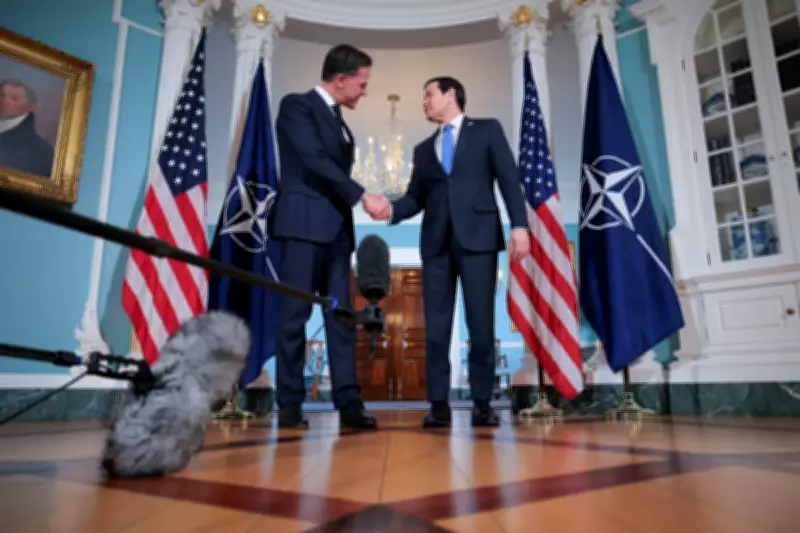
Separately, Secretary of State Marco Rubio met with Rutte at the State Department on Wednesday morning. According to an official statement, their discussions covered multiple critical issues including the Iran conflict, American efforts to negotiate an end to the Russia-Ukraine war, and increasing coordination with NATO allies.
British Prime Minister Keir Starmer, who has been a particular source of frustration for Trump, is scheduled to travel to the Gulf region to support the ceasefire agreement. The United Kingdom has been actively developing a comprehensive post-conflict security plan for the Strait of Hormuz, recognizing its vital importance to global energy markets.
The fundamental commitment binding all thirty-two NATO member nations remains the mutual defense agreement stipulating that an attack against one member constitutes an attack against all. This principle has only been invoked once in the alliance's history—following the September 11, 2001 terrorist attacks against the United States.