Prime Minister Keir Starmer Condemns Israeli Military Actions in Lebanon
Prime Minister Sir Keir Starmer has declared Israeli strikes on Lebanon following the announcement of a US-Iran ceasefire as "wrong" and insisted they "should stop." The Labour leader made these remarks during a diplomatic tour of Gulf nations, highlighting growing tensions as the fragile truce shows signs of strain.
Ceasefire Under Pressure as Violence Escalates
Israel's bombardment of Beirut has raised serious concerns about the sustainability of the two-week ceasefire brokered by US President Donald Trump. The attacks on Hezbollah militants resulted in Wednesday becoming the deadliest day in Lebanon since the conflict began, with disputes over whether the country was included in the ceasefire agreement.
In response to the Israeli strikes, Tehran has once again closed the strategically vital Strait of Hormuz, a critical oil shipping channel that handles approximately one-fifth of the world's petroleum exports. This move threatens global energy supplies and demonstrates how quickly regional tensions can escalate.

Starmer's Clear Stance on Principles Over Technicalities
When questioned about whether Israel's actions constituted a breach of the ceasefire, Starmer told ITV's Talking Politics podcast: "We haven't all got access to all the details of the ceasefire. But look, let me be really clear about it – they're wrong."
The Prime Minister elaborated: "That should stop – that's my strong view – and therefore, the question isn't a technical one of whether it's a breach of the agreement or not. The question is actually a matter of principles as far as I am concerned and, in a sense, my argument would be it should be included in a ceasefire."
Starmer emphasised that ships passing through the Strait of Hormuz must maintain "toll-free navigation" as part of any sustainable ceasefire agreement, highlighting the economic dimensions of the conflict.
UK-US Relations and Diplomatic Language
The Prime Minister also addressed his relationship with President Trump, who recently mocked Starmer's refusal to be drawn into the conflict. In a video from a private White House Easter lunch, Trump impersonated the British leader while recounting how he had requested the UK send "two old broken-down aircraft carriers" to the Middle East.
Starmer responded firmly to Trump's rhetoric, which included social media posts ending with "praise be to Allah" and warnings that "a whole civilisation will die" if Tehran failed to meet demands. "Let me be really clear and blunt about this – they're not words I would use or would ever use because I come at this with our British values and principles foremost and uppermost in my mind," Starmer stated.
Monitoring UK Bases and Learning from History
The Prime Minister revealed that the UK is "monitoring" the use of British bases by Washington to ensure they are only being utilised for collective self-defence rather than offensive operations against Iran. "From the get-go we've been monitoring this situation," Starmer explained, "so I'm pretty clear in my own mind about what we've agreed and what the use of the bases are."
He emphasised the importance of learning from historical conflicts: "That is a really important point of principle because we have to learn the lessons of Iraq. We need to be clear where we stand as a country and I'm the British Prime Minister, I make decisions on what's in the British national interest."
Strategic Vision for a Changed World
In a separate article for The Guardian, Starmer wrote that "Iran must now become a line in the sand," arguing that "how we emerge from this crisis will define all of us for a generation." He presented a vision for Britain's future in an increasingly volatile world: "Instead of hoping to return to the world of 2008, we will forge a new path for Britain – one that strengthens our energy, our defence and our economic security in a new age."
The Prime Minister pointed to the government's industrial strategy and child poverty initiatives as examples of "doing things differently – thinking about the long-term, and remaking this country so that Britain is prepared for a world where shocks like this are more frequent."

Regional Diplomacy and Alliance Building
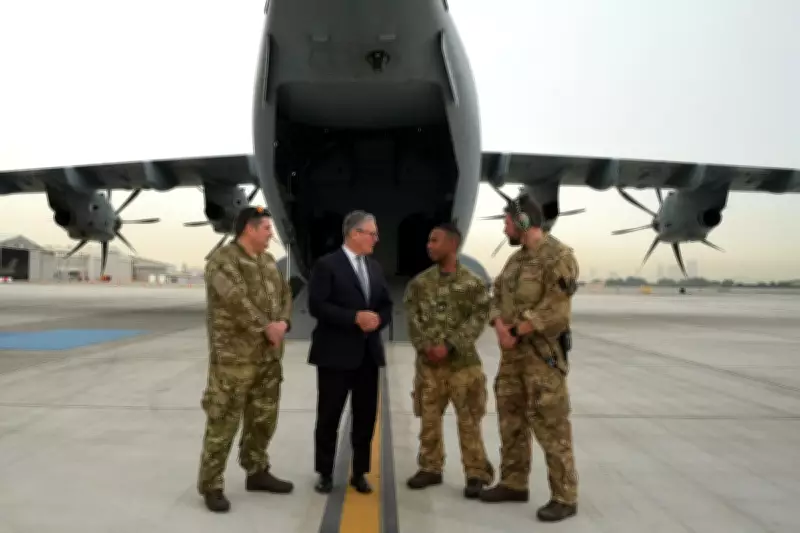
Starmer's Gulf tour included stops in Saudi Arabia, the United Arab Emirates, Bahrain, and Qatar, where he engaged with regional leaders to strengthen diplomatic ties. In Bahrain, he met with King Hamad bin Isa Al Khalifa and Crown Prince Salman bin Hamad Al Khalifa at Al Sakhir palace.
The Crown Prince welcomed Starmer's visit as a "true reflection of friends standing with friends," adding: "You come not only with words but with action." The Prime Minister responded that it was "important to stand with allies," underscoring Britain's commitment to regional partnerships during this period of instability.
As the ceasefire remains precarious and diplomatic tensions continue, Starmer's statements represent a significant intervention in international efforts to de-escalate the conflict while asserting British foreign policy principles in an increasingly complex global landscape.