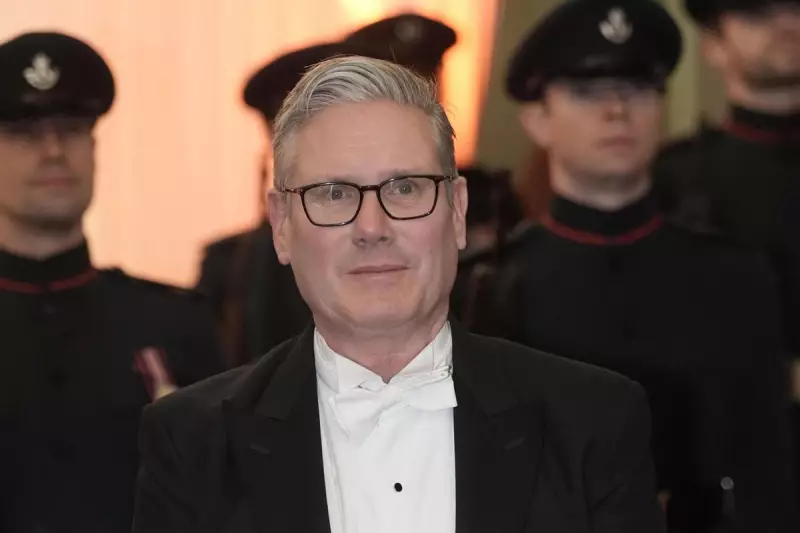
Prime Minister Sir Keir Starmer has declared that Britain must not retreat from a 'chaotic and dangerous' world, using a major speech to champion internationalism and criticise inward-looking political rivals.
A Defence of 'Outward-Facing' Foreign Policy
In his annual Guildhall address on foreign policy, delivered in the City of London on Monday evening, Sir Keir took aim at opposition figures who advocate for the UK to leave institutions like the European Convention on Human Rights (ECHR) or NATO. He accused them of promoting a 'corrosive, inward-looking attitude' that offers 'grievance rather than hope' and a 'declinist vision of a lesser Britain'.
The Prime Minister argued that such an approach is a fatal misreading of the current global moment. 'A world which is more dangerous and unstable than at any point for a generation' requires engagement, not withdrawal, he stated. 'In these times, we deliver for Britain by looking outward with renewed purpose and pride, not by shrinking back,' Sir Keir said. 'In these times, internationalism is patriotism.'
Addressing Brexit and Global Engagement
Sir Keir framed his government's strategy as 'the biggest shift in British foreign policy since Brexit', marking a decisive return to an outward-facing posture. While stating he would 'always respect' the 2016 referendum as a democratic decision, he was critical of its execution. 'Wild promises were made to the British people and not fulfilled. We are still dealing with the consequences today,' he told the audience.
Since taking office last year, the Prime Minister has been active internationally, highlighting deals with the US, India, and the EU, and leading the 'coalition of the willing' in support of Ukraine. He used his speech to defend this record against critics who accuse him of neglecting domestic issues for global summits.
Navigating the Complex China Challenge
A significant portion of the address was devoted to the UK's relationship with China. Sir Keir rejected what he described as a 'binary choice' between the 'golden age' of engagement under David Cameron and a subsequent 'ice age'.
He acknowledged that China poses 'national security threats to the UK', particularly in defence, AI, and critical infrastructure, where protection is 'non-negotiable'. However, he also described China as 'a defining force in technology, trade and global governance', arguing that a failure to engage would be a 'dereliction of duty'.
'We're absolutely clear that when it comes, for example, to defence, AI or our critical national infrastructure, we will always protect our security and our economic interests,' Sir Keir said. 'But we're also clear that in areas where there is no significant risk, we are going to give businesses the confidence, clarity and support they need to win these opportunities.' This stance follows controversy earlier in the year over a collapsed spy trial, which ministers denied was undermined to preserve relations with Beijing.
The speech, delivered on Monday 01 December 2025, firmly sets out the philosophical underpinnings of the Starmer government's foreign policy as it seeks to redefine Britain's role on the world stage post-Brexit.