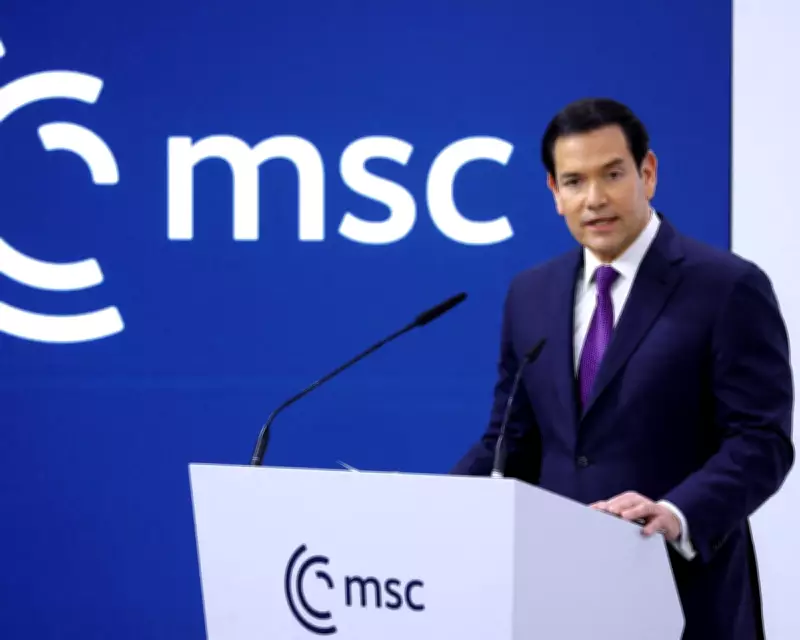
At the Munich Security Conference last weekend, US Secretary of State Marco Rubio delivered a speech that initially offered European leaders a glimmer of hope. His soothing tone marked a stark contrast to the previous year's address by Vice-President JD Vance, which had brutally accused Europe of abandoning fundamental values. The audience, including Germany's defence and foreign ministers alongside dozens of US officials, responded with a standing ovation, relieved to hear something other than outright abuse.
A Surface-Level Conciliation
Rubio played a reassuring tune, declaring that the United States and Europe "belong together." He explained that American directness stemmed from a deep understanding that European and US destinies are forever intertwined, even describing the US as "always a child of Europe." This rhetoric prompted visible relief from MSC president Wolfgang Ischinger and reassurances from European Commission President Ursula von der Leyen and EU chief diplomat Kaja Kallas, who indicated the bloc could work with this approach.
The Underlying MAGA Message
However, upon closer examination, European reactions swiftly changed. Analysts realized that Rubio's conciliatory language masked a message fundamentally aligned with Vance's MAGA ideology. The speech was laden with familiar blood-and-soil obsessions: mass migration, civilisational erasure, the demise of Christian culture, unfettered trade, outsized welfare states, weak militaries, "a climate cult," and worthless international institutions.

The White House summary removed any ambiguity, explicitly listing Trumpian buzzwords like "sovereign nations," "shared heritage," "Christian foundations," "outdated globalist structures," and "defence of western civilisation." Claudia Major of the German Institute for International and Security Affairs succinctly characterized it as "an offer of friendship – but on white, Christian, Maga terms."
Echoes of Far-Right Rhetoric
Rubio elaborated that the US seeks allies "who are proud of their culture and their heritage," friends who see themselves as "heirs to the same great and noble civilisation" and are "able and willing to defend it." Mujtaba Rahman of the Eurasia Group noted this chilling line echoed word-for-word the far-right Alternative for Germany (AfD), highlighting the ideological alignment.
To reinforce Washington's stance, Rubio followed the conference with bilateral visits to what Rahman described as "the two most pro-Putin, anti-Brussels and Trump-loving leaders in the EU": Slovak Prime Minister Robert Fico and Hungarian Prime Minister Viktor Orbán. In Budapest, Rubio hinted at financial support and declared Trump "deeply committed to the success" of Orbán, the EU's disruptor-in-chief facing a power challenge in April's elections.
European Pushback and Diverging Definitions
Analysts interpreted this move as a deliberate affront to the EU, with one telling the Guardian it was guaranteed to reinforce fears that the US seeks to promote chaos and disunity among allies. Historian Phillips O'Brien summarized Rubio's speech as a call for "the end of a tolerant, democratic Europe and its break-up into a disparate group of smaller, Trumpist states," pronouncing the death of the liberal democratic system since 1945.
European leaders demonstrated growing resistance. German Chancellor Friedrich Merz asserted that MAGA's culture war is not Europe's, emphasizing commitments to free trade, climate agreements, and the WHO. French President Emmanuel Macron urged Europe to accelerate becoming a geopolitical power with defence, technologies, and de-risking strategies. Kallas, despite her initial welcome, sharply criticised "fashionable" US "Euro-bashing," insisting that "woke, decadent Europe is not facing civilisational erasure."
Nuclear Deterrence and Strategic Autonomy
Evidence of Europe's newfound "steeliness," as noted by the Guardian's diplomatic editor, emerged in discussions about nuclear deterrence. Macron referenced a "convergence" between French and German strategic defence positions and the possibility of "placing nuclear dissuasion within a wholistic approach to defence and security." Merz and British Prime Minister Keir Starmer also touched on European security interdependence, broaching the contentious topic of reducing reliance on the US nuclear umbrella.

These issues, alongside debates over European digital sovereignty, are set to strain transatlantic ties further. While EU member states continue to squabble—such as Germany pressing France on defence spending—signs indicate Europe is starting to push back. If Vance's speech last year marked the beginning of a transatlantic break-up, this MSC initiated the debate over divorce terms.
Redefining Western Civilisation
As Le Monde editorialized, if the US paints the EU as "a graveyard of ambition, identity and liberty," the bloc can highlight Washington's "climate denialism, abandonment of science, plutocratic drift and authoritarian tendencies." It has become clear that "western civilisation" no longer holds the same definition on either side of the Atlantic, and Europeans have no reason to relinquish their own interpretation. The Munich Security Conference thus underscored a deepening ideological rift, with Rubio's speech serving as a MAGA-litmus test for future transatlantic relations.