Avant-garde theater legend Robert Wilson's final work was a bold reimagining of Melville's classic. His collaborators explain bringing it to the Brooklyn stage.
Not far into Herman Melville's 1851 epic novel Moby-Dick, a shipowner describes the man who will take their whaler on a tragic quest. Captain Ahab, he says, is 'a queer man … a grand, ungodly, godlike man'. The same might be said of Robert Wilson.
By the time he died last July at the age of 83, Wilson had transformed himself from a stuttering, gay son of conservative southern Baptist parents in Waco, Texas, into New York City's titan of experimental theatre, opera and dance. His shows could be hours long, or even a full week. They could demand an audience to watch a performer walk with astonishing slowness across a stage, or dazzle them with rows of figures striking flamboyant poses before bright screens. Wilson collaborated with his own adopted children, with corps of performers he wrangled himself, with luminaries including Philip Glass and Tom Waits. Early on, he developed an instantly recognizable visual vocabulary, and insisted on using it until the very end.

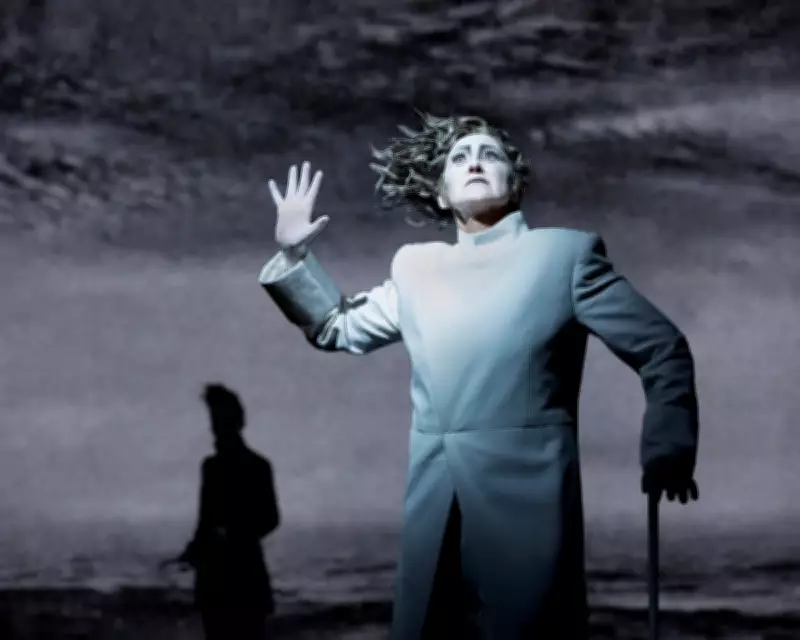
He launched many of these theatrical explorations from the Brooklyn Academy of Music (Bam), from 1970's almost-silent play The Life and Times of Sigmund Freud to 2016's Letter to a Man, starring Mikhail Baryshnikov as Vaslav Nijinsky. This spring, his final work will reveal itself to his hometown crowd after an initial 2024 presentation in Düsseldorf. In Moby Dick, Melville's wild rumination on global capitalism, obsession, masculine intimacy and fate comes to life on a stage at Bam defined by many of Wilson's signature gestures.
There is Wilson's astonishing use of bands of light, for example, and his demands on performer's bodies to somehow do nothing and everything at once. There's a collaborator, too – in this case, the accomplished British musician Anna Calvi, who has written a raucous and glamorous suite of songs for the show. It's their second collaboration, following 2017's The Sandman. 'David Byrne put me in touch with him,' Calvi says via email, knowing she was a fan of Wilson's work with Tom Waits. '[Byrne] wrote to me, saying, ''Are you ready to go down the rabbit hole?'' Which is a very good description of working with Bob!'
In many ways, though, Wilson harpoons expectations for what might happen when a god of American theater hunts down a Great American Novel. Wilson's Moby Dick is short, sleek and almost sentimental. And it reminds us that ambition might sometimes have lethal costs, but that life isn't worth living without it.
'All the things that made him Bob Wilson are represented in this project,' says Bam's artist director, Amy Cassello, who worked with him for decades. 'There's an elegance, a specificity of color and of light. Everything about his vision was so complete, and his practice so rigorous, that as an audience member, you're absorbed in his world.' In 2024, she travelled to Düsseldorf with another of his longtime collaborators, Bam's curator at large Helga Davis, to see that first production of the Melville adaptation. They were spellbound. 'The source material is important,' says Cassello, 'but the music was incredibly well-executed. Sometimes people think of a pretension or heaviness with his work.' She laughs. 'I wouldn't go so far as to say this is a kinder, gentler Robert Wilson.' But, she says, Calvi's brutally beautiful songs offer a map for new audiences to find their ways through Wilson's territory which, like Melville's landscapes, can be hard to navigate.
Indeed, Wilson and Calvi largely jettison Melville's notoriously verbose texts, building sea-shanty glossolalia into little cabins for all you need to know about, for example, a bar full of sailors, or how it feels to walk a plank. 'I loved how he always got me to do things I would never normally do,' says Calvi. 'I remember being at a casting and at one point, at Bob's request, I was rolling around on the floor with the other actors!'
In stark sections of dialogue carved from the book, Wilson floats constellations of talking heads in a dark sky, or erects lonely pinnacles for the power-mad to shout from. 'He's not telling us what Moby Dick is,' says Davis. 'He's giving us a lens which we might discover for ourselves what the journey means.'

Davis has travelled with Wilson before – it was she who, in 2012, piloted the spaceship which touches down at the peak of his landmark opera with Philip Glass, Einstein on the Beach, in the last staging Wilson was involved with in his lifetime. That opera, like Moby Dick, distills maximalist intelligence into gestures so minimalist they might seem mannered. But, says Davis, they are in fact 'vehicles for human experience'.
Indeed, Moby Dick's smallest moments are its most humane and most powerful. The first night our narrator Ishmael and his companion Queequeg spend together, for example, they grasp each other's hands from their separate little casket-like beds, as if an enduring intimacy between two men could be its own American epic. 'One thing he would always say is that what you see should help you hear, and what you hear should help you see,' says Davis. In this moment, we hear the men begin a refrain in delicate voices: 'Yes, if I dream it, really it could happen.' We then see this refrain wash up against other characters, for better and worse, throughout the show. 'Bob's work can be very hard on the senses, very insistent,' says Davis. 'But this is tender.'
That's not a word generally associated with Wilson. But it certainly describes the way many feel towards him. 'I miss his wonderful creative spirit. The world feels a little less colourful without him in it,' says Calvi. Cassello agrees. 'You can't help but be sad about his passing,' she says. 'We have stage hands who remember the last time he was here. He was exacting and demanding. But our production crew were always proud they could make him proud.' As the shipowner says of Ahab in Melville's book: 'It's better to sail with a moody good captain than a laughing bad one.' Robert Wilson's Moby Dick is one last chance to enlist.
Moby Dick is at Brooklyn Academy of Music from 29 April to 3 May.