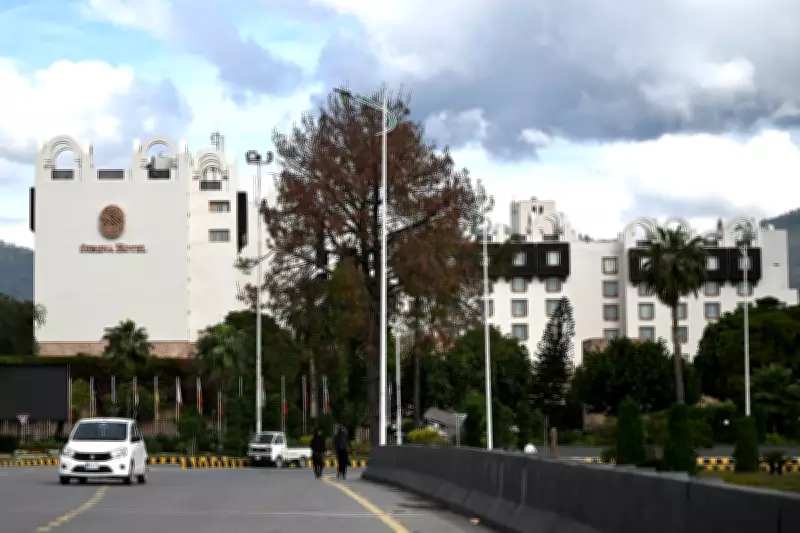
Islamabad has been placed under a stringent lockdown as Pakistan's capital prepares to host pivotal negotiations aimed at concluding the US-Israeli war against Iran. The city is on high alert, with army and paramilitary forces securing key areas and police implementing severe traffic restrictions to ensure the safety of diplomats during these high-stakes talks.
Security Measures and Public Holidays Enforced
In anticipation of the diplomatic gathering, the Pakistani government declared public holidays on Thursday and Friday, urging citizens to avoid non-essential travel. Police have cordoned off the Red Zone, a central district housing vital government offices and foreign missions, permitting only official vehicles to pass through. This lockdown follows a recent suicide bombing in Islamabad in February, which heightened security concerns and contributed to regional tensions with Afghanistan.
Ceasefire Breakthrough and Regional Tensions
Pakistan achieved a significant diplomatic milestone by mediating a ceasefire between the United States and Iran early on Wednesday. The truce was announced just under two hours before a deadline set by US President Donald Trump, who had threatened to obliterate a "whole civilisation" if Iran did not reopen the Strait of Hormuz—a crucial maritime route responsible for transporting approximately one-fifth of the world's oil and gas supply.

However, the ceasefire faced immediate jeopardy when Israel launched unannounced strikes on Lebanon, resulting in hundreds of casualties. Despite this escalation, the agreement has paved the way for American and Iranian diplomats to convene in Islamabad, seeking to end nearly six weeks of intense conflict that has destabilised the Middle East and impacted the global economy.
Diplomatic Delegations and Security Challenges
The United States is expected to send a delegation led by Vice President JD Vance, while Iran will be represented by Foreign Minister Abbas Araghchi and Parliament Speaker Mohammad Bagher Ghalibaf. Gulf nations such as Qatar and Saudi Arabia, both involved in the conflict, may also dispatch delegations to participate in sideline discussions.
Security preparations are extensive, with a 30-member US team already in Islamabad to evaluate arrangements. Pakistani Interior Minister Mohsin Naqvi has assured US Chargé d'Affaires Natalie Baker of comprehensive measures to protect the visiting diplomats. The talks are being held at the Serena Hotel, which was requisitioned by the government, with guests asked to vacate by Wednesday evening.
Analyst Perspectives on the Negotiations
Elizabeth Threlkeld, Director of the South Asia Program at the Stimson Center, highlighted the security risks, noting the limited preparation time and high-profile nature of the talks. "Given those risks, the lack of preparation time and the high-profile nature of these talks, this is a very challenging visit from a security perspective and speaks to the importance this administration places on the negotiations," she stated.
Security analyst Zahid Hussain emphasised that Pakistan's challenge extends beyond venue protection to preventing external forces from derailing the diplomacy. Analysts caution that while Pakistan has facilitated the ceasefire, its influence may be limited in compelling concessions if the US and Iran are unwilling to reach a compromise.
The outcome of these negotiations holds immense significance, as diplomats strive to achieve what some describe as a "mission impossible"—a peace deal that could stabilise the Middle East and rejuvenate a world economy battered by the closure of the Strait of Hormuz.