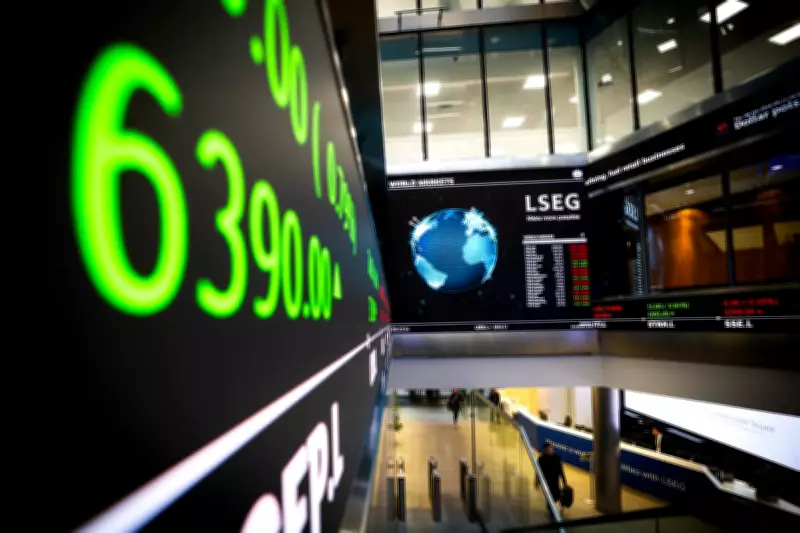
The FTSE 100 closed lower on Wednesday as renewed Middle East hostilities drove oil prices higher and dampened investor sentiment. The blue-chip index fell 41.21 points, or 0.4%, to 10,332.30, while the FTSE 250 dropped 192.07 points (0.8%) to 23,186.29, and the AIM All-Share declined 11.08 points (1.4%) to 807.24.
Oil Markets Rally on Geopolitical Fears
Brent crude for August delivery rose to $97.37 a barrel on Wednesday, up from $94.68 at Tuesday's London equities close, as fighting between the US and Iran intensified. A drone strike on a passenger terminal at Kuwait International Airport killed one person and wounded dozens, despite a purported ceasefire. David Morrison, senior market analyst at Trade Nation, noted: 'Investors trimmed their exposure following reports of further hostilities between the US and Iran overnight. Iran was accused of launching drones and ballistic missiles at targets in Kuwait, but all were successfully intercepted according to US Central Command.' He added that the US military carried out 'self-defence strikes' on Iranian targets, suggesting the Strait of Hormuz will remain closed, which is a concern for Europe, the UK, and many Asian Pacific countries.
OECD Warns of Global Economic Impact
The Organisation for Economic Co-operation and Development (OECD) warned that the conflict has already hurt global growth prospects and could trigger a more severe shock if no effective ceasefire is reached before 2027. In its quarterly update, the group of 38 industrialised nations forecast global economic growth would slip to 2.8% this year if Gulf energy exports return to pre-conflict levels in the third quarter. OECD chief economist Stefano Scarpetta cautioned: 'The longer the disruptions last, the larger the economic and social costs become.' He noted that many countries risk falling into recession, and a drop in investment spending—including in energy-intensive AI—would likely push up unemployment.
European and US Markets Decline
European equity markets also fell, with the CAC 40 in Paris down 1.3% and the DAX 40 in Frankfurt closing 1.3% lower. In New York, the Dow Jones Industrial Average dropped 0.7%, the S&P 500 fell 0.5%, and the Nasdaq Composite dipped 0.7%. Ahead of Friday's US nonfarm payrolls, stronger-than-expected private sector jobs data emerged. The ADP National Employment Report showed private sector employment rose by 122,000 jobs in May, above the 117,000 consensus forecast and up from a revised 105,000 in April.
UK Services Sector Contracts
In the UK, the services sector slipped into contraction for the first time in over a year. The S&P Global UK services PMI business activity index fell to 49.3 in May from 52.7 in April, dropping below the 50 threshold that separates growth from contraction for the first time since April 2025. The broader composite PMI output index also fell to 49.7 from 52.6. ING believes a June interest rate rise now looks unlikely, though a July hike remains possible if energy flows through the Strait of Hormuz do not improve.
Currency and Commodity Moves
The pound traded at $1.3435 on Wednesday afternoon, down from $1.3475 on Tuesday. Against the euro, sterling eased to €1.1574 from €1.1578. The euro fell against the dollar to $1.1606 from $1.1638, while the dollar rose to 159.96 yen from 159.89. Gold prices declined to $4,443.05 an ounce from $4,503.10. US Treasury yields rose, with the 10-year note yielding 4.49% and the 30-year bond at 4.99%.
FTSE 100 Winners and Losers
Oil majors BP and Shell rose 1.7% each, benefiting from higher crude prices. However, miners suffered as metals prices fell: Fresnillo dropped 3.7%, Anglo American lost 2.8%, and Rio Tinto declined 2.8%, further hit by a downgrade to 'underperform' from RBC Capital Markets. On the FTSE 250, B&M European Value Retail soared 15% on hopes its turnaround is gaining traction, despite reporting a 47% fall in annual pre-tax profit to £227 million. Boohoo surged 17% after reporting a return to growth in the first quarter, with gross merchandise value rising 0.5% year-on-year. Conversely, WPP fell 5.1% after Goldman Sachs initiated coverage with a 'sell' rating, citing limited visibility on a return to healthy organic growth.
The biggest risers on the FTSE 100 included Bunzl, SSE, Howden Joinery, Tesco, and J Sainsbury. The biggest fallers were ICG, Burberry Group, Fresnillo, Rio Tinto, and Anglo American.
Looking Ahead
Thursday's global economic calendar features construction PMI reports and US weekly initial jobless claims. In the UK, full-year results are due from CMC Markets, Mitie Group, and Ondine Biomedical.