Milan Demonstrators Rally Against US ICE Unit Deployment for Winter Olympics Security
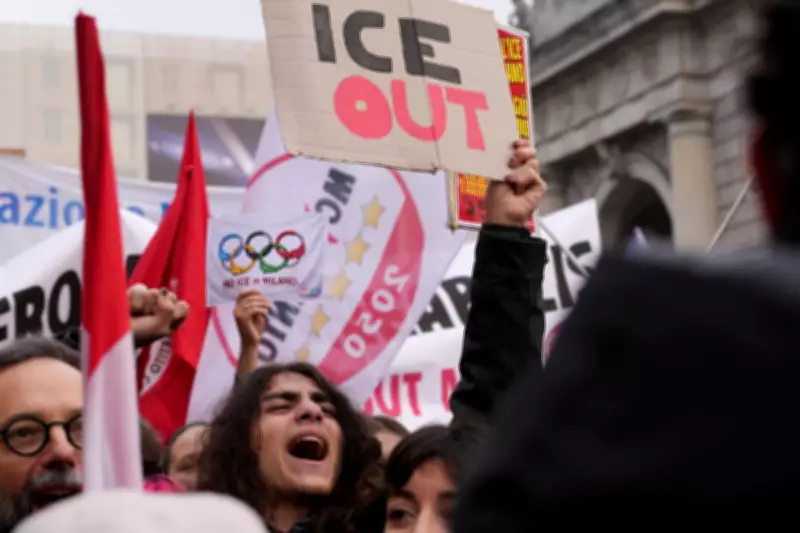
Hundreds of demonstrators assembled in Milan on Saturday to voice strong opposition to the deployment of US Immigration and Customs Enforcement (ICE) agents during the upcoming Winter Olympics. The protest, which took place in the symbolic Piazza XXV Aprile, drew participants from across the political spectrum, united in their concern over the presence of American immigration enforcement personnel on Italian soil.
Symbolic Location and Broad Coalition
The choice of Piazza XXV Aprile, named to commemorate Italy's liberation from Nazi fascism in 1945, was particularly significant. Protesters included members of the left-leaning Democratic Party, the CGIL trade union confederation, and ANPI organizations dedicated to preserving the memory of Italy's partisan resistance during World War II. This diverse coalition highlighted the depth of feeling against what many perceive as creeping fascist ideologies in the United States.
Organizers distributed plastic whistles to participants, creating a cacophony of sound as music blared from a nearby van. The atmosphere was charged with emotion, reflecting broader anxieties about human rights and international security cooperation.

Banners and Slogans Express Deep Concerns
Protesters carried banners with powerful messages that encapsulated their grievances. One read, "No thank you, from Minnesota to the world, at the side of anyone who fights for human rights." Another declared, "Never again means never again for anyone," while a more lighthearted sign stated, "Ice only in Spritz," referencing the popular Italian aperitif. These slogans underscored the protesters' dual focus: opposing specific ICE operations and rejecting what they see as authoritarian tendencies in US policy.
Protester Silvana Grassi held a sign equating ICE with the Gestapo, expressing deep distress over reports of ICE agents involved in violent incidents in Minneapolis. "It makes me want to cry to think of it," she said. "It's too terrible. How did they elect such a terrible, evil man?" Her comments reflect the emotional impact of media coverage of ICE activities on international perceptions.
Official Backlash and Political Repercussions
The deployment has sparked significant political backlash within Italy. Milan Mayor Giuseppe Sala has publicly stated that the ICE agents are not welcome in the city. Meanwhile, Interior Minister Matteo Piantedosi has been summoned to Parliament to testify about the security arrangements this week, indicating the seriousness with which Italian authorities are treating the controversy.
It is important to note that the ICE agents scheduled for deployment are from Homeland Security Investigations, a unit focused on cross-border crimes such as human trafficking and cybercrime, rather than the Enforcement and Removal Operations division responsible for immigration enforcement in the US. These agents are expected to operate from a control room, assisting with security coordination rather than engaging in street-level operations.
Protesters Remain Unconvinced Despite Clarifications
Despite these clarifications, protesters remained steadfast in their opposition. Paolo Bortoletto, another participant, acknowledged that the officers would have an investigative role but insisted, "We don't want them in our country. We are a peaceful country. We don't want fascists. It's their ideas that bother us." This sentiment was echoed by Grassi, who stated, "Even if it's not the same ones, we don't want them here."
The protest highlights growing tensions between international security cooperation and local sensitivities, particularly in a city preparing to host a global event like the Winter Olympics. With the opening ceremony scheduled for February 6, attended by US Vice President JD Vance and Secretary of State Marco Rubio, the controversy adds a layer of diplomatic complexity to the games.
As Milan continues its preparations, the demonstration serves as a potent reminder of the intersection between sports, politics, and human rights on the world stage.