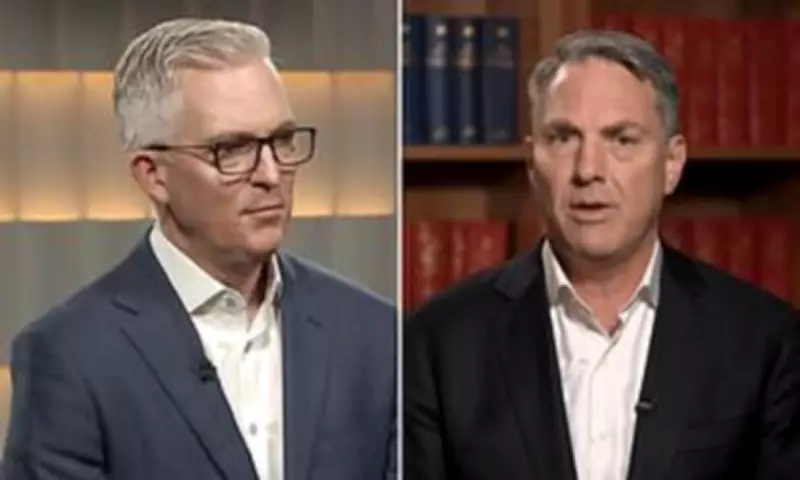
Deputy Prime Minister and Defence Minister Richard Marles has faced intense scrutiny over Australia's position regarding the escalating Middle East conflict and the United States' naval blockade of Iran. During a rigorous interview on ABC's Insiders program, host David Speers repeatedly pressed Marles for clarity on whether the Australian government supports President Donald Trump's blockade strategy.
Deflecting Direct Questions on US Policy
Speers pointedly asked Marles, 'Do you support this blockade or not?' in reference to the US action. Marles, however, declined to provide a direct yes-or-no answer, stating, 'I'm not about to second‑guess America's reaction in the context of that.' When Speers noted that Marles was avoiding stating Australia's official position, the Defence Minister reiterated his stance, saying, 'What I'm saying is I'm not going to second‑guess the decisions that they're making.'
Marles added only that he could 'understand the American reaction' to Iran's actions. Iran had recently abandoned plans to keep the Strait of Hormuz open, vowing to restrict transit while the US blockade remains. Trump responded by accusing Tehran of using the strategic waterway as a bargaining chip, asserting that Iran must not be allowed to 'blackmail' the United States.

Wedgetail Deployment and Its Defensive Mission
The interview then shifted focus to Australia's military presence in the Gulf, specifically the E‑7 Wedgetail surveillance aircraft currently deployed in the region. Marles clarified that the Wedgetail had been sent 'at the request of the UAE' and was focused solely on defending Gulf states. 'It's there to provide for the defence of the countries of the Gulf, principally the UAE,' he explained. 'It's about being able to provide visibility of threats, particularly those that become airborne.'
Marles made it explicitly clear that the aircraft was not tasked with supporting the US blockade in the Strait of Hormuz. He insisted its mission was purely air defence, not maritime enforcement. 'That is actually a bit different to what one might do in respect of any particular operation in relation to the Strait of Hormuz,' he stated.
Intelligence Sharing and Trump's Complaints
When questioned about whether intelligence gathered by the Wedgetail could be shared with the US, Marles refused to answer directly. He argued that military capabilities do not operate in 'yes‑or‑no' terms, describing the Wedgetail as 'optimised' to detect airborne threats to Gulf states. He dismissed questions about its relevance to the blockade as 'not relevant in the context of what this capability is doing,' repeatedly characterising the deployment as a 'defensive mission.'
Attention then turned to President Trump's public complaints. On Thursday, Trump told reporters he was 'not happy' with Australia's involvement in US-led efforts in the region. 'Well, I'm not happy with Australia,' Trump said. 'Because they were not there when we asked them to be there. They were not there having to do with Hormuz. I'm not happy. I'm not happy.'
Asked if Trump was referencing the blockade, Marles again refused to engage directly. 'I can't give a running commentary on what the president says,' he responded. Speers pressed further, inquiring if any form of request, formal or informal, had come from the US. Marles replied only, 'there has not been a specific request,' and did not clarify whether broader discussions had taken place. When informed that Trump claimed Australia was asked and declined, Marles simply said, 'I've articulated what Australia's posture is.'
Throughout the interview, Speers asked Marles about Australia's involvement in the Middle East multiple times, highlighting the Defence Minister's consistent evasion of direct answers regarding the nation's role in the conflict and its alignment with US strategy.