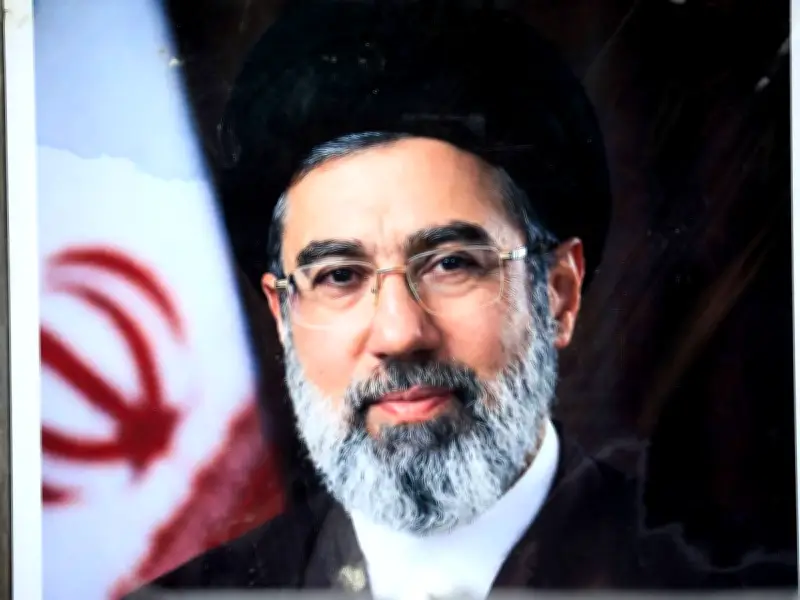
Iran's Supreme Leader has mocked Donald Trump's 'desperation' to re-open the Strait of Hormuz following his acceptance of a peace agreement to conclude the conflict and end the current US naval blockade under conditions widely regarded as extremely advantageous to the Islamic Republic.
Khamenei's Statement on the Agreement
"As you have been informed, a memorandum of understanding was signed between the presidents of Iran and the United States of America," Mojtaba Khamenei announced in a Thursday statement, reports the Mirror. "In the course of reaching this stage, the officials in charge, out of sincere concern and goodwill, made extensive efforts-and of course, it was the American president who, out of desperation, used all kinds of leverage to bring this about."
The interim agreement was signed on Wednesday by Donald Trump and Iranian President Masoud Pezeshkian, drawing the three-month conflict to a close. US Central Command subsequently confirmed via social media that the blockade of maritime traffic entering and exiting the Strait of Hormuz would cease, while Vice President JD Vance informed journalists that 12.5 million barrels of oil traversed the Strait on Wednesday.
US Naval Presence and Terms
Presently, the US Navy maintains over a dozen vessels, including two aircraft carriers, stationed in Iranian waters. Central Command stated that US Navy vessels "will remain in the general area to make sure that all aspects of the agreement are adhered to, obeyed and in full force and effect."
In another part of his statement, Khamenei revealed that despite "held a different view" from the Iranian president regarding negotiations with Trump, he ultimately approved the peace agreement after Pezeshkian assured him that "if the American side seeks to make excessive demands, they will not submit to them."
"From this moment on, we-that is, you, the proud nation, and this humble servant-will await the realization of the aforementioned conditions," he continued.
Republican Criticism and Vance's Defense
Senior figures within the Republican party itself have voiced concerns about the Trump administration's agreement. However, Vance appealed to critics to "have a little bit of faith in the president of the United States." The idea that he is going to strike a deal that's bad for the American people, it's preposterous," Vance stated, emphasising that the administration must continue explaining the deal's merits to the public.
"I think that when people get to understand not just the agreement, our negotiating posture as a country, they will realize this is an excellent thing for the American people," Vance remarked. "That's part of our job. We've got to tell the story about what this means for Americans."
Terms Favor Iran
The terms stipulate that Iran must take immediate action to reopen the Strait of Hormuz and will face no restrictions on oil sales. Tehran is set to receive no less than $300 billion for post-war reconstruction, while measures will be implemented to lift all American and United Nations sanctions previously imposed on the nation.
The US and Israel launched military action on February 28, partly aimed at stopping Iran from acquiring nuclear weapons, though Trump's objectives in the confrontation have constantly evolved. The temporary agreement halts hostilities before achieving that goal and instead creates a two-month window for nuclear talks, seemingly granting Iran multiple advantages immediately while demanding minimal concessions.
Reactions from Pence and Israeli Expert
Mike Pence, who served as Vice President during Trump's initial administration, told CNN he considers the peace accord with Iran "much bigger than a mistake," branding it a "deeply ill-advised" form of "appeasement." Meanwhile, Israeli expert Danny Citrinowicz characterised the arrangement as a strategic "catastrophe". What had been presented as a combined US-Israeli effort to diminish, or potentially overthrow the Islamic Republic has, in his assessment, transformed into American acknowledgement of Iran.
"We went to topple the regime with US backing and ended with Washington effectively giving legitimacy and strengthening the same regime we wanted to bring down," said Citrinowicz, a leading Iran specialist at Israel's Institute for National Security Studies. He argues the accord fails to deliver any of Israel's fundamental requirements: no restrictions on Iran's missile capabilities or proxy forces and no definitive route to dismantling its nuclear infrastructure. Even Israel's operations in Lebanon have been limited by the ceasefire structure enforced at Iran's demand.
The consequences are both political and strategic. The agreement undermines Netanyahu's stance on Iran and lays bare the boundaries of his influence with a US president widely regarded as a close ally of Israel.
"Israel has been isolated, after this war, both in the region and in the world," said one Iranian official, who declined to be named. "Iran got what it wanted...We did not abandon our friends, such as Hezbollah, rather, we were even prepared to go to the extent of walking away from the table and returning to war because of them," added another.