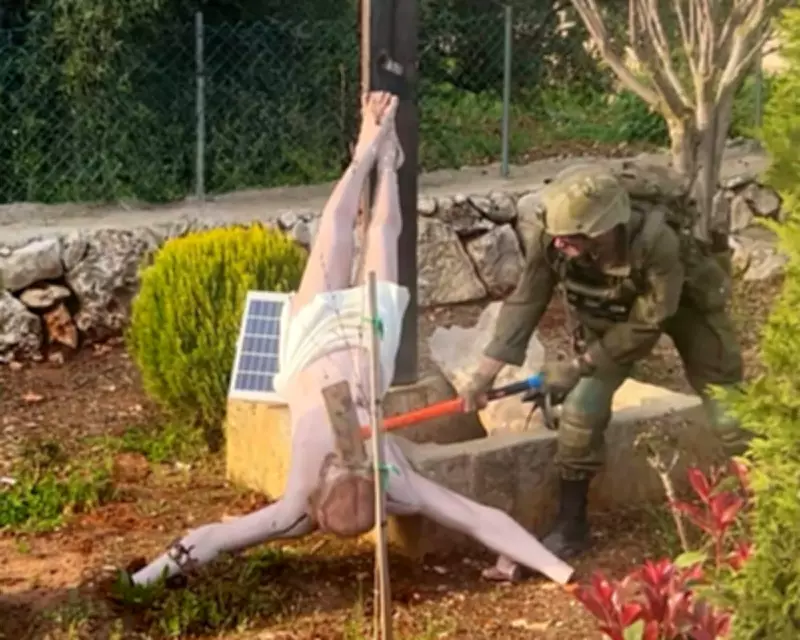
Israeli Army to Launch Criminal Investigation After Soldier Strikes Jesus Statue in Lebanon
The Israeli military has announced it will conduct a criminal investigation following an incident where a soldier was photographed striking a Catholic statue of Jesus with a sledgehammer in southern Lebanon. Military officials confirmed the authenticity of the image circulating on social media, which appears to show the soldier targeting the head of a crucified Jesus statue that had fallen from a cross.
The statue is located in Debl, a Christian village near the Israel-Lebanon border, according to local municipality reports. Officials have not yet determined if the sculpture sustained damage from the attack.
Condemnation from Israeli Leadership
Israeli Prime Minister Benjamin Netanyahu expressed strong condemnation, stating he was "stunned and saddened" upon learning of the defacement. He promised "harsh disciplinary action" against the responsible individual. The Israel Defense Forces (IDF) spokesperson confirmed the soldier has been identified but will not be named publicly, adding that efforts are underway to collaborate with village residents to restore the statue.

This act has provoked widespread outrage in Lebanon and internationally, particularly among evangelical communities in the United States. Support for Israel among American evangelicals, traditionally a key ally, has been declining since the onset of the Gaza conflict.
International Reactions and Broader Tensions
The Italian government and papal authorities reacted with anger to the incident. Italian Defence Minister Guido Crosetto described it as an "unacceptable and unjustifiable act," echoing condemnation from Rome. Tensions between the Vatican, Italy, and Israel have escalated recently, following criticism of the war in Iran and an incident where Israeli police blocked Cardinal Pierbattista Pizzaballa from entering the Church of the Holy Sepulchre.
Archbishop Vincenzo Paglia commented on the defacement, linking it to a broader "lack of culture" that fosters religious and political fundamentalism. He highlighted Jesus's historical connections to southern Lebanon, emphasizing messages of peace rather than destruction.
Pattern of Damage and Legal Implications
Israeli soldiers have reportedly damaged other mosques and historical religious sites during operations in south Lebanon, though officials have not addressed these incidents. Additional reports include soldiers filming themselves rummaging through displaced residents' homes and mocking women by wearing their intimate clothing.
Recent losses include the Grand Mosque of Bint Jbeil, a structure dating to the Roman era, and the partial bulldozing of the Shia and Christian shrine of Saint Peter in Chamaa. Such actions may violate international humanitarian law under the Geneva Conventions, which protect religious sites from intentional targeting or destruction.
The Israeli army has also conducted extensive demolitions in south Lebanese towns, releasing videos of remote detonations and drone footage showing razed areas. Military statements indicate plans to continue demolishing houses along the border.
Apologies and Regional Context
Israeli Foreign Minister Gideon Saar condemned the act as "shameful and disgraceful," assuring severe measures would be taken and apologizing to affected Christians. Lebanon became involved in the Middle East conflict in early March when Hezbollah launched rockets at Israel in support of Iran, prompting Israeli strikes and an invasion of the south. Despite a recent ceasefire, Israeli troops remain stationed in the region.