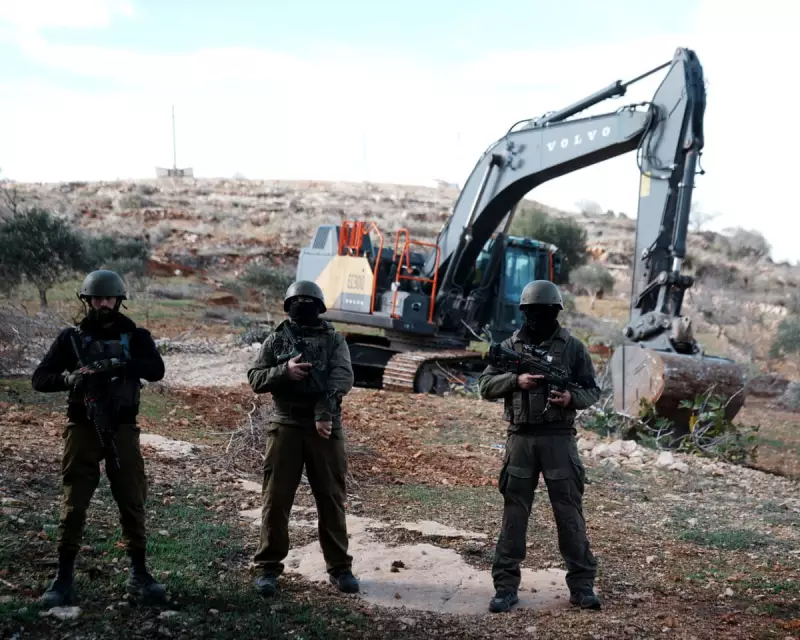
Israeli military personnel stood guard as heavy construction machinery tore through Palestinian agricultural land in the occupied West Bank on Sunday, 8 December 2025, destroying crops and uprooting olive trees believed to be centuries old. The incident occurred in the village of Karyut, where local farmers stated that the demolition is part of a larger plan to seize hundreds of acres for a new Israeli settlement project.
Destruction Under Military Guard
Eyewitness accounts and photographic evidence from the scene depict a stark tableau of destruction. Israeli soldiers were observed standing by while bulldozers and other vehicles systematically cleared the land. The targeted fields and groves are a primary source of livelihood for many families in Karyut, with olive cultivation holding deep cultural and economic significance across Palestinian society.
Farmers from the area reported that the scope of the planned land confiscation is extensive, encompassing hundreds of acres around the village. This latest action has intensified fears of further displacement and the erosion of any viable Palestinian territory in the West Bank.

A Pattern of Settlement Expansion
This event is not isolated but fits into a long-standing pattern of settlement expansion considered illegal under international law. The timing is particularly sensitive, coming shortly after the Israeli government's recent approval for 19 new Jewish settlements, an announcement that drew sharp criticism for its brazen flouting of legal norms.
In correspondence to the Guardian, Rev David Haslam from Evesham highlighted the dire situation, noting that Palestinian Christians describe life in the West Bank as being "like being in a small prison inside a larger one." His letter, published on 22 December, questioned when the international community would impose serious sanctions to halt such flagrant violations.
International Law and Local Anguish
The systematic destruction of agricultural land and the uprooting of ancient olive trees are seen as direct attacks on Palestinian heritage and survival. These actions are widely condemned by human rights organisations as contravening the Fourth Geneva Convention, which prohibits an occupying power from destroying private property.
The visual documentation of the event, provided by the Anadolu Agency, adds a powerful, grim layer to the ongoing narrative of the occupation. As settlement projects advance, the prospects for a contiguous Palestinian state diminish, fueling local despair and international concern over the vanishing possibility of a two-state solution.
The international response remains a point of contention, with critics arguing that without tangible consequences, such as meaningful sanctions, the cycle of land appropriation and destruction is likely to continue unabated.