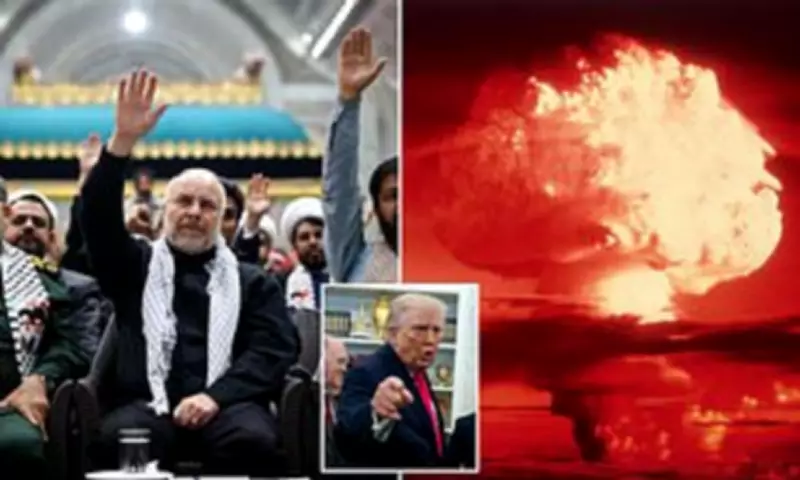
Secret Memos Reveal Ghalibaf's Nuanced Nuclear Stance During 2008 Hiroshima Visit
On October 20, 2008, Mohammad Bagher Ghalibaf, then the Mayor of Tehran, embarked on a rare international trip to Japan. His destination was the Peace Memorial Museum in Hiroshima, where he viewed a poignant artifact: a pocket watch frozen at 8:15 am, marking the exact moment the city was devastated by an American nuclear bomb on August 6, 1945, resulting in 140,000 deaths. After solemnly signing the visitor book, Ghalibaf pledged, 'I will spare no effort in helping to create a world without nuclear weapons. Promoting dialogue...is an essential step.'
US Intelligence Debriefs Japanese Officials on Private Meetings
Following the visit, US officials discreetly debriefed their Japanese counterparts who had engaged in private discussions with Ghalibaf. The insights gathered were compiled into two classified memos labeled 'secret' and 'confidential', which were subsequently forwarded to the State Department in Washington. According to these intelligence documents, Ghalibaf demonstrated a slight divergence from the official Iranian regime position on nuclear matters during his conversations with Japanese officials, indicating a willingness to consider compromise.
The memos, later disclosed by WikiLeaks, noted that while Ghalibaf publicly adhered to the regime's rhetoric in the presence of other Iranian officials, albeit with limited conviction, he privately expressed a desire for dialogue when alone with Japanese representatives. This subtle shift in tone, described as 'marginal' yet discernible, suggested a potential openness to engagement that contrasted with Tehran's typically confrontational stance.

Ghalibaf's Complex Profile: Pragmatist or Brutal Hardliner?
Today, as the speaker of Iran's parliament and a key political figure, Ghalibaf has emerged as a focal point for US diplomatic efforts. President Trump is reportedly keen to engage with him in search of a pragmatic Iranian leader who might abandon nuclear weapons ambitions. However, Ghalibaf's background complicates this prospect. A former Revolutionary Guard commander and police chief, he is notorious for his role in suppressing student protests in 1999, 2003, and 2009, earning him the moniker 'butcher' among many Iranians.
In a leaked audio recording, Ghalibaf bragged about personally beating protesters with wooden sticks and securing authorization for security forces to shoot at students on campus. Protesters have also dubbed him the 'rooftop killer' due to allegations of students being thrown from buildings. Despite this brutal reputation, the intelligence memos from his Hiroshima visit portray him as a 'refined, affable, highly polished guest and interlocutor', with Japanese officials describing him as 'calm, decent, and pleasant', as well as 'very smart and well-informed'.
Nuclear Dialogue and Diplomatic Implications
During his discussions in Japan, Ghalibaf asserted Iran's right to a civil nuclear program, arguing that the country had 'paid too high a price to give it up'. He criticized Western 'double standards' regarding nuclear programs in India and North Korea, yet emphasized that Iran could pursue its goals 'without confrontation' and should make 'further efforts' to build international trust. Notably, he avoided charged or emotional language, suggesting a pragmatic approach to dialogue.
The memos indicate that Ghalibaf viewed Iran's path as 'engaging in dialogue with the world in a better way'. At the time, he was positioning himself as an alternative to hard-line President Mahmoud Ahmadinejad. Nearly two decades later, it remains unclear if these views persist, but some White House officials reportedly see him as a potential US-backed leader. One US official told Politico, 'He's a hot option...But we got to test them, and we can't rush into it.'

Current Negotiations and Denials
Recently, President Trump hinted at ongoing negotiations involving Vice President JD Vance, Secretary of State Marco Rubio, and other envoys, stating, 'We have a number of people doing it. And the other side, I can tell you, they'd like to make a deal.' Speculation has swirled that Ghalibaf is the Iranian negotiator, but he has publicly denied this, posting on social media, 'No negotiations with America have taken place. Fake news is intended to manipulate financial and oil markets.' Iranian media have dismissed the reports as a 'psychological operation' aimed at creating internal divisions.
Ghalibaf's political influence has grown since the death of Supreme Leader Ali Khamenei in February, with Khamenei's son, Mojtaba, a long-time supporter, now in power. US cables from 2008 reveal that Mojtaba was the 'backbone' of Ghalibaf's election campaigns, providing advisory, financial, and political support. However, analysts like Michael Rubin caution that diplomats may confuse Ghalibaf's 'pragmatism with opportunism', noting his history as a survivor seeking leadership roles.
Background and Controversies
Born to a shopkeeper in Torqabeh, Ghalibaf served in the Iran-Iraq War, trained as a pilot, and rose through the ranks to lead the Revolutionary Guard’s air force and later Iran's police. As Tehran's mayor from 2005 to 2017, he faced corruption allegations, including donations to a foundation run by his wife. He has engaged with the West, attending the World Economic Forum and studying New York's urban management, yet as parliament speaker, he praised Hamas's 2023 attacks, declaring the 'Zionist regime will never have peace until it is annihilated.'
As Trump seeks a deal to curb Iran's nuclear ambitions, Ghalibaf remains a enigmatic figure: a potential partner for dialogue shadowed by a brutal past and regime loyalties. The legacy of his Hiroshima visit and the secret memos continue to shape diplomatic calculations in a volatile region.