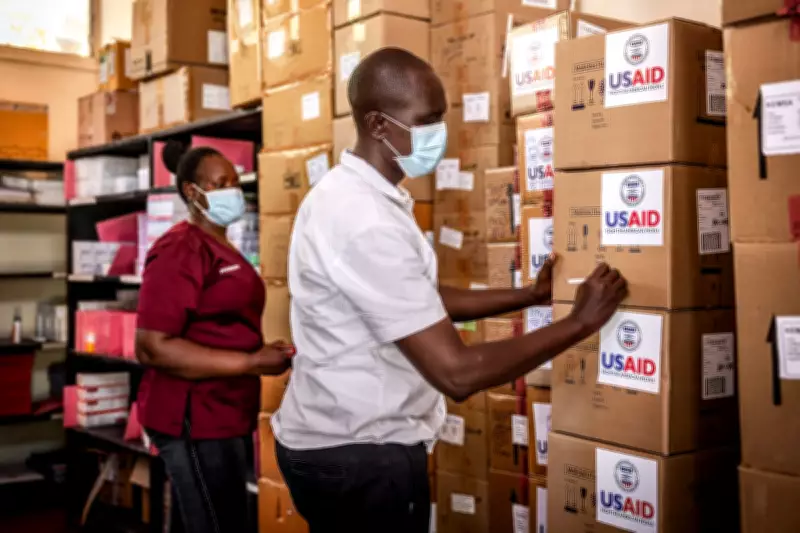
Former USAID Official Details 'Ignorance and Cruelty' of Trump-Era Agency Dismantling
In a stark new account, former USAID official Nicholas Enrich has detailed the devastating impact of the Trump administration's dismantling of the United States Agency for International Development. His book, Into the Wood Chipper, published last week, chronicles the early days of Doge's foray into the agency, using a phrase coined by Elon Musk to describe the cuts.
The Beginning of the End for USAID
Enrich, now 43, was working in Kenya in 2003 when President George W. Bush signed a landmark $15 billion, five-year commitment to combat HIV, the largest international health commitment by any nation to fight a single disease. For the young American government aid worker, it was a moment of profound inspiration. "It clicked that my government was ready to join the fight against HIV and I was excited to be a part of that," he recalls.
More than two decades later, Enrich has witnessed a dramatic reversal. Within days of taking office in January last year, Donald Trump issued a temporary pause on USAID funding. By March, a formal dissolution of the agency was announced. By July, with over 80% of programs canceled, USAID was officially merged into the state department, marking the end of an era in global development.

Global Consequences and Human Cost
The effects of these cuts have been dire. According to Oxfam estimates, at least 23 million children stand to lose access to education, and as many as 95 million people would lose access to basic healthcare, potentially leading to more than 3 million preventable deaths per year. For Enrich and his colleagues, the efforts felt like a wrecking ball. "It looked like a group of unqualified people that came in to replace decades of expertise and tore down an agency," he says.
Enrich's account comes amid a broader debate over the US's role in the world and stressed alliances. He writes that he wanted to let people know "what happened and however bad they thought that it might be inside USAID when Doge came in to tear it apart, it was way worse – especially the incompetence, ignorance and cruelty that came along with it."
Internal Turmoil and Political Motivations
The dismantling process was marked by internal turmoil and questionable motivations. Enrich describes how Trump appointees voiced concerns that the agency was providing abortions, despite strict legal prohibitions against such activities. "I didn't know whether to laugh or cry," Enrich says. "USAID didn't provide abortions to anyone. In fact, we had strict legal prohibitions on that. But it was one of the concerns of Republican members of Congress."
Some officials were motivated by personal grievance, Enrich claims. He writes that Mark Lloyd, who led USAID's bureau for conflict prevention and stabilization, believed career staff had killed his dog during the first Trump administration. "He was excited to get rid of USAID staff because he really considered them to be pet murderers," Enrich alleges.
Missed Lessons and National Security Threats
The dismantling of USAID came just five years after the Covid-19 pandemic, during which the agency had sent over $10 billion in emergency funding to more than 120 countries. Enrich believes the Trump administration missed crucial lessons from that experience.
"Outbreaks that start abroad do not respect international borders, and USAID had invested hundreds of millions of dollars in early-warning systems to detect potential outbreaks of diseases in countries where they originate and to deal with them before they are able to spread," he explains. "But that was immediately torn down, leaving us blind to what might be developing."
Enrich points to the suspension of drug trials for drug-resistant tuberculosis as another example of how the situation was made worse. "Our inability to detect outbreaks and prevent the next outbreak is a threat to national security but it's not the only one," he adds.
The 'Trade Over Aid' Approach and Global Implications
Last week, Devex reported that the state department had sent out a cable memo to US embassies to push host nations to sign a "trade over aid" declaration that explicitly rejects the US's role as the top provider of humanitarian assistance in favor of business relationships that create opportunities for US companies.

Enrich is deeply critical of this approach. "It is politically naive to think that Kennedy's plan was purely altruistic – it was designed to counter Soviet influence during the cold war," he says. "But the Trump administration's 'trade over aid' transactional approach is naked and unproven."
Equally worrying, he points out, is that other donor nations have mirrored US cuts to foreign development aid. "When we turn our backs on the world, and break the promises we made to millions of people, it erodes the soft power partnerships that the US had built over the years and drives them into partnerships with adversaries like Russia and China," Enrich warns.
A Call for Restoration and Reflection
Enrich's book also addresses a broader topic: how to adjust to, or equally to resist, Trump's style of government. "I wanted to share my story as an example so that normal people can make choices if they find themselves in that position," he told the Guardian in an interview.
As an expert in drug-resistant tuberculosis who served as acting assistant administrator for global health, Enrich issued a memo in March 2025 that outlined the risks of freezing foreign aid, concluding it would have "severe domestic and global consequences." Fewer than 30 minutes after it was published, he was put on administrative leave.
In retrospect, he says, "I think I spent too long to try to implement the policies of the administration." But as a career public servant, he and his colleagues weren't well suited to resistance. "We're not activists or advocates so it doesn't come naturally to reach a point of saying, 'Hey, wait a minute. This is not OK.'"
Despite the devastation, Enrich remains hopeful about USAID's potential restoration. "I believe that USAID can and should be reinstated, but that's not to say that we can't make changes," he says. "To show the world that we have an agency that says 'from the American people' was the embodiment of American generosity and soft power. The folks who say it's gone and can't be brought back lack boldness and imagination."