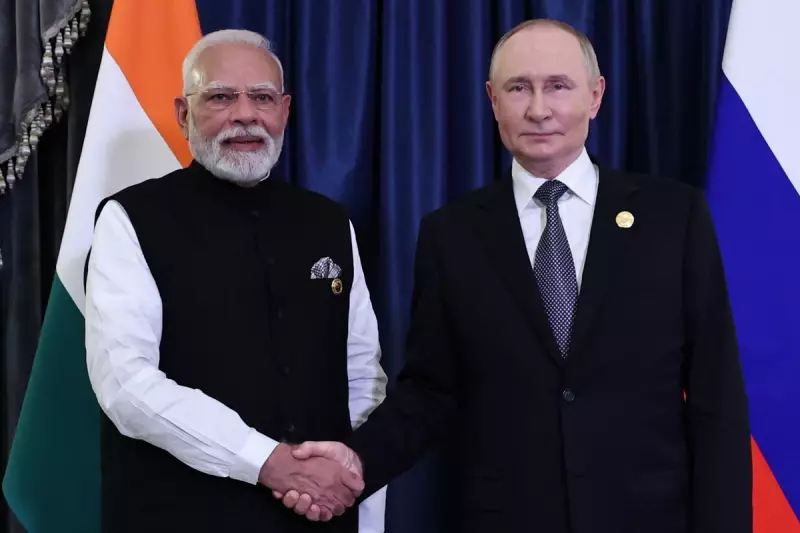
In an unusual and pointed diplomatic move, the ambassadors of Britain, France, and Germany in India have issued a stark public condemnation of Vladimir Putin's conduct in the Ukraine war. The joint intervention comes just days before the Russian president's arrival in New Delhi, placing India in a delicate position.
A Coordinated Diplomatic Rebuke
UK High Commissioner Lindy Cameron, French Ambassador Thierry Mathou, and German Ambassador Philipp Ackermann co-authored a joint opinion piece for The Times of India. They accused Russia of escalating the conflict in Ukraine even while peace negotiations were supposedly underway. The diplomats claimed that nearly two dozen of the "largest air attacks of the entire war" had occurred since peace talks began.
"These are not the actions of someone that's serious about peace," the envoys wrote. They argued that the indiscriminate attacks were "a systematic choice by Russia to wage its war of aggression with absolute ruthlessness." The article placed the onus for ending the conflict squarely on the Russian leader, stating that Mr Putin was "the one leader who could end the war any time he so wishes."
Broader Allegations of Malign Activity
The European diplomats extended their criticism beyond Ukraine, alleging a pattern of destabilising behaviour. They claimed that "Russian fighters are making dangerous and escalatory incursions into European airspace," sparking concern within NATO. The envoys also accused Moscow of seeking to "exploit and undermine trust in key democratic institutions, including elections, independent media, civil society and the rule of law."
These claims align with recent reports. The Financial Times noted that NATO was on high alert after incidents in the Baltic Sea where vessels were accused of damaging undersea cables. Furthermore, a senior NATO military official, Admiral Giuseppe Cavo Dragone, warned of a potential "pre-emptive" and more "aggressive" approach to deter what he called Russian "hybrid attacks," including drone incursions and cyber operations.
Timing Sparks Diplomatic Discomfort in India
The publication's timing, immediately before President Putin's two-day state visit beginning on Thursday, has been labelled a breach of protocol by some Indian analysts. Kanwal Sibal, a former Indian foreign secretary, denounced the article as a "diplomatic insult to India" that questioned New Delhi's close ties with a friendly nation.
The op-ed did reference Indian Prime Minister Narendra Modi's own stance, quoting his remark that "a solution cannot be found on the battlefield." However, the direct criticism of a visiting head of state's policies has created an awkward atmosphere for the host government.
Mr Putin is arriving with Defence Minister Andrei Belousov and a large business delegation. The agenda is expected to focus on strengthening bilateral ties, with discussions likely covering:
- The potential purchase of additional S-400 air defence missile systems.
- New energy deals, despite the threat of US sanctions.
- Progress on a free trade agreement between India and the Russia-led Eurasian Economic Union.
- Expanded cooperation in civilian nuclear energy, shipping, and agriculture.
Analysts like Michael Kugelman of the Atlantic Council suggest the visit allows India to "reassert the strength of its special relationship with Moscow." However, Indian officials remain wary of triggering a reaction from the United States, which under President Donald Trump has already doubled import levies on India as punishment for buying Russian crude oil.
Some observers believe evolving geopolitics may ease India's position. Harsh Pant of the Observer Research Foundation noted that recent US-Russia talks on Ukraine could make it easier for New Delhi to engage with Moscow. He added, "A large part of the trading relationship was based on energy, which is now losing traction under the threat of sanctions from the US. And at the end of the day, only defence remains, which continues to bind the two together."