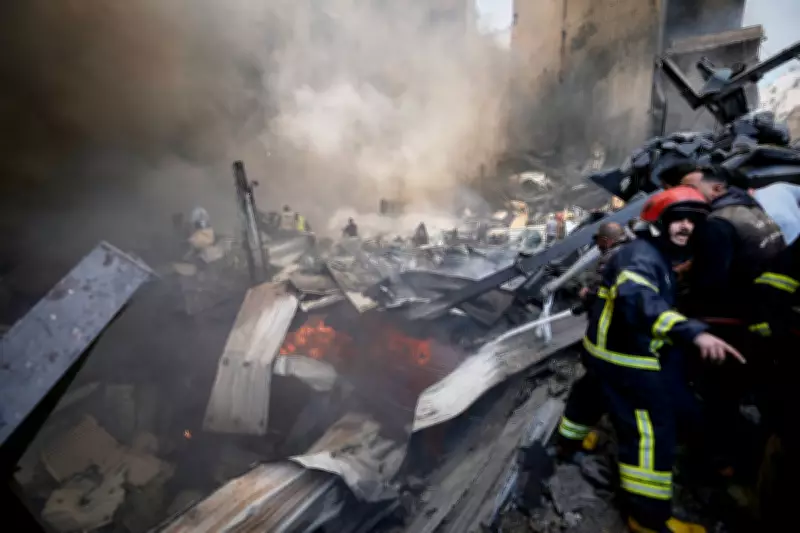
Ceasefire Under Severe Strain as Regional Tensions Escalate
A tentative two-week ceasefire in the ongoing conflict involving Iran, Israel, and the United States is facing significant threats from multiple fronts, risking a collapse back into full-scale hostilities. The fragile truce, intended to pave the way for potential negotiations in Islamabad, is being tested by military actions and provocative maneuvers that could unravel the delicate peace.
Iran's Alleged Mining of the Strait of Hormuz
On Thursday, semiofficial news agencies in Iran published a chart suggesting that the country's paramilitary Revolutionary Guard deployed sea mines in the Strait of Hormuz during the war. This revelation appears to be a calculated pressure tactic, coinciding with the uneasy ceasefire. The Strait of Hormuz, a critical maritime chokepoint through which 20% of the world's traded oil and natural gas once flowed, has been closed by Iran since Wednesday in response to Israeli actions. This closure has halted vessel traffic, amplifying global energy security concerns.
UN Condemns Israeli Strikes in Lebanon
In a strongly worded statement, UN Secretary-General António Guterres "unequivocally" condemned Israeli strikes in Lebanon that resulted in hundreds of casualties on Wednesday, following the ceasefire announcement. The strikes targeted the Iran-backed Hezbollah militant group, with Israel asserting that the ceasefire agreement does not extend to its conflict in Lebanon, a position contested by Iran and mediator Pakistan. Early Thursday, sirens sounded in northern Israel as Hezbollah claimed retaliatory rocket attacks, highlighting the volatile situation.

Trump's Warning and Military Posturing
Adding to the tension, U.S. President Donald Trump issued an online statement on Thursday via his Truth Social platform, insisting that a surge of American warships and troops would remain deployed around Iran until compliance with agreements is assured. Trump's message, which warned that "the 'Shootin' Starts' bigger, and better, and stronger than anyone has ever seen before" if terms are not met, is seen as an effort to pressure Iran amid the uncertain ceasefire. He also vowed that Iran would not develop nuclear weapons and that the Strait of Hormuz "WILL BE OPEN & SAFE," despite current closures.
Think Tank Warns of Ceasefire Collapse
The Soufan Center, a New York-based think tank, issued an analysis on Thursday warning that the ceasefire "hovers on the verge of collapse." The report emphasized that Israel's strikes in Lebanon, even if technically outside the formal deal, are viewed as escalatory and risk derailing the truce. It suggested that Israel's actions may aim to drive a wedge between Iran and its proxies or respond to perceived exclusion from initial ceasefire discussions.
Religious Sites Reopen in Jerusalem
In a positive development, the Al-Aqsa Mosque compound in Jerusalem reopened for dawn prayer on Thursday after being closed throughout the Iran war, according to the Jordanian-administered Islamic Waqf. Jerusalem police announced the lifting of restrictions on all holy sites in the Old City, deploying hundreds of officers and volunteers to manage the situation. During the conflict, access to Christian, Jewish, and Muslim sites had been severely restricted or prohibited, dampening Lent, Passover, and Ramadan observances. The reopening comes just in time for Orthodox Christians to celebrate Easter on Sunday, offering a brief respite in the region's turmoil.
The convergence of these events underscores the precarious nature of the ceasefire, with diplomatic, military, and economic pressures threatening to reignite broader conflict. Stakeholders remain on high alert as the situation continues to evolve.