

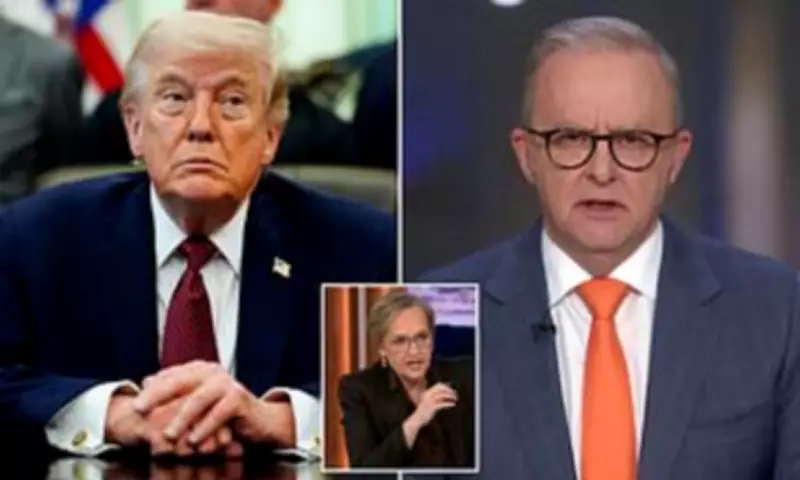
Albanese Declines to Comment on Trump's Claims About Australia's Role in Iran Conflict
Prime Minister Anthony Albanese has steadfastly refused to state whether former US President Donald Trump was being untruthful after Trump repeatedly accused Australia of failing to support America during the war on Iran. The diplomatic tension escalated last Thursday when Trump publicly criticised the Albanese government for not assisting the United States in reopening the Strait of Hormuz.
Trump's Public Criticism and Albanese's Response
Speaking to reporters outside the White House, Trump expressed his dissatisfaction, stating, 'I'm not happy with Australia because they were not there when we asked them to be there.' He did not elaborate further on the status of his relationship with the Australian Prime Minister when pressed for details.
In response to Trump's comments, which were made hours earlier, Albanese dismissed the criticism, insisting that there had been 'no new requests' from the United States for assistance regarding the Strait of Hormuz. The Prime Minister emphasised his commitment to maintaining a respectful and constructive dialogue with the US leader.

Intense Grilling by ABC 7.30 Host Sarah Ferguson
During a televised interview on Monday night, ABC 7.30 host Sarah Ferguson aggressively questioned Albanese about why Trump had singled out Australia for criticism. 'On Donald Trump, you won't answer the question that's been put to you numerous times now about why he keeps criticising Australia over its response to his war,' Ferguson began. She further probed, 'Do you at least understand why people in Australia are so anxious about this?'
Albanese responded by deflecting the inquiry, saying, 'Well, that's a question for President Trump. I have a respectful relationship with the US president. As is expected of me as Australia's prime minister. They're an important ally. In the discussions I've had with him, they're always very constructive.'
Persistent Questioning and Diplomatic Evasion
Ferguson continued to press the Prime Minister, asking directly, 'Is our most important ally lying about the fact that Australia was asked to do something and failed to do it?' Albanese again avoided a direct answer, stating he would not provide a 'running commentary' on Trump's remarks. He explained, 'Trump has made comments, and one of the comments I made very early on in the Trump presidency was I wouldn't give an ongoing running commentary on things that are truly obsessed over by journalists, but not necessarily by the public.'
Ferguson countered that the issue extended beyond media fixation, highlighting the US as Australia's 'indispensable ally' and expressing confusion over Trump's motivations for 'lashing out' at Canberra. Albanese replied, 'To be clear, Sarah, I've seen the footage - in response to a question which invited the sort of statement that was made by the president. What I can say is the relationship that I have with President Trump is constructive. People have seen that.'
Albanese's Defence of the Bilateral Relationship
The Prime Minister elaborated on his interactions with Trump, noting, 'We've had a number of face-to-face meetings as well as a number of discussions, and they've all been in the interests of both Australia and the United States. They've been friendly, they've been constructive, they've been important. I will continue to do that.' This defence comes at a time when Trump's popularity in Australia has significantly declined.
Declining Public Perception of Trump in Australia
Recent polling data reveals a sharp drop in Trump's approval ratings among Australians. The latest Resolve Political Monitor poll indicates that 62 per cent of Australians hold an unfavourable view of Trump, with fewer than 20 per cent viewing him positively. This marks the lowest level of support during his second term as US president, underscoring the growing public concern over the diplomatic strains highlighted by the recent exchange.






