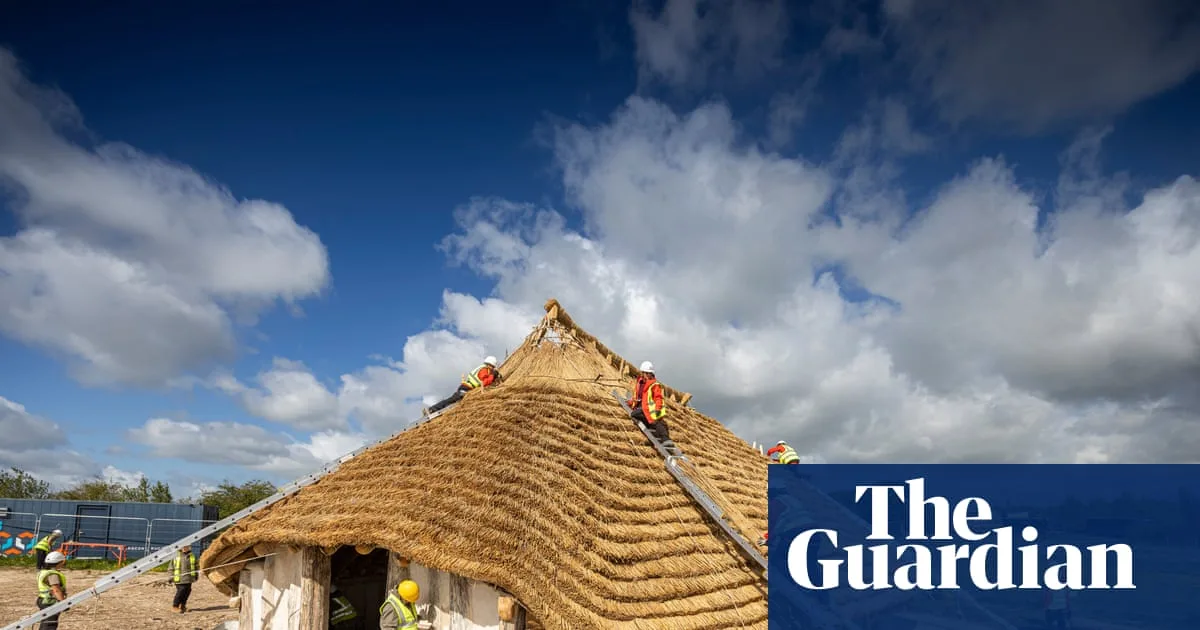
English Heritage has unveiled a 7-metre-high reconstruction of a 4,500-year-old Neolithic hall near Stonehenge, offering visitors a glimpse into the lives of the prehistoric builders who raised the stone circle. The £1 million project, built entirely by hand over nine months by more than 100 volunteers, is in its final stages of construction near the Stonehenge visitor centre on Salisbury Plain. The Kusuma Neolithic Hall will open to the public this summer before becoming an immersive learning space for schools.
The structure is based on the archaeological footprint of Durrington 68, a unique 'square in the circle' building discovered two miles away near Woodhenge. First excavated in 1928 by Maud Cunnington and re-examined in 2007 by the Stonehenge Riverside Project, the original site features a horseshoe-shaped ring of post holes surrounding four massive internal roof support pillars. Because centuries of ploughing destroyed the original floor and hearths, its true purpose remains a mystery, but discoveries of animal bones and grooved ware pottery nearby point towards winter feasting or ritual gatherings.
Experimental archaeologist Luke Winter analysed European Neolithic carpentry and prehistoric pollen data to design the hall. 'Everything in that building was growing in this landscape 5,000 years ago,' he said. 'We've been using replica stone tools to create every aspect of this building … we've counted literally every blow every axe has made.' Winter noted that the building perfectly aligns with the winter solstice, like Stonehenge itself.

The project forms the first phase of an educational expansion by English Heritage. Alongside the hall, a new learning centre housing the Clore Discovery Lab and Weston Learning Studio is scheduled to open by the end of 2026. Iona Keen, English Heritage's head of learning and interpretation, said the goal was to double educational capacity to nearly 100,000 students annually over the next five years, with free access for educational and youth groups.
Stonehenge's curator, Win Scutt, said the monuments and dwellings surrounding the Neolithic site were driven by a 'society that wanted connection'. 'This whole thing is about social society, not science,' he said, adding that massive cooperative projects were a medium for collective representation. Volunteers Sarah Davis and James Humphrey described the project as transformative, with Davis saying: 'It's just amazing to think of the people who actually built the original structure.'