
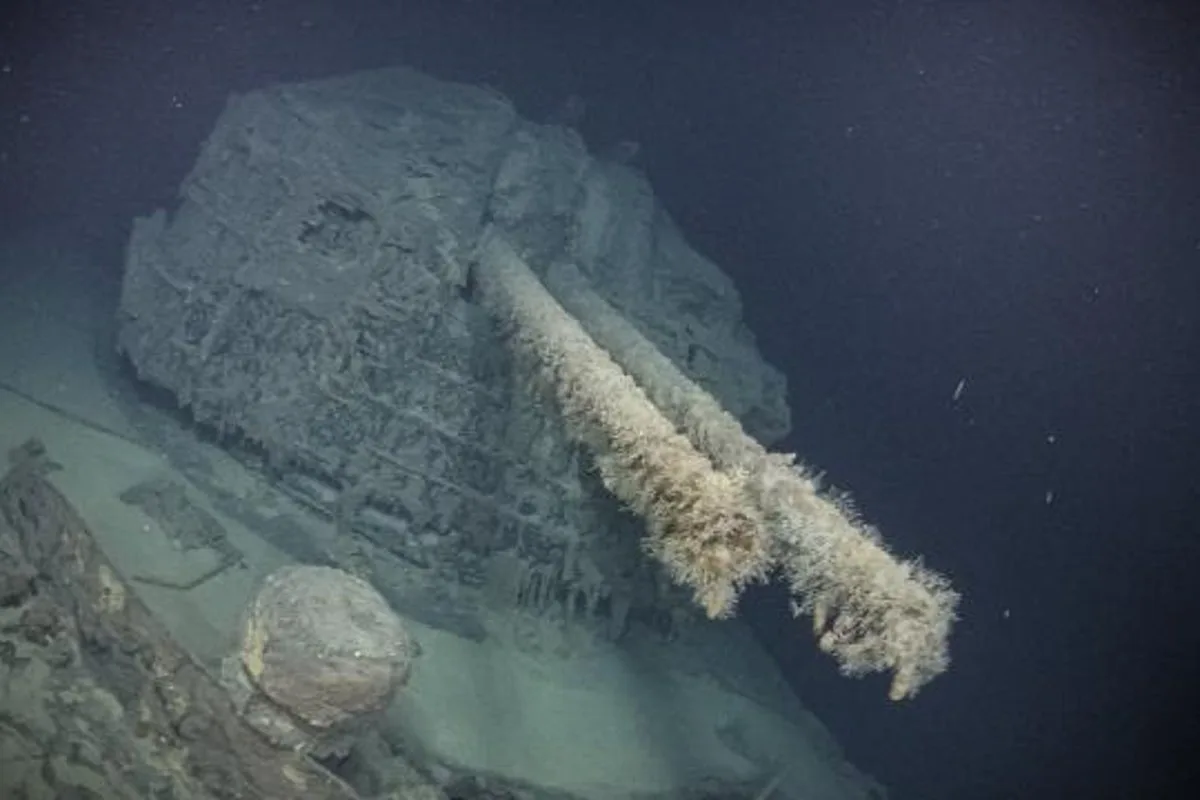
A Japanese navy destroyer that sank during a pivotal Second World War battle has been found on the Pacific Ocean floor, 83 years after it was torpedoed. The Imperial Japanese Navy destroyer Teruzuki went down in December 1942 while transporting supplies to soldiers in the Solomon Islands.
Measuring over 134 metres long, Teruzuki was the second Akizuki-class destroyer built for the Imperial Japanese Navy, equipped with air-search radar. These ships primarily served as escorts with anti-aircraft capabilities for main battle vessels. The destroyer was sunk by US torpedoes while transporting food for troops on Guadalcanal, an island known as 'Gato' or the 'island of starvation'.
After being hit, a detonation broke the rudder and one propeller shaft, disabling the ship. A ruptured oil tank then caught fire, igniting ammunition and causing an explosion. Nearly 350 crew members survived, rescued by other Japanese destroyers, but ten died. Since Imperial Japan's naval plans were tightly guarded secrets, no historical images of Teruzuki exist, making this the first visual survey of the vessel for this generation.
A US marine research team discovered the wreck in the Iron Bottom Sound, an area that witnessed five major naval battles between August and December 1942, resulting in over 20,000 casualties, 111 naval vessels, and 1,450 aircraft lost. Fewer than 100 of these ships and planes have been located in this area, which is less than 25 nautical miles wide, 40 nautical miles long, and 1,400 metres deep.
Samuel J. Cox, a retired US Navy rear admiral, said: 'Iron Bottom Sound was the scene of five ferocious major night surface battles, resulting in the loss of dozens of ships and thousands of men. Both sides showed extreme courage and tenacity, although in the end the U.S. Navy and allies prevailed, at enormous cost.'
Researchers confirmed the wreck as Teruzuki after comparing it with the only other known Akizuki-class destroyer sunk in the Solomon Islands. A team of US and Japanese marine researchers conducted the first visual scan earlier this month, finding that the bow had collapsed to one side and most of the superstructure had fallen off. The details matched testimonies from surviving crew members, and the positions of gun turrets were consistent with Teruzuki's design.




