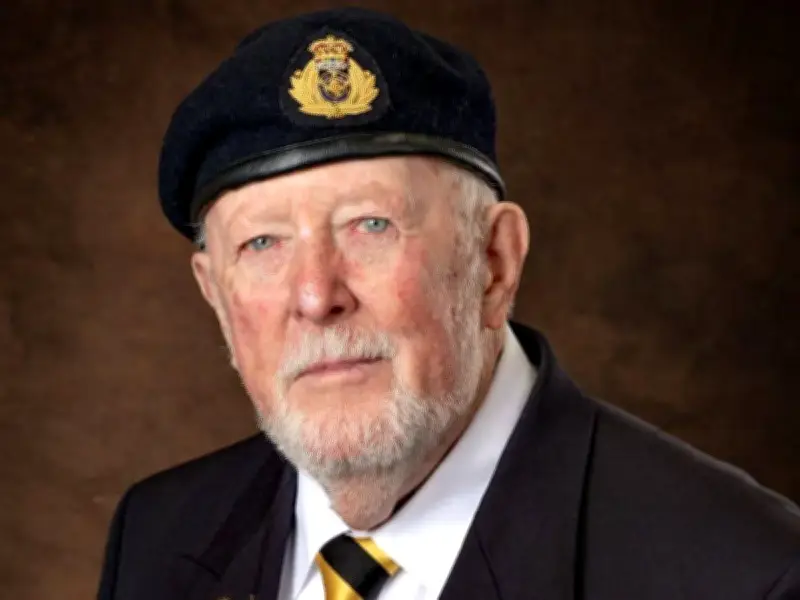
Captain Terry Hughes, an 87-year-old nuclear test veteran, has revealed how his DNA was "scrambled" after being just 15 miles from the UK's largest-ever thermonuclear weapon test, leading to a catalogue of health issues and family tragedies.
Captain Hughes was 19 when he was deployed to Christmas Island in the South Pacific for Operation Grapple in 1958, where the UK detonated its largest-ever thermonuclear weapon - a hydrogen bomb (H-bomb). He was one of approximately 22,000 servicemen dispatched to Australia and the South Pacific as part of the UK's nuclear testing programme during the 1950s and 1960s.
Deployment and the Grapple Y test
Captain Hughes, from Lydney in Gloucestershire, was serving with the Royal Fleet Auxiliary as a junior navigating officer. He told the Daily Express: "When we arrived, we didn't know what was going to happen."
"They then told us they were going to explode a H-bomb."
The bomb, codenamed Grapple Y, was dropped near Christmas Island on April 28 and remains the largest and most powerful nuclear weapon ever tested by Britain. It carried an explosive yield of approximately three megatonnes of TNT, making it roughly 200 times more destructive than the bomb that obliterated Hiroshima in 1945.
No protective clothing and a tense crew
Captain Hughes described the mood on the vessel as "tense" ahead of the detonation. The crew were provided with no protective clothing whatsoever, which only heightened their unease.
He added: "I'd experienced bombs in World War Two but that's a very different story."
"This H-bomb was 200 times more powerful than they let off in Japan. So my first thought was: 'If they've done this in Japan, why are we doing this here? They must know the effects.'"
"Before the detonation, we were given certain positions on the ship. I was told to go and help the crew down below in the ship in the engine room. None of us knew what was going to happen so I was sent down there in case of an emergency."
"We were all very apprehensive and we were given a countdown before the bomb exploded. We were between about 15 to 20 miles away when it happened."
Health consequences and the fight for justice
The men were subsequently redeployed without undergoing any medical checks whatsoever. Captain Hughes was dispatched immediately to Scotland, before heading to Iceland and eventually returning to Britain.
He said: "Like everyone else, we didn't talk about it. We didn't talk about the radiation."
"That was until around the mid-80s when the court case emerged."
In 1985, nuclear test veteran Melvyn Pearce launched a damages claim against the Ministry of Defence. Having developed lymphoma in 1978, he alleged the condition was directly linked to his exposure during the nuclear testing programme of the 1950s. He secured a significant victory when it was ruled that the MoD could not rely on Crown immunity to prevent servicemen from taking legal action against the government. However, he was ultimately forced to drop his claim after legal and medical experts were unable to establish that radiation exposure was the direct cause of his cancer.
It was the court battle that prompted veterans such as Captain Hughes to speak out. He is now a member of LABRATs, a campaign group that has launched an offensive against the MoD, alleging that the government concealed the blood and urine test records of servicemen deployed to testing sites including Christmas Island. LABRATS contends that the documentation demonstrates that veterans were deliberately used as guinea pigs to examine the long-term effects of radiation on the human body. This is firmly denied by the MoD.
Family impact and calls for apology
Captain Hughes's son, now in his 50s, has endured a range of health problems, including multiple thrombosis, which has "affected him very badly". Meanwhile, his ex-wife, who passed away from a brain tumour a couple of years ago, experienced miscarriages thought to be caused by the radiation. Captain Hughes also suspects his skin cancer is connected to radiation exposure.
He is now pushing for education about the nuclear testing and an apology from the government, demanding an independent tribunal and compensation for those impacted.
Hughes said: "Before Andy Burnham became an MP, he was one of our very strong campaigners."
"He said any future Prime Minister should stand up and give an apology. He also said there should be an independent inquiry into all of this. But, since he's become Prime Minister, he's been very quiet."
To commemorate the anniversary, there will be an All Tests Reunion (ATR), a gathering organised for British nuclear test veterans and their families, which Captain Hughes described as "special". He said: "We are a family and we look after each other. That's very important and something they can never take away."
A Government spokesperson said: "We recognise the significant contribution that nuclear test veterans have made, and continue to make, to our national security."
"The Government remains committed to engaging openly with the community, including through a recent meeting between the Prime Minister, the Defence Secretary and LABRATS."
"As this work progresses, our focus will be on transparency, accountability and building confidence among veterans and their families."