
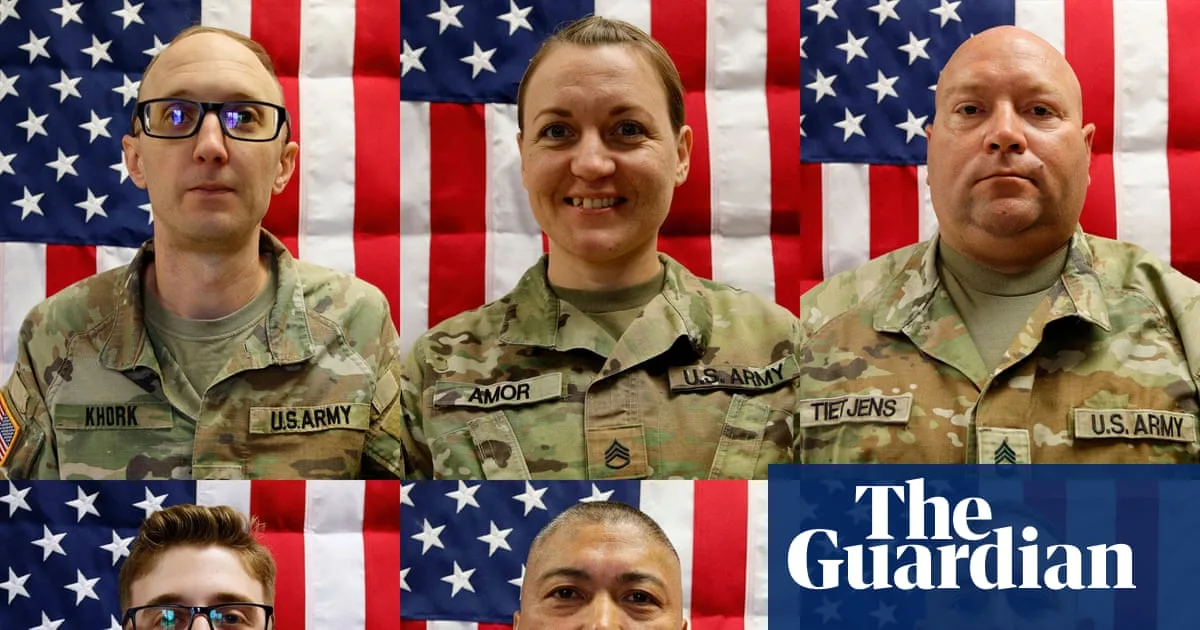
More details have emerged about the six American service members who were killed in an unmanned aircraft system attack in the Shuaiba port in Kuwait on Sunday, the first known US fatalities since the US and Israel launched their military campaign against Iran on Saturday.
On Tuesday evening, the US Department of Defense identified four of the six US soldiers who were killed as Capt Cody A Khork, 35; Sgt first class Nicole M Amor, 39; Sgt Declan J Coady, 20; and Sgt first class Noah L Tietjens, 42. On Wednesday evening, the Pentagon identified the fifth deceased service member as Maj Jeffrey R. O’Brien, 45, and the Department of Defense said it believed the sixth individual was Chief warrant officer 3 Robert M Marzan, 54.
All of them had been assigned to the 103rd sustainment command in Des Moines, Iowa, and were “supporting Operation Epic Fury”, the Department of Defense said. They were killed on Sunday during an “unmanned aircraft system attack” in port Shuaiba, Kuwait, according to the military.
Since Saturday, when the US and Israel launched their military campaign against Iran, US and Israeli forces have carried out large-scale strikes across Iran, including striking the compound of Iran’s supreme leader, Ayatollah Ali Khamenei, who was killed on Saturday. Iran has responded with retaliatory strikes, launching missiles aimed at Israel and US military facilities in the region, including in Bahrain and the United Arab Emirates.
When announcing the operation, Donald Trump said that his administration was “taking every possible step to minimize the risk to US personnel in the region”. But, he added, “the lives of courageous American heroes may be lost, and we may have casualties”, adding that “that often happens in war”.
On Tuesday evening, the US army reserve said that the US soldiers who were killed “served fearlessly and selflessly in defense of our nation”. “Their sacrifice, and the sacrifices of their families, will never be forgotten,” said Lt Gen Robert Harter, the chief of the army reserve and the commanding general of the US army reserve command. “On behalf of the army reserve, we express our heartfelt condolences to their families and loved ones.”




