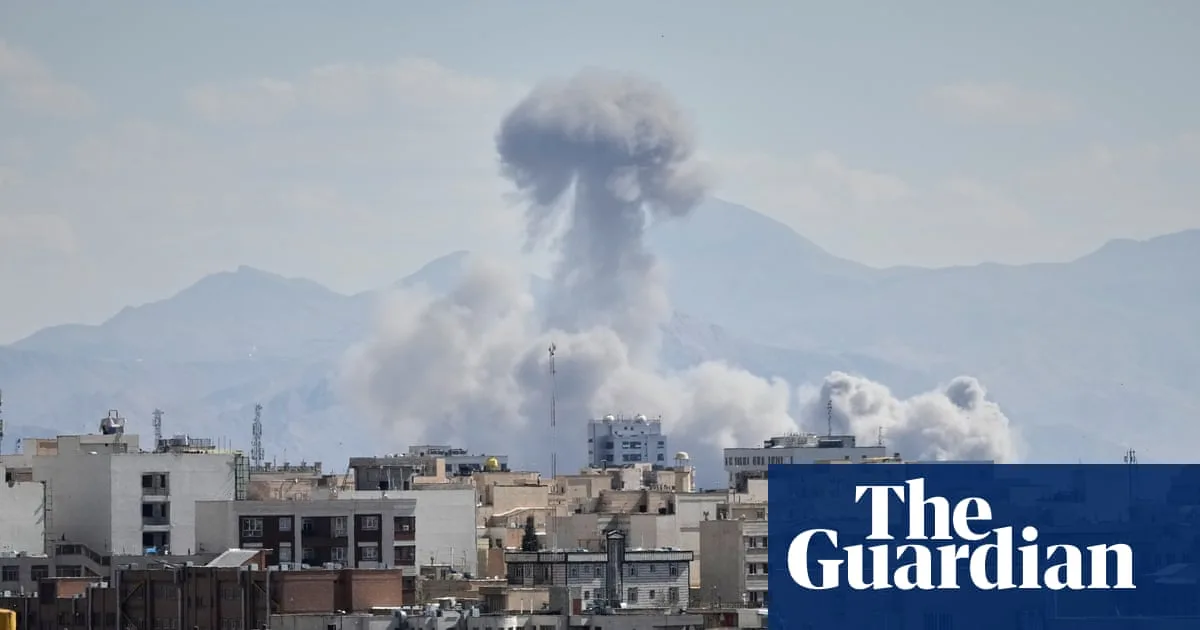
Escalating Iran Strikes Raise Fears of Global Nuclear Conflict
As the United States and Israel continue conducting military strikes against targets across Iran, international concerns are mounting that this escalating confrontation could spiral into a broader global conflict with catastrophic consequences. European nations are already being reluctantly drawn into the crisis, deploying military assets to protect allies while attempting to avoid direct involvement in the hostilities.
Risk of Wider War Involving Nuclear Powers
Military analysts have issued stark warnings that if the fighting expands and draws in Iran's powerful international allies, particularly Russia and China, the risk of a catastrophic global war could increase dramatically. Both Russia and China maintain some of the world's largest nuclear arsenals, raising grave concerns that a major confrontation could quickly escalate beyond the Middle East theater. Experts have long cautioned that in the event of a nuclear conflict, the United States itself would inevitably become a primary target for retaliation.
While major metropolitan centers such as New York City and Washington, DC would likely be among the first locations targeted, numerous lesser-known regions across America could also find themselves in the crosshairs due to their strategic military importance. From Shreveport, Louisiana, to Ogden, Utah, a network of remote facilities connected to US defense infrastructure could become critical targets in any nuclear exchange scenario.
Russian Television Revealed Potential US Targets
In 2019, Russian state television broadcast a chilling list of potential American targets that could be struck during a nuclear attack, providing a disturbing glimpse into how such a catastrophic scenario might unfold. These fifteen sites were identified based on multiple strategic factors including population density, proximity to crucial military facilities, emergency preparedness capabilities, and evacuation logistics. As the United States and Israel persist with strikes across Iran, anxieties are intensifying that the expanding conflict could trigger a wider war with devastating global repercussions.
Strategic US Cities Vulnerable to Nuclear Targeting
Honolulu, Hawaii
Honolulu, home to approximately 357,000 residents and critical military installations including Pearl Harbor and Joint Base Pearl Harbor–Hickam, represents one of the most isolated and vulnerable targets should the United States face attack. The Hawaiian capital may appear as a tranquil tropical paradise, but the island could transform into one of the most exposed locations during a nuclear conflict. With about 350,000 inhabitants, the city maintains significant population density, and its remote position in the central Pacific Ocean—roughly 2,500 miles from California—means evacuation options would be severely limited during an emergency.
Shreveport, Louisiana
This Louisiana metropolitan area is frequently overlooked, yet it hosts one of the most powerful nuclear airbases in the United States. Barksdale Air Force Base stations B-52 bombers capable of delivering nuclear strikes globally. With a projected 2025 population around 172,033, Shreveport's proximity to this base—less than six miles distant—creates substantial risk of civilian casualties. Approximately 390,000 residents live just six miles from this US Air Force Base that houses the nation's nuclear-armed B-52 bombers.
Ogden-Clearfield, Utah
Ogden and Clearfield are situated along Utah's Wasatch Front, adjacent to one of America's most vital military installations: Hill Air Force Base, which supports the Air Force Nuclear Weapons Center. Collectively, these two cities contain a combined population exceeding 121,000 residents, placing thousands of civilians near a crucial component of the national nuclear defense infrastructure. Despite the region's picturesque mountain scenery and suburban character, its adjacency to the base could render it a direct target during a strategic nuclear strike. Evacuation would prove challenging due to surrounding mountains and limited major highways that could rapidly become congested during emergencies. Experts estimated in 2023 that a nuclear detonation in this area could result in more than 87,000 fatalities.
Cheyenne, Wyoming
Cheyenne may be a relatively small city, but it holds enormous strategic significance as the location of Francis E. Warren Air Force Base, one of the primary command centers for US intercontinental ballistic missiles. Despite a population of roughly 66,000 residents, Cheyenne's role in America's nuclear missile network makes it a potential high-priority target during nuclear conflict. Evacuation could prove difficult due to the region's rural infrastructure and limited transportation routes, which would struggle to move large numbers of people swiftly.
Great Falls, Montana
Great Falls is positioned just miles from Malmstrom Air Force Base, a critical installation overseeing hundreds of nuclear missile silos across the northern United States. Although the city's population numbers only about 60,000 residents, its proximity to one of the country's key nuclear missile commands grants it outsized strategic importance. Montana's vast distances between population centers, combined with a restricted road network and harsh winter conditions, could make evacuation during emergencies particularly challenging.
Colorado Springs, Colorado
Nestled at the base of the Rocky Mountains, Colorado Springs hosts several major military facilities including the North American Aerospace Defense Command (NORAD) and Peterson Space Force Base. NORAD is responsible for monitoring and defending airspace over the United States and Canada, making this region a vital hub for North American defense. With a population approaching 492,000 residents, Colorado Springs functions as both a major city and critical military center. The surrounding mountains could render evacuation extremely difficult, with limited exit routes likely to become heavily congested during crises.
Omaha, Nebraska
Omaha serves as a key command hub for the US nuclear arsenal, with Offutt Air Force Base—headquarters of the US Strategic Command—located just outside the city. The base has played a central role in America's nuclear command structure since the Cold War era and continues overseeing global military operations. With approximately 486,000 residents, Omaha sits adjacent to one of the most important command centers in the nation's nuclear defense system. Severe winter weather and the region's limited shelter infrastructure could complicate evacuation efforts during emergencies.
Albuquerque, New Mexico
Albuquerque contains Kirtland Air Force Base, which stores one of the largest concentrations of nuclear weapons in the United States. The city, with a population exceeding 557,000 residents, operates as a crucial hub for nuclear storage, logistics, and military research. Its sprawling layout and desert environment could make evacuations slow and difficult during large-scale emergencies.
Major Metropolitan Centers at Heightened Risk
Houston, Texas
With approximately 2.3 million inhabitants, Houston ranks among the largest and most economically significant cities in the United States. The city functions as the nation's energy capital, hosting massive oil refineries, shipping ports, and critical industrial infrastructure. Due to its economic importance and strategic resources, Houston could become a major target during large-scale conflict.
Seattle, Washington
Seattle's metropolitan area contains more than 760,000 residents and lies near Naval Base Kitsap, one of the US Navy's largest submarine and nuclear weapons facilities. The region also operates as a global technology hub and major seaport, enhancing its strategic importance. However, the city's geography—surrounded by mountains and waterways—means relatively few land routes exist for evacuation.
Los Angeles, California
Los Angeles, with over 3.7 million residents, represents the second-largest city in the United States and a major economic powerhouse. The city hosts significant ports, aerospace companies, defense contractors, and global media organizations. Its enormous population and economic importance render it a potential target during any large-scale conflict. Evacuation would prove extremely challenging, as the region's freeway system already experiences heavy congestion during normal conditions.
San Francisco, California
San Francisco is home to around 842,000 residents and sits at the center of one of the world's most influential technology and financial regions. However, the city's geography presents major evacuation challenges. Surrounded by water on three sides and connected to the mainland by only a handful of bridges, escape routes could quickly become overwhelmed during emergencies.
Chicago, Illinois
Chicago ranks as the third-largest city in the United States, with nearly 2.7 million residents and approximately 9.6 million people in its metropolitan area. The city operates as a major transportation hub and economic center, linking rail, air, and shipping networks across the country. Due to its infrastructure, population density, and economic importance, Chicago could become a strategic target during nuclear conflict.
Washington, DC
Washington, DC functions as the political and military nerve center of the United States, housing the White House, Congress, and the Pentagon. This makes the capital one of the most obvious targets during any major conflict. With roughly 684,000 residents, the city plays a central role in the nation's leadership and military command structure.
New York City
New York City represents the most populous urban center in the United States, with about 7.9 million residents. It contains Wall Street, the United Nations, and numerous global media and financial institutions. A strike on New York would produce devastating human consequences and enormous global economic impact, rendering it one of the most symbolic potential targets during any nuclear confrontation.




