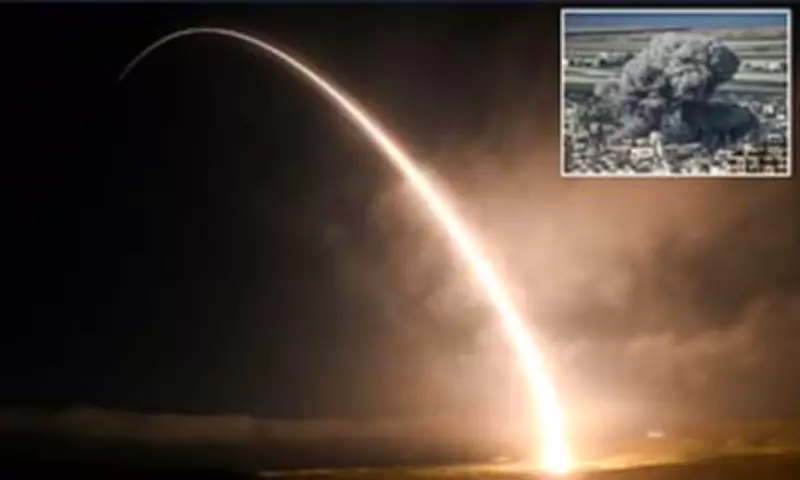
The United States Air Force executed a pivotal test launch of a nuclear-capable intercontinental ballistic missile on Tuesday evening, emphasizing that the operation was meticulously planned to guarantee the highest state of military preparedness. The Minuteman III ICBM blasted off at 11:01 PM Pacific Time from Vandenberg Space Force Base in California, marking a significant demonstration of strategic deterrence capabilities.
Timing Amid Escalating Geopolitical Strains
This critical test coincided with one of the most aggressive joint military campaigns launched by the United States and Israel in recent decades, dramatically heightening tensions with Iran and sparking widespread concerns about the potential for a broader regional conflict. Air Force officials were quick to clarify that the launch, officially designated GT 255, had been scheduled years in advance and was not a direct reaction to contemporary global events. They underscored that the primary objective was to rigorously validate the operational performance and reliability of the weapon system under controlled conditions.
Technical Details and Mission Profile
The unarmed missile achieved a staggering velocity of approximately 15,000 miles per hour, traversing a distance of 4,200 miles in just 22 minutes before accurately striking its designated target near Kwajalein Atoll in the vast Pacific Ocean. This test also provided a crucial opportunity to evaluate the missile's advanced multiple reentry vehicle technology, which is engineered to enhance overall effectiveness and improve the weapon's ability to penetrate sophisticated enemy defense systems.

Lieutenant Colonel Karrie Wray, commander of the 576th Flight Test Squadron, provided detailed insight into the mission's purpose. She stated, 'GT 255 enabled us to meticulously assess the performance of individual components within the missile system. By continuously evaluating diverse mission profiles, we can systematically enhance the operational capabilities of the entire ICBM fleet, thereby ensuring the maximum level of readiness for the land-based leg of the nation's nuclear triad.'
Historical Context and Strategic Imperatives
In late October 2025, former President Donald Trump mandated the resumption of nuclear weapons testing by the US military, arguing that such measures were essential to keep pace with alleged testing activities by geopolitical rivals Russia and China. A separate ICBM test followed in the subsequent month, reinforcing this strategic posture. The Minuteman III arsenal constitutes a fundamental pillar of America's nuclear deterrent, designed explicitly for launch only in retaliation to a nuclear assault by an adversary nation. This formidable weapon is capable of reaching any global target within a mere 30 minutes post-launch.
Geographical distances highlight its reach: Iran lies approximately 7,600 miles from California, Russia about 6,000 miles, and China around 6,300 miles. Trump has consistently asserted that Iran must never acquire nuclear weapons, claiming to have 'obliterated' Tehran's nuclear program in strikes last June, though he recently alleged reconstruction attempts. He warned on Saturday, 'Just imagine how emboldened this regime would be if they ever had and actually were armed with nuclear weapons as a means to deliver their message.' It is important to note that Iran does not currently possess a nuclear arsenal.
Logistics and Future Developments
Although America's ICBM can carry up to three Mk 12A nuclear warheads, each with a destructive yield equivalent to 350,000 tons of TNT, today's test involved an unarmed missile. The Air Force randomly selected a missile from F.E. Warren Air Force Base in Wyoming, transporting it over 1,300 miles to California for reassembly and launch. This test is part of a data-driven program spanning decades, involving more than 300 similar launches to validate weapon system performance.
The Air Force elaborated in an official statement, 'The data collected from these routine tests is essential for ongoing and future force development.' The launch culminated from months of meticulous preparation with multiple government partners, including maintenance support from airmen of the 91st Missile Wing at Minot Air Force Base, North Dakota, and launch initiation by operators from all three missile wings.

General S.L. Davis, commander of Air Force Global Strike Command, affirmed, 'The data we gather ensures our long-range strike capabilities are not just a theoretical concept, but a proven, reliable, and lethal force, ready to defend the nation at a moment's notice.'
The Nuclear Triad and Modernization Plans
The ICBM represents one of two primary missile systems currently deployed by America, the other being submarine-launched ballistic missiles (SLBMs) launched from underwater submarines. As a vital component of the US military's nuclear forces, capable of delivering nuclear payloads globally, the Minuteman III is scheduled for phased retirement by 2029. It will be replaced by the next-generation LGM-35A Sentinel ICBM.
The US Air Force has declared that 'the Sentinel weapon system is the most cost-effective option for maintaining a safe, secure, and effective land-based leg of the nuclear triad and would extend its capabilities through 2075.' This transition underscores a long-term commitment to modernizing America's strategic deterrent while ensuring continuous readiness amid evolving global security challenges.