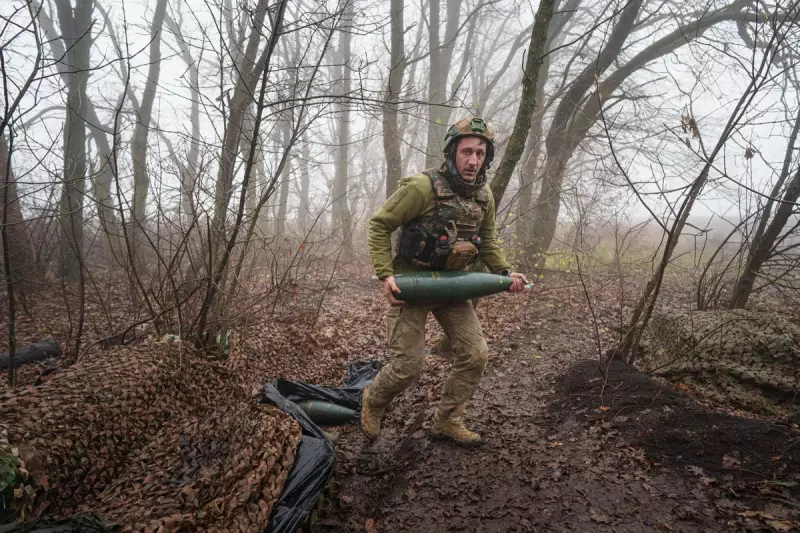
Exhausted Ukrainian soldiers, battling relentless Russian assaults along a sprawling front line, have voiced profound doubts that a prospective peace agreement will secure a durable future for their nation. As diplomats attempt to finalise a deal, troops entrenched in the nearly four-year conflict believe Russia's ultimate ambition to conquer Ukraine remains unchanged, regardless of any signed pact.
Frontline Fears of a Temporary Truce
Moving between damp basements and muddy dugouts, the soldiers' motivation stems from defending their homeland. However, they contend that Moscow cannot be trusted to honour any peace without ironclad security guarantees, such as NATO membership for Ukraine. Military analysts echo this sentiment, suggesting a new Russian invasion with refreshed forces is inevitable without them.
From a dark, mud-walled trench in the border area between Dnipropetrovsk and Donetsk regions, a 40-year-old artillery gunner using the call sign "Kelt" shared his grim forecast. Sheltering from enemy drones, the former furniture salesman from Kyiv stated, "This truce will be short-term, to restore Russia’s forces — for some three or five years — and they will come back." His words were punctuated by the sound of artillery fire.

Serhii Filimonov, commander of the Da Vinci Wolves battalion, expressed a similar view, worrying a deal would merely allow Russia to rearm. "I think it would be nice for the Russians -- to end the war, remove the sanctions, prepare for a new war and attack again," he said, adding he sees no lasting peace until Russia is destroyed or its leadership changes.
The Critical Strain on Ukraine's Manpower and Defences
The sustainability of Ukraine's resistance is under severe pressure. Filimonov described how his brigade held its defensive line but was often let down by neighbouring units filled with inexperienced recruits. American military analyst Rob Lee highlighted the central issue: "Ukraine lacks manpower, lacks reserves." He warned that a single struggling Ukrainian brigade could enable a Russian advance.
Ukrainian military expert Taras Chmut told public broadcaster Suspilne on Friday that many front-line battalions are critically understrength, sometimes comprising only 20 fighters instead of the standard 400-800. Despite mobilising up to 30,000 recruits monthly, many find ways to avoid service or are unfit for frontline duty.
Nevertheless, Ukrainian forces demonstrate resilience. Yurii Fedorenko, commander of the Achilles UAV Brigade, noted they are holding key locations like Pokrovsk in Donetsk, and Kupiansk and Vovchansk in Kharkiv. Russia's failure to capture these sites, despite committing tens of thousands of soldiers, "testifies to the high motivation and resilience of the Ukrainian army."
The Uncertain Path Ahead: Peace Terms and Western Support
The draft of a U.S.-Russia peace plan reportedly stipulates limiting Ukraine's army and a withdrawal from remaining parts of Donetsk. President Volodymyr Zelenskyy has called a revised version potentially "workable," but final terms are unclear. Russian President Vladimir Putin insists fighting will continue unless Ukraine withdraws from all four annexed regions—Donetsk, Luhansk, Zaporizhzhia, and Kherson.
Kelt ridiculed the idea of reducing Ukraine's military, saying it would simply make it easier for Russia "to kill you later rather than now." However, maintaining the current force of over one million troops is nearly impossible without sustained Western aid. Since 2022, Ukraine has spent almost all tax revenue on its military, relying on Western grants and loans for civilian expenditures.
Economist Glib Buriak noted the European Union's $50 billion aid package from 2024-2027 is insufficient. Kyiv will need $83.4 billion for the military and $52 billion for other state costs in 2026-2027 alone. Ukraine's future financial health, including its ability to maintain an army, hinges on managing frozen Russian assets and risks a drop in aid if the war ends.

Analyst Rob Lee, who visits the front regularly, observed that while Russia advances faster in 2025 than 2024, capturing the remaining third of Donetsk in 2026 is not guaranteed. He described Moscow's strategy as pushing in multiple directions simultaneously, testing Ukrainian defences which prioritise holding key areas.