
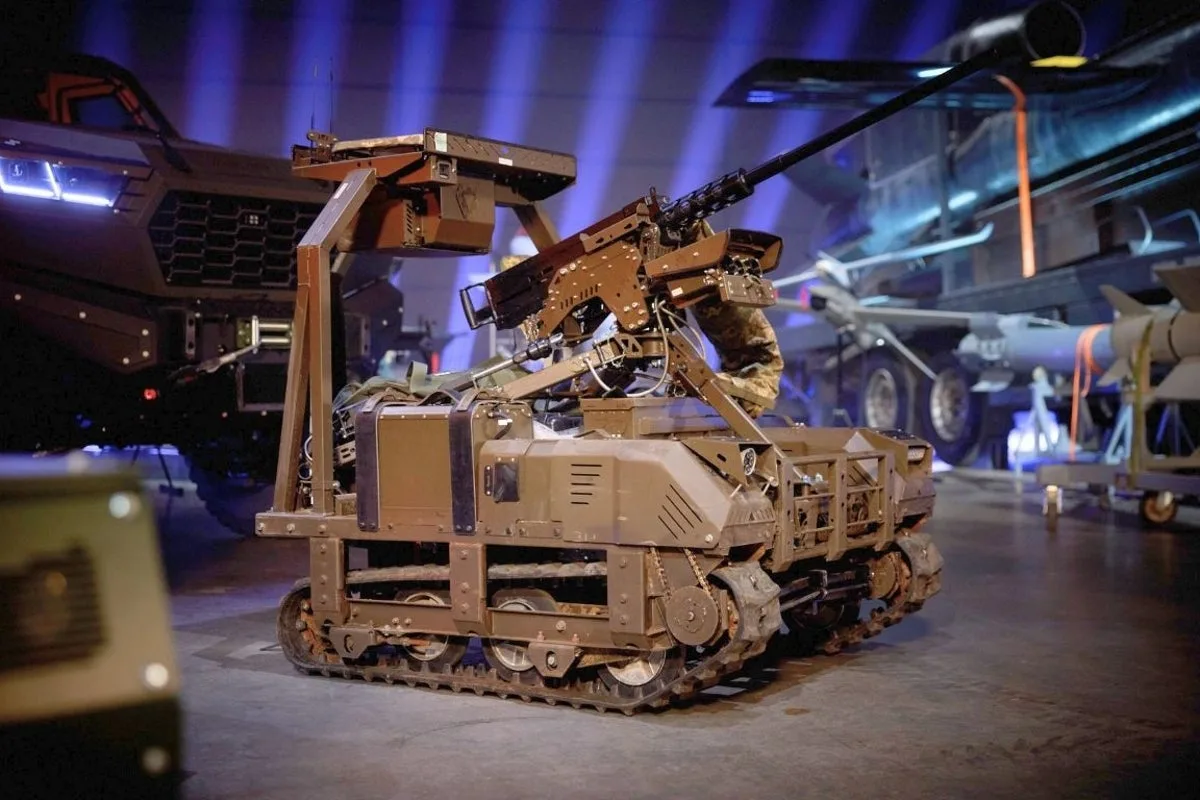
After more than four years of war, Ukraine is deploying remote-controlled ground robots to take command of the battlefield. Last Wednesday, President Volodymyr Zelensky announced that the 3rd Separate Assault Brigade had regained territory using only unmanned ground vehicles (UGVs) and drones, a mission he described as a first in the conflict. 'The occupiers surrendered, and the operation was carried out without infantry and without losses on our side,' he said, referring to an operation in the northeastern Kharkiv region.
The use of UGVs marks a new phase in the war, which has already been transformed by drones for reconnaissance and attack. Ukrainian commanders and engineers say UGVs represent the future of warfare, a future that has already arrived. The 3rd Assault Brigade aims to replace around 30 per cent of its infantry with UGVs to reduce troop losses on the eastern front lines, according to Mykola Zinkevych, commander of the 'NC13' Strike UGV Unit that carried out the Kharkiv operation.
'The logic is simple: where the risk to a human is high, a robot should be used. Because the life of an infantryman is priceless, and robots don’t bleed,' Zinkevych told The Independent. 'We’re working toward a model where UGVs take on the most dangerous tasks, while infantry becomes a highly specialised force focused on what UGVs cannot perform.'
Yaroslav Drobysh, operator and chief sergeant of the unit, said UGVs have eased the burden for infantry by carrying out logistical tasks and transporting supplies without losses. His unit claims to be the world's first strike UGV unit, starting with no military doctrine for their use. Ukraine is now a world leader in UGV production and use; last year, its UGV market grew by 488 per cent, according to a study by the KSE Institute, BRAVE1, and Defence Builder.
The vehicles have been transformative for logistics, carrying 200 to 600kg of cargo to frontline positions, compared to the 20kg an infantryman can carry. They deliver supplies, evacuate wounded, hold positions, destroy enemy targets, and lay mines. Zinkevych said the unit has carried out more than 100 strike operations using UGVs in recent months, destroying enemy troops, shelters, and command posts. However, he warned that slowing development is 'something we cannot allow' and called for a boost in funding.
Among the most used UGVs is the TW12.7, produced by Ukrainian company DevDroid, which mounts a Browning machine gun. Earlier this year, a single TW12.7 held a frontline position for six weeks, providing suppressive fire. Oleg Fedoryshyn, head of research and design at DevDroid, said the UGV has transformed how troops hold positions: 'It’s easier to control an area for 24 hours when you are sitting in a safe zone 50km from the UGV.' The average cost of a UGV for the Ukrainian military is $30,000 (£22,100), rising to $50,000 with a Browning machine gun.




